
If you've searched for "probiotics for weight loss," you've probably found two extremes: miracle-pill marketing on one side, and blanket dismissal on the other. Neither is accurate. As a physician, I want to walk you through what controlled studies actually found when researchers gave men and women specific probiotic strains and measured what happened to their weight, waistline, and fat mass. The honest answer sits in the middle — modest, real, strain-specific effects that work best as a support tool, not a substitute for the basics.
Why This Question Keeps Coming Up
Gut bacteria are no longer a fringe topic in obesity research. Large population studies have repeatedly found that men carrying more visceral fat — the fat packed around the abdominal organs — tend to have a different balance of gut bacteria than lean men. That's distinct from the broader hormonal story we've covered in Belly Fat After 40, and from the microbial mechanics explained in Visceral Fat and Gut Bacteria Explained. This article focuses on one narrower, very practical question: when you take a probiotic supplement specifically for weight management, what does the clinical trial data say actually happens?
What "Probiotics for Weight Loss" Actually Means
Probiotics are live bacterial strains, taken as a supplement, that are meant to support a healthy balance of microbes in your digestive tract — the trillions of organisms collectively called your gut microbiome. These bacteria don't just sit there; they ferment fibre into short-chain fatty acids (SCFAs), small molecules that influence how your body stores fat, regulates hunger hormones, and manages inflammation. Body mass index (BMI) is simply weight divided by height squared, used in most studies as a rough proxy for body fatness.
The Short Version
- Probiotics are not fat burners; they influence digestion, fermentation, and hormone signalling.
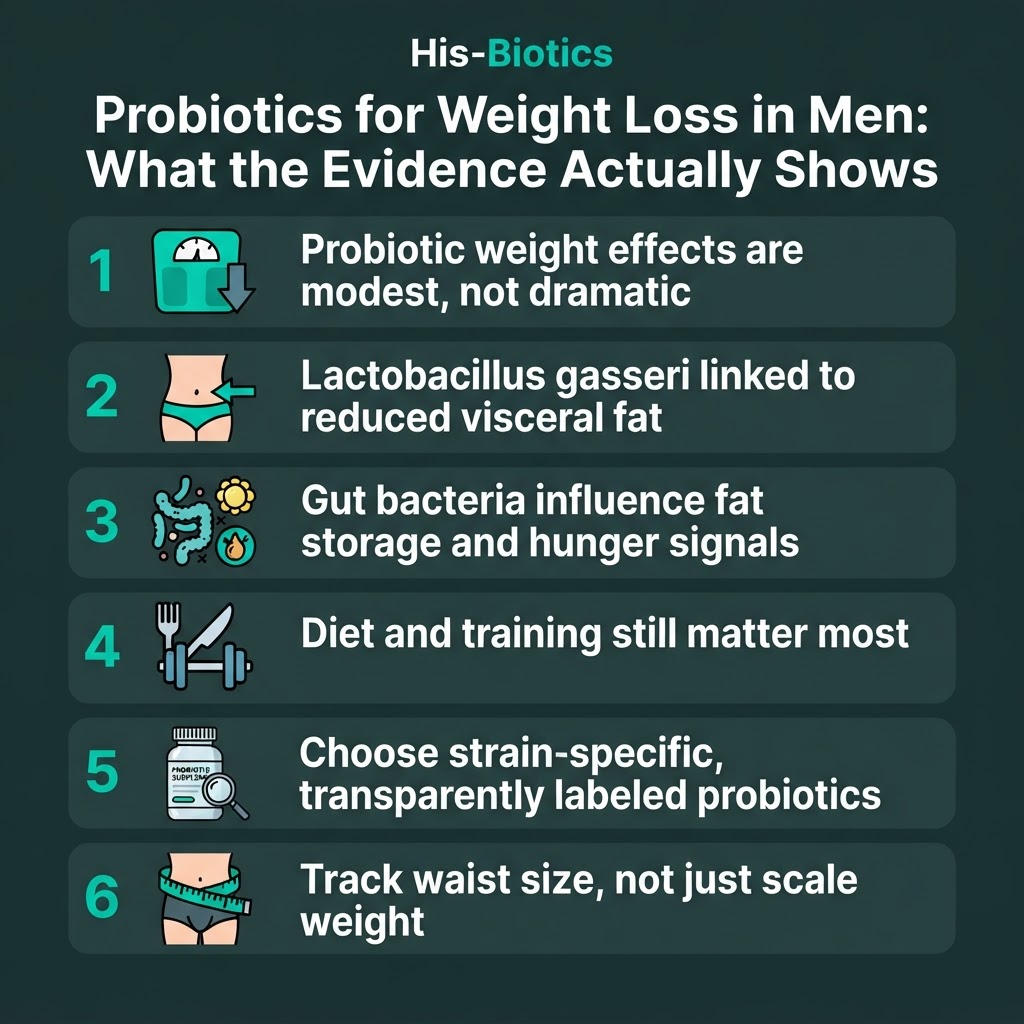
- Effects on weight are measured in small percentage shifts, not dramatic transformations.
- Strain matters enormously — results from one bacterial strain rarely apply to another.
- Diet, especially fibre intake, determines how much a probiotic can actually do.
What the Clinical Research Actually Shows
The most frequently cited human trial used a specific strain, Lactobacillus gasseri SBT2055, given daily for 12 weeks to adults with a tendency toward obesity. Researchers used CT scans to measure abdominal fat directly, rather than relying on bathroom-scale weight alone.
Daily intake of fermented milk containing Lactobacillus gasseri SBT2055 significantly reduced abdominal visceral fat area, body weight, and waist and hip circumference compared with placebo over 12 weeks.
— Kadooka et al., European Journal of Clinical Nutrition (2010)
You can read the original trial data yourself via the National Library of Medicine's PubMed database. It's a well-designed study, but it's also a single strain tested in one population over a relatively short window. Broader systematic reviews, which pool data across many such trials, paint a more conservative picture.
The overall effect of probiotic supplementation on body weight and body mass index was statistically significant but small in magnitude, and should be interpreted as a modest adjunct rather than a standalone solution for obesity.
— Borgeraas et al., Obesity Reviews (2018)
That second quote matters more than the flashy headline numbers you'll see on supplement sales pages. Across dozens of randomized trials, probiotics have shown a real but small average effect — often a few hundred grams to a couple of kilograms over several months, concentrated mostly around waist circumference rather than total body weight. The World Health Organization's overview of obesity and overweight still identifies calorie balance, diet quality, and physical activity as the dominant levers — probiotics sit well outside that core list.
Why the Same Supplement Doesn't Work the Same for Every Man
Men's starting gut composition varies widely based on diet history, antibiotic use, stress levels, and even testosterone status. We've written in detail about how digestion habits and hormone production interact in The Gut-Testosterone Loop, and that relationship cuts both ways — lower testosterone is itself associated with greater central fat storage, which can blunt how much a probiotic alone is able to shift things. A man with significant insulin resistance or heavy visceral fat is working against stronger metabolic headwinds than a man who is moderately active and twenty pounds over his ideal weight.
This is also why trial results are inconsistent between studies. Some recruit lean volunteers, some recruit people with obesity, some run for eight weeks, others for a year. If a man's baseline gut bacteria are already badly disrupted — from poor diet, chronic stress, or frequent antibiotic courses — a probiotic may have more room to produce a measurable shift. If his gut is already reasonably balanced, the added effect will be smaller, which lines up with what we outlined in Male Gut Microbiome: Why Daily Probiotics Change Everything.
How to Read a Weight-Loss Probiotic Study Like a Doctor
Supplement marketing loves to cite "clinical studies," but not all studies are built the same way. Before you believe a weight-loss claim on a label, it helps to ask a few specific questions.
- Was the study done in humans, or only in mice? Rodent fat-loss results frequently don't translate to people.
- Did it use the exact strain and dose in the product you're buying, or a different, unrelated strain?
- Was there a placebo group, and was the study randomized?
- Did researchers measure actual fat (via scans or waist circumference) or just self-reported weight?
- How long did the study run — under eight weeks is a short window for meaningful metabolic change?
A surprising number of commercial products cite a strain-specific study on the label while containing a completely different, unstudied strain in the capsule. That gap between marketing and formulation is exactly why we broke down label-reading in The Best Probiotic for Men With Bloating: A Doctor's Buying Guide and why transparency about strains matters more than a flashy weight-loss claim.
What a Sensible, Evidence-Based Approach Looks Like
Given the data, the most defensible way to use a probiotic for weight support is as one piece of a broader routine, not the centrepiece. The research consistently shows the biggest, most reliable gains come from fibre intake, protein adequacy, resistance training, and sleep — probiotics appear to nudge those systems rather than replace them.
- Prioritise fibre-rich foods daily; fibre is the fuel that lets gut bacteria produce beneficial SCFAs.
- Keep protein intake adequate to preserve muscle while in a calorie deficit.
- Treat a probiotic as a 8–12 week trial with a specific, studied strain — not a quick fix.
- Track waist circumference monthly rather than only daily scale weight, since that's what most trials actually measured.
- Pair any supplement decision with the basics reviewed by the Mayo Clinic's overview of obesity management.
None of this is about chasing a dramatic before-and-after. It's about stacking several small, evidence-supported levers so they compound over months, which is a far more realistic picture than most supplement advertising suggests.
Choosing a Probiotic If You Decide to Try One
If you want to add a probiotic to your routine with weight and waistline support as one of several goals, look for a formula that discloses its exact strains and CFU counts (colony-forming units, a measure of live bacteria per dose) rather than a vague "proprietary blend." We go through exactly what's inside a well-formulated men's capsule in Inside the Capsule: A Doctor's Breakdown of His-Biotics Ingredients and Strains, and how real users report changes over time in His-Biotics Probiotic Reviews. The His-Biotics Probiotics ORIGINAL Multivitamin Capsules are formulated with daily digestive and metabolic support in mind for men who want a straightforward, well-documented starting point.
It's worth repeating: a probiotic may help support a healthier gut environment, which in turn is associated with more favourable fat distribution and digestive comfort — but it is not a weight-loss treatment, and no honest formulation should be marketed as one. Set expectations around modest, gradual support rather than rapid transformation, and you'll judge your own results far more accurately.
Your Simplest First Step
The single easiest place to start is not a dramatic diet overhaul — it's choosing one well-documented, transparent probiotic formula and giving it a genuine 8–12 week trial while you track your waist measurement, not just the scale. You can explore the full His-Biotics range to find the formula that matches where you're starting from. If you'd like future breakdowns like this one sent directly to you, consider subscribing to the His-Biotics newsletter below.