
If you typed "his-biotics probiotic reviews" into a search bar, you're probably standing at the shelf of a decision, not just curiosity. Maybe you've read about gut health and testosterone online, or a friend mentioned feeling less bloated and more switched-on after a few weeks on a probiotic. Before you add anything to your cart, I want to walk you through how to actually read a supplement review — what's useful, what's noise, and what a realistic result looks like for a man's gut and hormones. I'm Dr. Chomba Chuma, founder of His-Biotics, and this is the conversation I wish more men had before they bought any probiotic, including ours.
Why Reviews Alone Don't Tell You Enough
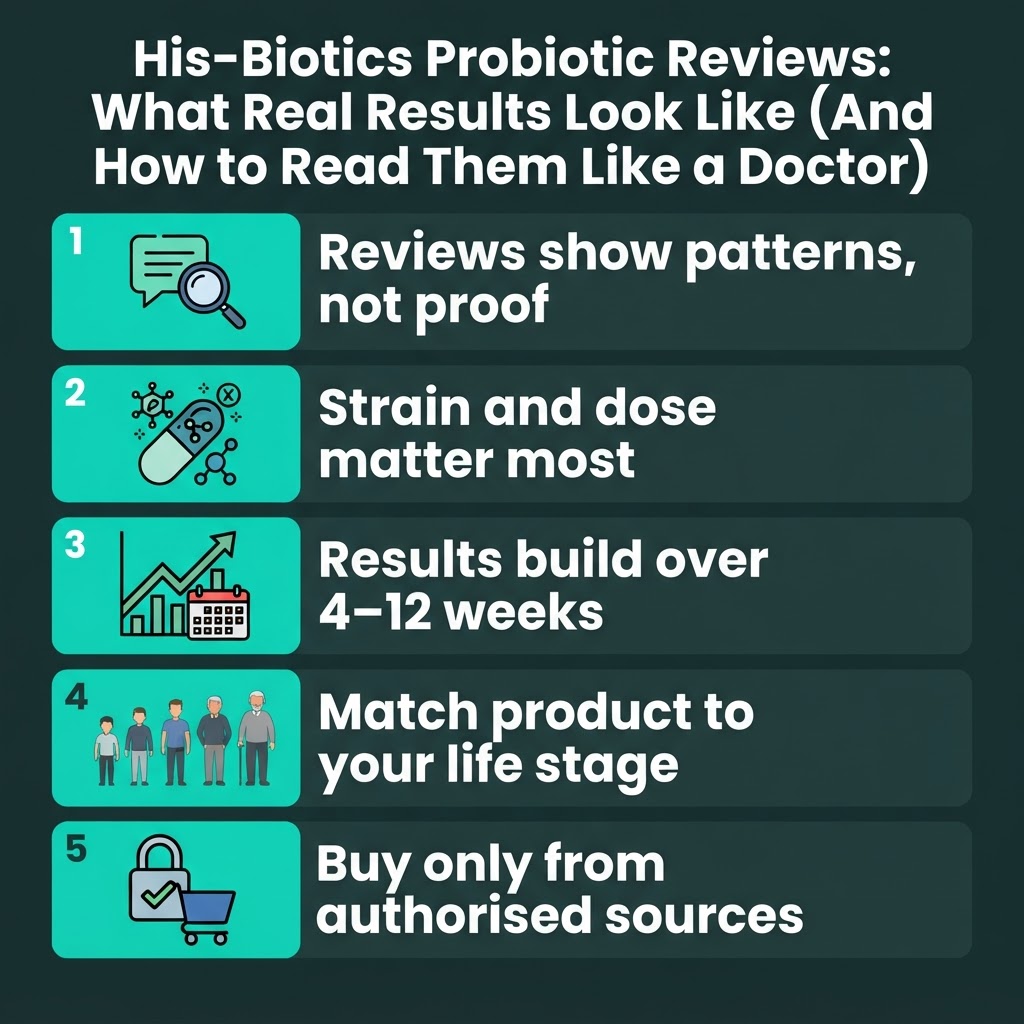
Reviews are useful for one thing: pattern recognition. If dozens of men independently mention better energy, fewer bathroom issues, or steadier mood within a similar timeframe, that's a signal worth noting. But a review can't tell you whether a product contains clinically studied strains at effective doses, or whether it was formulated with men's physiology in mind at all.
That's the gap most review pages never close. A five-star comment saying "this changed my life" is emotionally persuasive but scientifically empty without context — what was the person's starting point, diet, sleep, or stress load? This is why I always tell patients to read reviews as supporting evidence, never as the main evidence. The real homework happens one layer deeper, in the formulation itself, which we break down in detail in Inside the Capsule: A Doctor's Breakdown of His-Biotics Ingredients and Strains.
What the Science Actually Supports
Let's ground this in research rather than marketing language. Probiotics are formally defined as "live microorganisms that, when administered in adequate amounts, confer a health benefit on the host." That single sentence carries two important qualifiers: adequate amounts, and a host-specific benefit. Not every strain does the same job, and not every dose is high enough to matter.
Live microorganisms that, when administered in adequate amounts, confer a health benefit on the host.
— Hill et al., Nature Reviews Gastroenterology & Hepatology (2014), International Scientific Association for Probiotics and Prebiotics consensus statement
This is why strain specificity matters so much when you're comparing reviews across brands. A product reviewed for easing bloating in women may use entirely different strains than one formulated for a man's gut-hormone axis. We've written previously about how daily digestion habits influence hormone regulation in The Gut-Testosterone Loop, and that relationship is central to why men's probiotic reviews often mention energy and mood alongside digestion.
The Realistic Ceiling of What a Probiotic Can Do
No reputable probiotic will cure a hormone problem, reverse ageing, or replace medical care for a prostate concern. What research does support is that a healthy gut microbiome — the community of bacteria living in your digestive tract — is associated with better nutrient absorption, lower systemic inflammation, and improved regulation of stress hormones. Those downstream effects are often what reviewers are describing when they say they "feel better" without being able to name why.
According to the U.S. National Institutes of Health, probiotic benefits are highly strain- and dose-dependent, and effects seen in one clinical trial don't automatically apply to a different product with different organisms. That's a critical point when comparing reviews between competing brands.
How to Read a Supplement Review Like a Clinician
When I assess a product — any product, not just our own — I look past the star rating and ask a short checklist of questions. This habit will save you money and disappointment long before you click "buy."
- Does the review mention a specific, named strain (e.g., Lactobacillus rhamnosus) or just "probiotics" vaguely?
- Is the timeframe realistic — weeks, not days — for digestive and energy changes?
- Does the reviewer mention dose (CFU count, or colony-forming units, the standard measure of live bacteria) or just subjective feeling?
- Are there verified purchase marks, or does the review read like templated marketing copy?
- Does the reviewer disclose other lifestyle changes (diet, sleep, training) alongside taking the product?
If a review ticks most of these boxes, it's far more trustworthy than a generic five-star comment with no detail. This is also why, when men ask me how to verify a genuine product, I point them to our detailed sourcing guide, Where to Buy His-Biotics in South Africa, because counterfeit listings often carry the most exaggerated, least credible reviews.
Matching the Product to the Goal Behind the Review
One reason review comparisons get confusing is that His-Biotics isn't a single product — it's a small range built around different life stages and goals. A review praising faster training recovery and a review praising fewer night-time bathroom trips are not reviewing interchangeable things, even if both wear the His-Biotics name.
- Daily digestion, energy, and general gut-hormone support: the His-Biotics Probiotics ORIGINAL Multivitamin Capsules are the entry point most reviewers are describing when they mention "steadier energy" and "better digestion."
- Training recovery and exercise-induced gut stress: the His-Biotics Probiotics SPORT Multivitamin is aimed at active men whose gut lining takes a beating from intense exercise.
- Men over 50 managing prostate-related sleep disruption and slower metabolism: the His-Biotics Probiotics AGELESS 50+ Multivitamin is formulated with that stage in mind — a topic we cover directly in Waking Up to Urinate After 50.
- Men wanting a broader approach covering gut, hormones, and performance together: the Men's Performance Stack bundles complementary support rather than relying on one capsule to do everything.
When you read a review, ask which of these categories the reviewer actually fits. A 28-year-old gym-goer and a 58-year-old managing prostate symptoms are describing two different experiences, even if both leave five stars.
What a Realistic Timeline Looks Like
Patients and reviewers alike tend to expect either instant results or none at all, and both expectations are wrong. Gut bacteria populations shift gradually, and most clinical trials measuring digestive and inflammatory markers track changes over four to twelve weeks, not days.
In the first one to two weeks, most men notice changes in bowel regularity and possibly some mild adjustment as the gut flora shifts — this is common and usually settles. By four to six weeks, reviewers more consistently report steadier energy and reduced bloating, which lines up with research on how the gut microbiome influences systemic inflammation and sleep quality, something we unpack further in How Your Microbiome Affects Your Sleep. By three months, longer-term reviewers tend to describe the benefits as simply "normal" rather than dramatic — which, frankly, is what sustainable gut support should feel like.
Probiotics are not one-size-fits-all; their potential benefits are specific to particular strains, doses, and the health condition being addressed.
— U.S. National Institutes of Health, National Center for Complementary and Integrative Health, Probiotics Fact Sheet
This is also why a single glowing review written three days after purchase should be read with healthy scepticism. Genuine, detailed reviews tend to appear a month or more after first use, once a person has had time to notice a real pattern rather than a placebo bump.
Avoiding the Confusion of Fake or Mismatched Reviews
A frustrating reality of the supplement industry is that popular product names attract copycats, resellers, and review farms. If you're comparing "his-biotics probiotic reviews" across multiple third-party marketplaces, be cautious of listings with suspiciously uniform five-star reviews, no verified purchase tags, or pricing far below the official range. Mayo Clinic's general guidance on dietary supplements notes that product quality and labelling accuracy can vary significantly outside regulated retail channels, which is exactly the risk with grey-market listings.
The safest way to make sure the reviews you're reading match the actual product you'll receive is to buy directly from an authorised source. We've laid out exactly how to do that, retailer by retailer, in our sourcing guide so you're not left guessing.
Your Simplest First Step
You don't need to resolve every variable before starting. The single simplest first step is choosing the product that matches your current life stage and goal — daily general support, active training recovery, or management of changes after 50 — rather than chasing the review with the most dramatic claim. Browse the full range at the Velobiotics store and start with the one that fits where you are today.
If you'd like plain-English updates on gut health, hormones, and men's recovery science as we publish them, subscribe to the His-Biotics newsletter below.