The Male Gut: A Biological System Science Has Been Overlooking
For decades, conversations about men's health have centred on the obvious metrics — testosterone levels, cardiovascular risk, muscle mass, and mental resilience. What has been largely absent from that conversation is the ecosystem sitting quietly in your gut, influencing every single one of those outcomes. The gut microbiome in men is not simply a digestive accessory. It is a dynamic, living command centre that regulates immune function, modulates hormonal signalling, governs inflammation, and even shapes cognitive performance. Emerging gut microbiome research has made one thing abundantly clear: the microbial composition of the male gut is distinct from that of females, and it demands a distinct, targeted approach to support.
Men harbour a microbiome shaped by higher androgen levels, different dietary patterns, distinct stress physiology, and a unique immune landscape. Research published in Cell Host & Microbe (Org et al., 2016) demonstrated that the gut microbiota in males actively interacts with sex hormones through the gut-liver axis, influencing circulating testosterone and oestrogen metabolites in ways that have direct downstream effects on muscle, mood, and metabolic health. This is not a peripheral finding — it is a foundational insight that should be informing how men supplement for gut health. Yet most probiotic products on the market were designed with no consideration of male-specific physiology whatsoever.
At His-Biotics®, we built everything around this gap. When I founded the company, my central question was simple: what would a probiotic look like if it were designed exclusively for the male gut, with strains chosen for their evidence in male physiology and a delivery system capable of actually getting them where they need to go? The answer is His-Biotics® Original — our flagship Daily Vitality formula — and the science behind it is worth understanding in full.
Why Most Probiotics Fail Before They Even Reach Your Gut
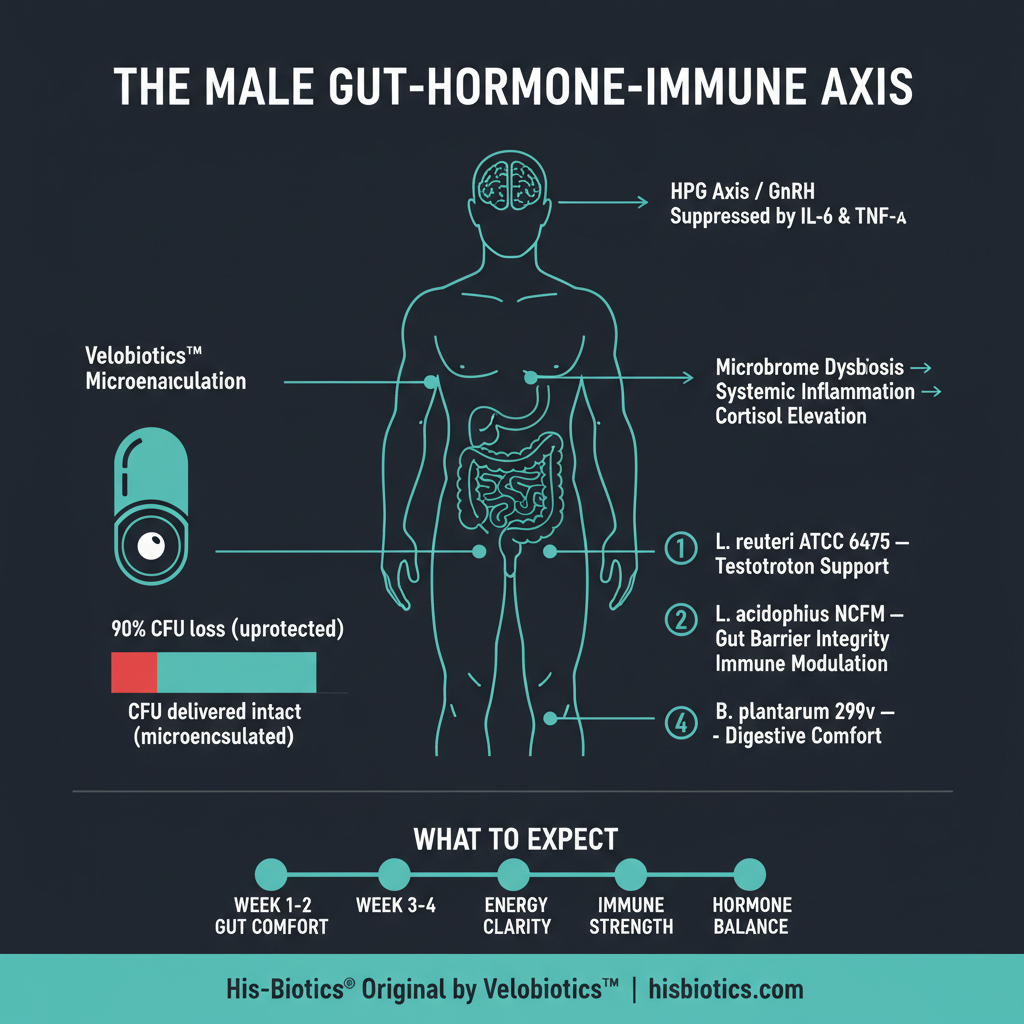
This is the conversation the supplement industry actively avoids. A probiotic label might boast 50 billion CFU — and that number might be entirely accurate at the point of manufacture. But by the time that capsule has survived your stomach acid (pH as low as 1.5–2.0), transited through bile salts, and been exposed to the enzymatic environment of the small intestine, a substantial portion of those live organisms may be functionally dead. A 2019 review published in the European Journal of Nutrition found that unprotected probiotic strains can lose up to 90% of their viable count during gastric transit alone. You could be paying for 50 billion CFU and receiving the benefit of five billion — or fewer.
This is precisely why Velobiotics™ microencapsulation is not a marketing footnote on our label — it is the cornerstone of how His-Biotics® delivers results. Velobiotics™ microencapsulation technology wraps each individual probiotic cell in a protective lipid matrix that is resistant to gastric acid and bile, designed to remain intact through the stomach and release the live bacteria precisely in the lower intestinal environment where colonisation and immune interaction actually occur. This is pharmaceutical-grade thinking applied to a daily supplement — and the difference in clinical relevance is significant.
The probiotic CFU count on our label reflects what is genuinely delivered to your colon, not what is placed into the capsule at the factory. That distinction matters enormously when you are trying to achieve meaningful shifts in microbiome composition, reduce systemic inflammation, or support hormonal metabolism. When we talk about gut health as a daily supplement priority, we have to be honest that delivery technology is inseparable from efficacy. A premium strain in a poor delivery vehicle is, in most cases, a wasted investment.
The Strains Inside His-Biotics® Original and Why Each One Was Chosen
Strain selection in male probiotics is not a matter of picking the most commonly studied bacteria and calling it a day. It requires interrogating the literature for evidence specific to male physiology, immune function in men, hormonal signalling pathways, and the particular microbial deficits that male lifestyle patterns — higher protein intake, greater alcohol exposure, more pronounced cortisol responses to occupational stress — tend to produce. Every strain in His-Biotics® Original was chosen against that evidence base.
Lactobacillus reuteri ATCC 6475
Perhaps the most compelling male-specific probiotic strain in the current literature. A landmark study published in PLOS ONE (Poutahidis et al., 2013) demonstrated that supplementation with L. reuteri in male subjects led to significantly elevated testicular testosterone production, improved muscle mass retention, and enhanced systemic oxytocin signalling. The mechanism involves the gut-testes axis, where microbiome-derived signals modulate Leydig cell function — the cells in the testes responsible for androgen synthesis. For any man interested in supporting natural testosterone levels through lifestyle and supplementation, this strain represents one of the most evidence-grounded options available. You can explore the broader body of PubMed research on probiotics and testosterone — the signal is consistent and growing.
Lactobacillus acidophilus NCFM
One of the most extensively characterised probiotic strains in existence, L. acidophilus NCFM has demonstrated robust effects on intestinal barrier integrity, modulation of pro-inflammatory cytokines (particularly IL-6 and TNF-α), and competitive exclusion of pathogenic organisms. For men in high-stress occupational or training environments, where elevated cortisol chronically degrades tight junction proteins in the gut lining, maintaining barrier integrity is not optional — it is foundational to every downstream health outcome, including immune resilience, hormonal balance, and cognitive clarity.
Bifidobacterium longum BB536
This strain was selected for its exceptional evidence in immune modulation and its specific activity within the gut-immune axis — the bidirectional communication network between the intestinal microbiome and the systemic immune system. B. longum BB536 has been shown in multiple randomised controlled trials to reduce upper respiratory tract infection duration and severity, to modulate IgA secretion in the gut mucosa, and to support a shift away from pro-inflammatory Th2 immune polarisation. For men over 35, whose immune function begins a measurable age-related decline, this represents targeted, evidence-based support.
Lactobacillus plantarum 299v
Included for its clinically validated effects on IBS-type symptoms, bloating, and gut transit time — issues that disproportionately affect men consuming high-protein diets, which generate significant fermentative byproducts in the colon. L. plantarum 299v also demonstrates direct effects on iron absorption, a micronutrient that plays an understated role in male energy metabolism and oxygen-carrying capacity during physical training.
The Gut-Immune-Hormone Axis: Why This Is the Central Story of Male Vitality
One of the most significant reframings in modern medicine is the recognition that the gut is not simply a digestive organ — it is the body's largest immune organ, housing approximately 70% of the entire immune system within its mucosal lining. The implications of this for male health are profound. When the gut microbiome is dysbiotic — skewed toward pro-inflammatory species, depleted of beneficial commensals, or compromised in barrier integrity — the immune system does not simply struggle to fight infections. It begins to generate low-grade systemic inflammation that silently degrades virtually every system in the male body.
Chronic low-grade inflammation is now understood to be a primary driver of testosterone decline in ageing men, a mechanism distinct from and additive to the natural age-related reduction in Leydig cell function. A dysbiotic gut raises circulating IL-6 and TNF-α, both of which directly suppress hypothalamic GnRH secretion and impair Leydig cell androgen synthesis. The result is a man who may present with hypogonadal symptoms — fatigue, reduced libido, poor recovery, cognitive fog — without classical hypogonadism on blood panels, because the inflammatory suppression of the HPG axis is subclinical but cumulative. Understanding the Gut-Testosterone connection is the first step toward addressing this pattern intelligently.
Furthermore, the gut microbiome plays a direct role in oestrogen metabolism through a subset of bacteria collectively termed the estrobolome. These bacteria produce the enzyme β-glucuronidase, which deconjugates oestrogens in the gut for recirculation into the bloodstream. In men, an overactive estrobolome contributes to oestrogen dominance — a pattern associated with gynaecomastia, central adiposity, and blunted testosterone signalling. Restoring microbial balance through targeted male probiotics is therefore not merely a gut health intervention — it is a hormonal health intervention with measurable downstream effects on male physiology.
We also recommend considering the evidence behind adaptogenic support for the gut-hormone axis. The clinical studies on KSM-66® Ashwagandha consistently demonstrate reductions in cortisol, improvements in testosterone-to-cortisol ratio, and enhanced gut motility — all of which are synergistic with a targeted probiotic protocol. This is why adaptogenic-probiotic synergy sits at the centre of our broader product development philosophy.
What Daily Use of His-Biotics® Original Actually Looks Like
One of the most common questions I receive from patients and customers alike is: how long before I notice a difference? The honest, evidence-based answer is that meaningful shifts in microbiome composition — measurable changes in alpha diversity and dominant species ratios — typically occur within four to eight weeks of consistent, daily probiotic supplementation with viable, well-delivered strains. Symptom-level changes — reduced bloating, improved bowel regularity, better post-meal energy — often appear within the first two weeks. Hormonal and immune markers, as you might expect, require longer timelines and are best assessed at the three-to-six-month mark.
His-Biotics® Original is formulated for daily use with one capsule taken in the morning, with or without food. The Velobiotics™ microencapsulation technology means you do not need to refrigerate the product, and it is shelf-stable at room temperature for the full duration of its shelf life — a practical advantage for men who travel, train, or simply don't want to manage refrigerated supplements. Consistency is the non-negotiable variable. The microbiome responds to sustained input; sporadic supplementation produces sporadic results.
What to Expect Week by Week
- Weeks 1–2: Improved gut comfort, reduced post-meal bloating, more regular transit. Some men notice improved sleep quality in the first two weeks, likely related to gut-derived serotonin and GABA precursor production.
- Weeks 3–4: Measurable improvements in energy levels and cognitive clarity, particularly in the afternoon — the period when cortisol typically troughs and many men experience an energy dip driven by inflammatory signalling.
- Weeks 5–8: Immune resilience begins to strengthen. Men in this window often report fewer minor infections, faster recovery from physical training, and improved mood stability — consistent with the serotonergic and anti-inflammatory effects of established beneficial colonisation.
- Months 3–6: The deeper hormonal and metabolic effects become apparent. For men tracking morning testosterone, this is typically the window in which any microbiome-mediated improvements in androgen metabolism become measurable. Body composition, libido, and recovery metrics often reflect these changes.
Key Takeaways
If you have read this far, you understand that supporting the gut microbiome in men is not a wellness trend — it is a foundational clinical priority with direct implications for hormonal health, immune function, cognitive performance, and physical vitality. Here is what the science, and our formulation philosophy, demands you take away from this article:
- Male gut microbiome health is sex-specific: Men require probiotic strains selected for male physiology, hormonal signalling, and the dietary and lifestyle patterns characteristic of male life — not a generic, unisex formula.
- Delivery technology determines efficacy: A high CFU count means nothing if the organisms are destroyed before reaching the colon. Velobiotics™ microencapsulation is the mechanism that ensures what is on the label is what arrives in your gut.
- The gut-immune-hormone axis is real and clinically significant: Gut dysbiosis drives systemic inflammation, which suppresses testosterone, impairs immune function, and degrades daily vitality — often subclinically, and often for years before overt symptoms appear.
- Strain specificity matters: Not all probiotics are created equal. Strains like L. reuteri ATCC 6475, B. longum BB536, and L. plantarum 299v have distinct, evidence-based mechanisms relevant to male health that generic lactobacillus blends simply cannot replicate.
- Consistency is the protocol: Meaningful microbiome shifts require daily supplementation over weeks to months. His-Biotics® Original is designed for that daily commitment — simple, shelf-stable, and clinically formulated to deliver results across that timeline.
- Gut health is testosterone health: For men experiencing fatigue, reduced libido, poor recovery, or unexplained mood changes, the gut microbiome should be the first place you look — not the last.
If you are ready to take a targeted, evidence-based approach to your gut health and daily vitality, I encourage you to start with His-Biotics® Original — our flagship Daily Vitality formula built specifically for the male microbiome. If you are unsure where to begin, or want to understand how your gut health may be affecting your testosterone levels specifically, take our free assessment via the Gut-Testosterone connection quiz. And if you want to explore the full spectrum of male gut health support we offer, browse our range of formulas — each one designed with the same clinical rigour and male-specific evidence base that defines everything we do at His-Biotics®.
— Dr. Chomba Chuma, MD & Founder, His-Biotics® by Velobiotics™