
Most men think of testosterone as something made exclusively in the testicles and regulated by the brain. That's true, but it's only half the story. A growing body of research shows that the trillions of bacteria living in your intestines — collectively called your gut microbiome — quietly influence how much testosterone your body makes, how it's used, and even how it's cleared from your bloodstream.
This isn't about one dramatic cause-and-effect switch. It's a loop: your gut affects your hormones, and your hormones affect your gut. Understanding this loop gives you a genuinely new lever to pull if you're dealing with low energy, sluggish recovery, or stubborn body composition changes that don't add up.
What Do We Mean by "Gut Health" and "Testosterone," Exactly?
Before going further, let's define terms simply. Your gut microbiome is the community of bacteria, yeast, and other microorganisms living mostly in your large intestine. A "healthy" microbiome is diverse and balanced, with beneficial species outnumbering troublemakers.
Testosterone is the primary male sex hormone, produced mainly in cells in the testicles called Leydig cells, under instructions sent from the brain. It governs muscle maintenance, libido, mood, bone density, and energy. When people say "gut-testosterone link," they mean the biological pathways connecting these two systems — and there are more of them than most men realize.
The Enterohepatic Hormone Loop: How Your Gut Bacteria Recycle Hormones
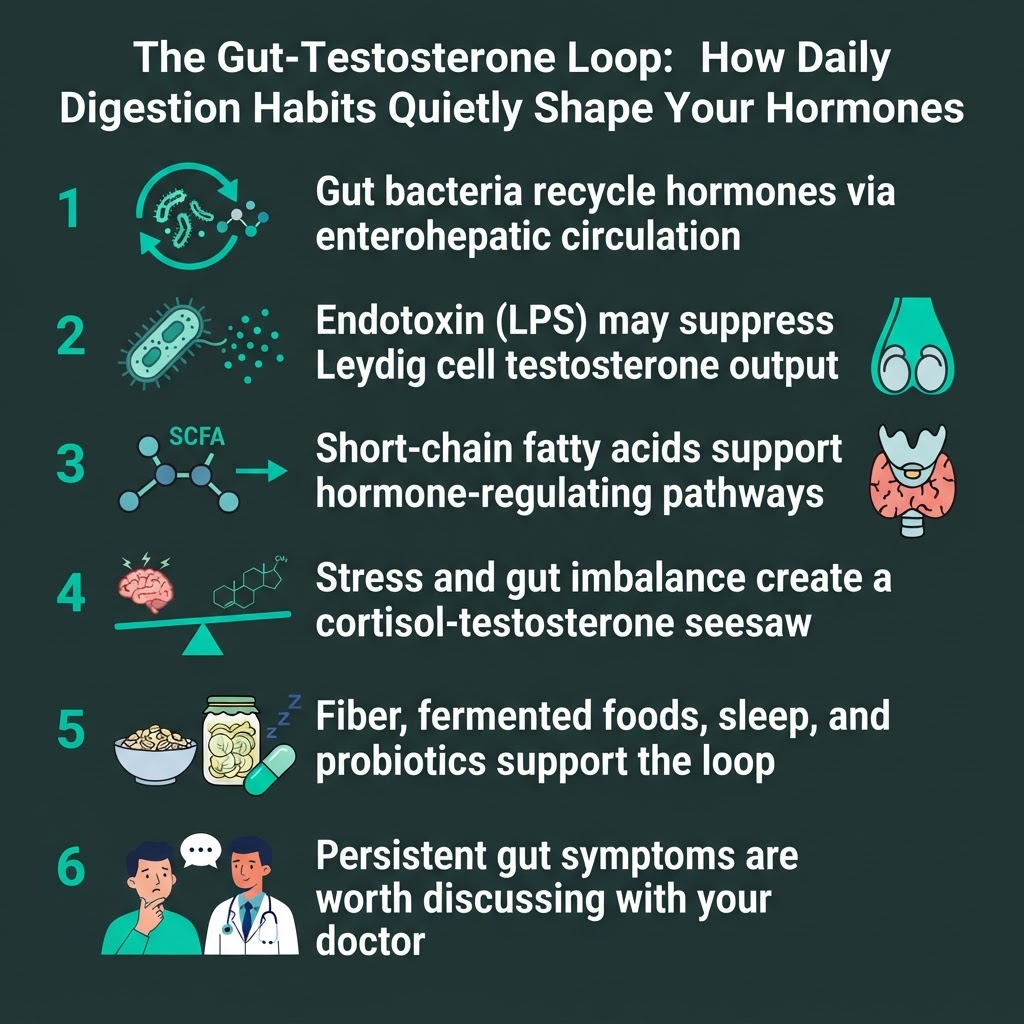
Here's a mechanism rarely discussed outside research papers. After your liver processes hormones like testosterone and estrogen for elimination, it sends them into the gut via bile, tagged for excretion in a process called enterohepatic circulation — essentially a recycling loop between your liver and intestines.
Certain gut bacteria produce an enzyme called beta-glucuronidase, which can "untag" these hormones, allowing them to be reabsorbed into the bloodstream instead of being excreted. When this enzyme is overactive — often due to an imbalanced microbiome — it can disrupt the ratio of testosterone to estrogen circulating in your body, even if your testicles are producing a normal amount.
This is one reason why gut imbalance can show up as hormonal symptoms (low libido, fatigue, fat gain around the midsection) even when a basic blood test shows "normal" total testosterone. The ratio and bioavailability matter as much as the raw number. If you want the foundational biology of how microbiome composition shapes testosterone production itself, we've covered that in detail in our piece on the gut microbiome's role in testosterone production.
Endotoxin, Inflammation, and Leydig Cell Function
Your gut lining is a single-cell-thick barrier separating your bloodstream from the contents of your intestines. When this barrier becomes more permeable than it should be — a condition informally called "leaky gut" — bacterial fragments called lipopolysaccharide (LPS), also known as endotoxin, can slip into circulation.
LPS triggers a low-grade inflammatory response throughout the body. Researcher Kelton Tremellen proposed what he called the GELDING hypothesis — short for Gut Endotoxin Leading to Decline IN Gonadal function — suggesting that chronic low-level endotoxin exposure can directly suppress testosterone production in Leydig cells and disrupt signaling from the brain to the testicles.
"Chronic, low-grade inflammation induced by gut-derived endotoxin may be an important, yet under-recognized, cause of hypogonadism in modern men."
— Tremellen K., Basic and Clinical Andrology (2016)
This is also why intense training without adequate gut support can backfire. Hard exercise temporarily increases gut permeability, which is a topic we explore from a performance angle in how intense training affects gut integrity. The inflammatory load from a compromised gut lining doesn't just slow recovery — it may quietly chip away at hormone output over time.
Short-Chain Fatty Acids: Quiet Supporters of Hormone Balance
Not everything your gut bacteria produce works against you. When beneficial bacteria ferment dietary fiber, they produce short-chain fatty acids (SCFAs) — compounds like butyrate, propionate, and acetate that nourish the cells lining your colon.
SCFAs do more than feed gut cells. Research suggests they help regulate inflammation, support insulin sensitivity, and may influence the hypothalamic-pituitary-gonadal axis — the communication chain between your brain and testicles that governs testosterone release. A gut that's low in fiber-fermenting bacteria tends to produce fewer SCFAs, removing one of the body's natural anti-inflammatory buffers.
"Sex differences in the gut microbiota can causally contribute to hormone-dependent physiology, indicating that microbial composition is not a passive bystander to the hormonal milieu, but an active participant in it."
— Markle et al., Science (2013)
In practical terms, this means the fiber you eat (or don't eat) today is partly a hormone-support decision, not just a digestion one.
The Stress-Gut-Cortisol-Testosterone Seesaw
Stress affects the gut and the gut affects stress — this is sometimes called the gut-brain axis. Chronic stress raises cortisol, your primary stress hormone, and sustained high cortisol is known to suppress testosterone production as part of the body's resource-prioritization response.
What's less appreciated is that gut imbalance itself can raise systemic inflammation and stress signaling, creating a feedback loop: a stressed gut contributes to elevated cortisol, elevated cortisol disrupts gut bacteria balance, and the cycle continues, with testosterone caught in the middle. Sleep quality sits right in the center of this loop, since poor sleep raises cortisol and disrupts microbiome diversity in a single stroke — a connection we unpack further in how your microbiome affects sleep and recovery.
This is partly why men under chronic occupational or life stress often notice both digestive complaints and low-testosterone symptoms arriving together, rather than as separate, unrelated problems.
Signs Your Gut May Be Quietly Dragging Down Your Hormones
None of these signs are proof on their own, but a cluster of them is worth paying attention to, especially alongside midsection fat gain discussed in our article on why belly fat after 40 behaves differently in men.
- Persistent bloating, irregular digestion, or food sensitivities that developed later in life
- Low energy and reduced motivation despite adequate sleep
- Slower recovery after workouts than you'd expect for your training load
- Reduced libido without an obvious lifestyle explanation
- Stubborn fat gain around the abdomen despite consistent diet and exercise
- Frequent minor infections or a sense of being "run down"
If several of these sound familiar, it's worth discussing both gut health and hormone levels with your physician rather than treating them as unrelated complaints.
Practical, Evidence-Informed Steps to Support the Gut-Testosterone Link
You don't need a radical overhaul to start supporting this system. Small, consistent changes compound over months, which matches how both microbiome shifts and hormonal patterns actually behave — slowly, not overnight.
- Eat a wider variety of plant fiber sources weekly (aim for 30+ different plants, not just more of the same vegetables) to feed diverse SCFA-producing bacteria
- Include fermented foods like plain yogurt, kefir, or sauerkraut a few times a week to introduce beneficial live cultures
- Prioritize 7–9 hours of consistent sleep, since both cortisol regulation and gut bacterial diversity are tied closely to sleep rhythm
- Manage training load thoughtfully — intense exercise without recovery support can increase gut permeability, a pattern we detail in how exercise affects gut integrity and how to counter it
- Limit excessive alcohol and ultra-processed food intake, both of which are associated with reduced microbial diversity
- Consider a daily probiotic formulated for men's physiology, alongside — not instead of — these foundational habits
A daily multi-strain probiotic, like the Men's Performance Stack from His-Biotics, is designed to support gut barrier integrity and microbial balance as part of this broader routine. It's not a substitute for sleep, fiber, or stress management — it's a tool that works alongside them.
What This Means for Your Next Blood Test
If you're having testosterone levels checked, it's worth mentioning any persistent digestive symptoms to your doctor. Gut-related inflammation doesn't always show up on a standard metabolic panel, but it can be a meaningful piece of the puzzle when hormone results come back lower than expected or symptoms don't match the numbers.
The Mayo Clinic notes that low testosterone has many potential contributing factors beyond the testicles themselves, and a thorough evaluation should consider the whole picture rather than a single number. This is exactly the kind of nuance worth raising directly with your physician.
Your Simplest First Step
You don't need to fix your diet, sleep, training, and stress all in one week. Start with one lever: add a daily probiotic built for men's gut and hormone physiology, and layer in one new fiber-rich food this week. You can explore the full range of options at the His-Biotics store or go straight to the Men's Performance Stack if hormone and performance support is your priority right now.
If you'd like more science-backed breakdowns like this one sent straight to your inbox, consider subscribing to the His-Biotics newsletter below.