
If you've noticed your waistline creeping outward even though your diet and gym routine haven't changed much, you're not imagining it. Something genuinely shifts in a man's body after 40, and it's not just "getting older." Hormones, sleep, stress, and gut health all start pulling in the same unhelpful direction.
The good news is that once you understand why this happens, the fix becomes far more logical — and far less about punishing workouts or extreme diets. This article breaks down the real biology behind midlife belly fat and gives you a practical, sustainable plan.
Why Belly Fat Behaves Differently After 40
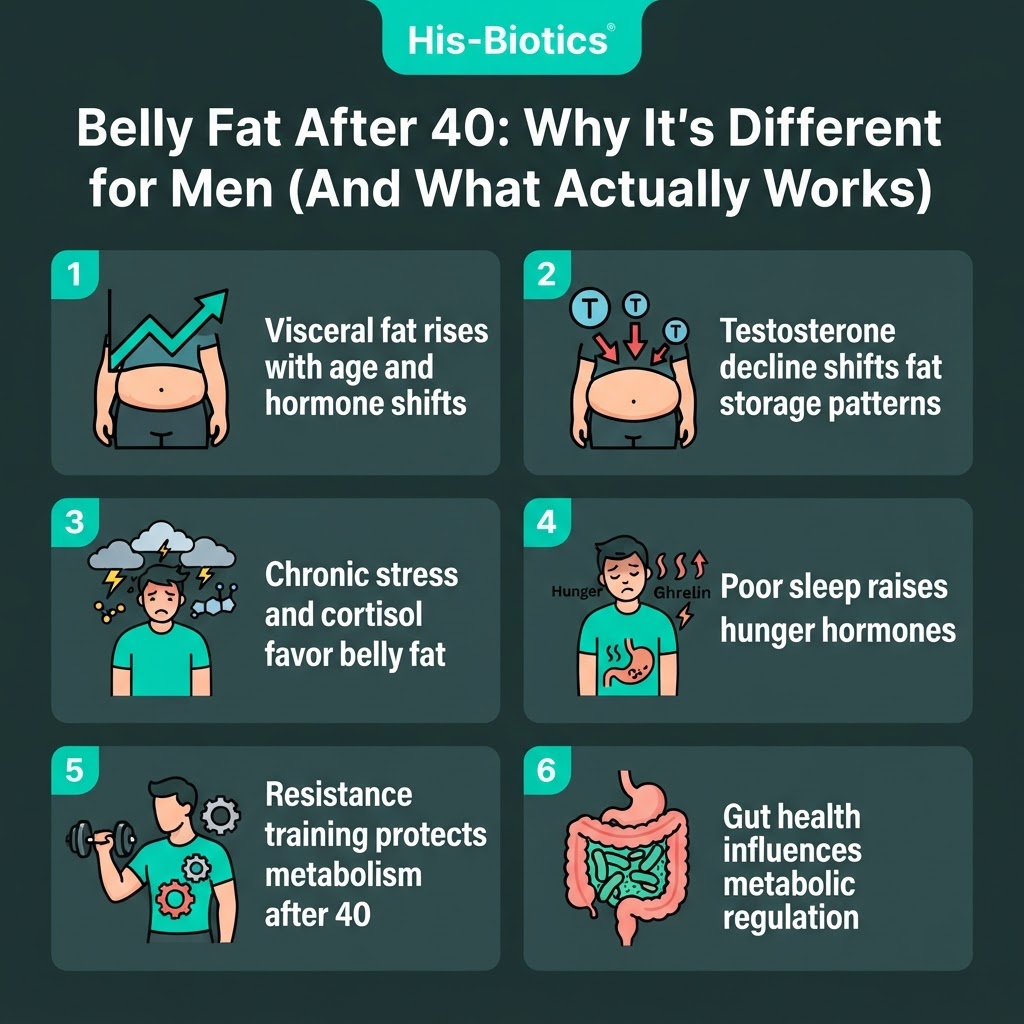
Not all body fat is the same. Fat just under the skin (called subcutaneous fat) is mostly cosmetic. But the fat that collects deep around your organs — known as visceral fat — is metabolically active tissue that releases inflammatory signals into your bloodstream.
After 40, men tend to store proportionally more visceral fat, even at the same body weight as their 20-something selves. According to the Mayo Clinic, this type of fat is more responsive to hormonal changes than fat elsewhere on the body, which is exactly why the belly becomes the first place things go wrong.
Muscle Loss Quietly Changes Your Metabolism
Starting around age 30, men lose roughly 3–8% of muscle mass per decade, a process called sarcopenia (age-related muscle loss). Muscle burns more calories at rest than fat does, so less muscle means a slower resting metabolism — even if your eating habits stay exactly the same.
This is why many men over 40 gain fat while eating the same amount of food they always have. The math of your metabolism has simply changed underneath you.
The Testosterone Connection
Testosterone isn't just about libido or muscle — it plays a direct role in where your body chooses to store fat. As levels decline, fat storage tends to shift toward the abdomen, and the body becomes less efficient at building or maintaining lean muscle.
Testosterone levels decline by about 1% to 2% a year beginning in a man's 30s, and lower levels are associated with increased abdominal fat mass.
— Harman et al., Baltimore Longitudinal Study of Aging, Journal of Clinical Endocrinology & Metabolism (2001)
Interestingly, this relationship runs both ways: excess visceral fat can further suppress testosterone production, creating a frustrating feedback loop. There's also a surprising gut connection to this hormonal picture — we've explored it in detail in The Hidden Link Between Your Gut Microbiome and Testosterone Production.
Cortisol, Stress, and the "Stress Belly"
Cortisol is your body's main stress hormone. In short bursts it's helpful — it sharpens focus and mobilizes energy. But chronic, low-grade stress from work, poor sleep, or constant notifications keeps cortisol elevated for hours or days at a time.
Elevated cortisol specifically encourages the body to store fat around the midsection rather than elsewhere, partly because visceral fat cells have a particularly high density of cortisol receptors. This is one reason men who feel constantly "wired but tired" often carry weight almost exclusively around the belly, regardless of their overall body size.
- Chronic stress raises cortisol, which favors abdominal fat storage.
- High cortisol can increase cravings for sugar and refined carbohydrates.
- Poor stress management often coincides with poor sleep, compounding the effect.
Sleep: The Hormone Reset You're Probably Skipping
Sleep is when your body regulates the two hormones that control appetite: ghrelin (which increases hunger) and leptin (which signals fullness). Just a few nights of short or poor-quality sleep can raise ghrelin and lower leptin, making you genuinely hungrier the next day — not just "weak-willed."
Poor sleep also blunts the natural overnight rise in testosterone and keeps cortisol elevated into the morning, stacking two belly-fat-promoting hormone patterns on top of each other. We go deeper into this relationship, including the surprising role of your gut microbiome, in How Your Microbiome Affects Your Sleep — And Why Better Sleep Means Better Everything.
A Simple Sleep Habit Worth Building
Aim for a consistent wake time, even on weekends. Irregular sleep timing disrupts your circadian rhythm (your internal 24-hour clock) more than a single short night does.
Consistency, more than perfection, is what protects your hormone balance long-term.
The Gut Health Piece Most Men Never Consider
Your gut microbiome — the trillions of bacteria living in your digestive tract — plays a measurable role in how you extract, store, and regulate energy from food. An imbalanced microbiome is associated with increased inflammation, altered insulin sensitivity, and even changes in appetite-regulating hormones.
This is a topic we cover extensively in Male Gut Microbiome: Why Daily Probiotics Change Everything, but the short version is this: a healthier gut environment supports better metabolic regulation, which is one more piece of the belly-fat puzzle working in your favor instead of against you.
For men over 40, gut health also intersects with another topic that deserves honest attention — we discuss it candidly in The Prostate Conversation Nobody Wants to Have — But Should.
A Practical, Realistic Plan for Men Over 40
None of this means you're stuck. It means the old "eat less, run more" approach needs a few strategic upgrades to work with your changing biology rather than against it.
Nutrition Adjustments That Matter Most
- Prioritize protein at every meal (aim for 25–35g) to counter age-related muscle loss.
- Reduce refined carbohydrates and added sugar, which spike insulin and worsen visceral fat storage.
- Add fiber-rich vegetables and legumes to support both blood sugar control and gut bacteria diversity.
- Limit alcohol — it's calorie-dense, disrupts sleep, and is processed by the liver in ways that favor abdominal fat storage.
Movement That Actually Targets the Problem
Resistance training (lifting weights or bodyweight training) is arguably more important than cardio after 40, because it directly counters muscle loss and helps preserve your metabolic rate. Two to three sessions a week focused on major muscle groups is enough to make a measurable difference over a few months.
Cardio still matters — particularly for cardiovascular health and stress reduction — but it shouldn't replace strength work. The World Health Organization recommends adults get at least 150–300 minutes of moderate aerobic activity weekly, alongside muscle-strengthening activities on two or more days.
Regular physical activity of at least moderate intensity has significant benefits for health, including reduced risk of cardiovascular disease and improved mental wellbeing.
— World Health Organization, Physical Activity Fact Sheet
What About Supplements?
Supplements are not a shortcut around food, sleep, and training — but they can support the systems that are already working against you after 40. A well-formulated men's probiotic multivitamin may help support gut balance, which in turn is associated with better metabolic and inflammatory markers.
For men specifically past the 40-year mark, the His-Biotics Probiotics AGELESS 50+ Multivitamin was formulated with age-related hormonal and gut changes in mind, combining targeted probiotic strains with nutrients that support energy metabolism and digestive health. Men focused on training and recovery alongside fat loss may also want to look at the Men's Performance Stack, which pairs gut support with performance-focused nutrients.
It's worth noting these products are designed to support your body's existing systems — they are not a stand-alone fix, and results depend heavily on the nutrition, movement, sleep, and stress fundamentals covered above.
Your Simplest First Step
You don't need to overhaul everything today. Pick one lever — usually adding a strength session, fixing your wake-up time, or cutting evening alcohol — and commit to it for the next two weeks before adding another.
If you want a simple daily habit to support the gut and metabolic side of this equation, take a look at the AGELESS 50+ Multivitamin or browse the full range at the His-Biotics store. And if you'd like more breakdowns like this one sent straight to your inbox, subscribe to the His-Biotics newsletter below.