
If you have ever wondered why the fat around your waistline seems to behave differently from fat elsewhere on your body, you are asking the right question. Visceral fat — the fat that wraps around your liver, pancreas, and intestines rather than sitting just under the skin — is not just a cosmetic issue. It is metabolically active tissue that talks to the rest of your body, and increasingly, research shows it is having a conversation with your gut bacteria too.
As a physician who focuses on men's health, I see this pattern often: a man eats reasonably, trains consistently, yet his midsection keeps expanding. Part of the missing piece is almost never discussed in gyms or diet plans — the trillions of microorganisms living in your intestines, collectively called the gut microbiome. This article breaks down, in plain language, how that invisible ecosystem influences where and how your body stores fat.
What Is Visceral Fat, Really?
Visceral fat is the deep abdominal fat that surrounds your internal organs, as opposed to subcutaneous fat, which is the softer layer you can pinch under the skin. Visceral fat is far more dangerous because it releases inflammatory chemicals directly into the bloodstream that reaches your liver first. According to the Mayo Clinic, excess visceral fat is strongly associated with insulin resistance, high blood pressure, and cardiovascular risk, even in men who are not overweight by body mass index alone.
Men tend to store fat viscerally far more than women do, partly due to hormonal differences, which is one reason belly fat shows up differently after 40. We have covered the hormonal side of this in detail in Belly Fat After 40: Why It's Different for Men. This article takes a different angle: the role your gut bacteria play in that story.
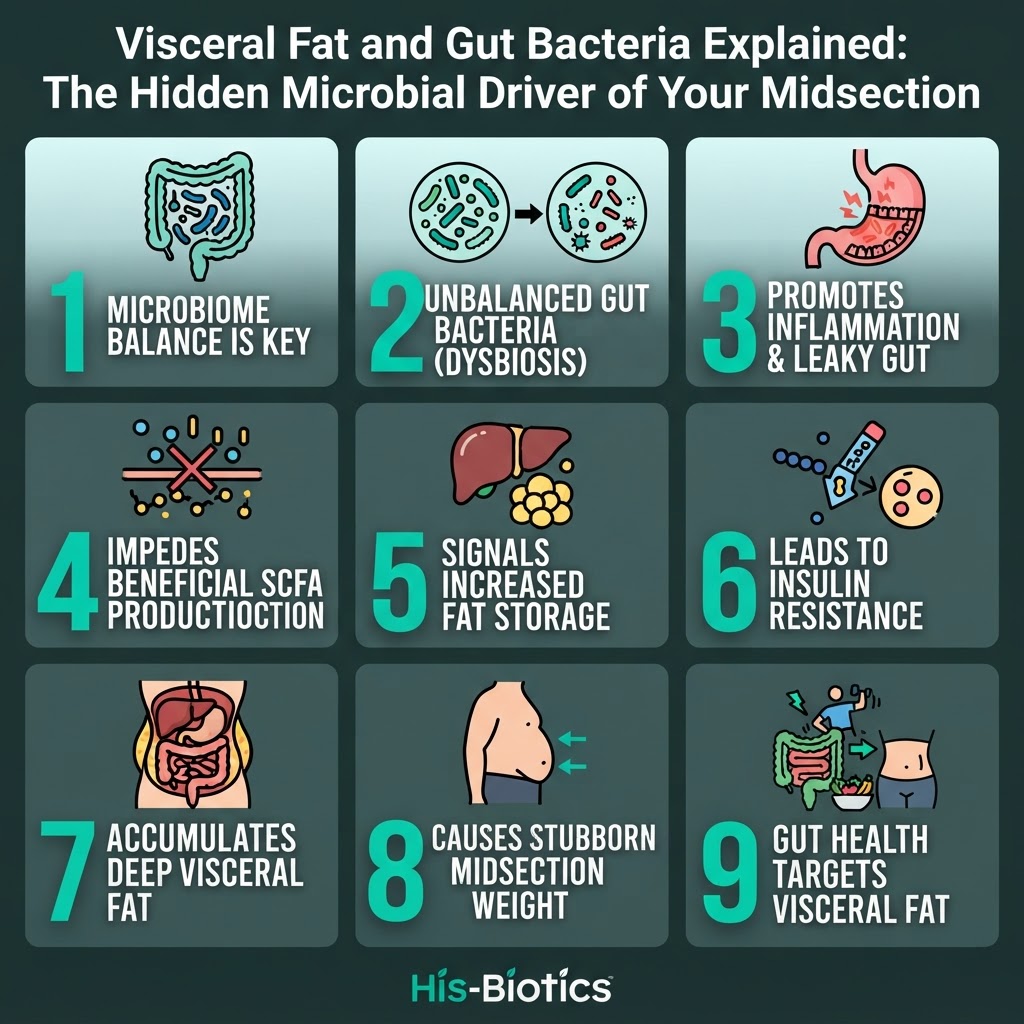
Meet Your Gut Microbiome
Your gut microbiome is the community of bacteria, fungi, and other microbes living mainly in your large intestine. A healthy adult carries somewhere between 300 and 500 different bacterial species, and their combined genetic material outnumbers your own human genes many times over. These microbes are not passengers; they actively digest fibre, produce vitamins, train your immune system, and — as we now understand — help regulate how your body stores and burns fat.
Two broad groups dominate most people's gut: Firmicutes and Bacteroidetes. Early microbiome research noticed that people with obesity tend to have a higher ratio of Firmicutes to Bacteroidetes compared with lean individuals, suggesting these bacterial groups extract and store energy from food differently. This finding has since been refined, but it opened the door to a much bigger question: can your gut bacteria actually cause fat gain, not just reflect it?
Gut microbiota from twins discordant for obesity, when transplanted into germ-free mice, transmitted the donor's body composition phenotype — lean-associated bacteria produced leaner mice, obese-associated bacteria produced fatter mice, on the identical diet.
— Ridaura et al., Science (2013)
How Gut Bacteria Influence Fat Storage
The mechanisms linking gut bacteria to visceral fat are more concrete than most people assume. Three pathways matter most for men trying to understand their midsection.
Short-Chain Fatty Acids: Fuel or Fat Signal?
When gut bacteria ferment fibre you cannot digest yourself, they produce compounds called short-chain fatty acids, or SCFAs. These include acetate, propionate, and butyrate, which act almost like hormones once absorbed into your bloodstream. Butyrate, in particular, supports the gut lining and may help regulate appetite hormones, while certain bacterial profiles produce excess acetate, which some studies link to increased fat storage and a stronger drive to eat.
The balance of SCFAs your gut produces depends heavily on which bacteria dominate your colon, which in turn depends on what you feed them. A fibre-starved gut shifts toward bacteria that favour energy harvesting over energy-burning signals. This is one reason a highly processed, low-fibre diet is linked to visceral fat gain independent of total calories consumed.
Leaky Gut, Endotoxins, and Low-Grade Inflammation
The lining of your intestine is a single-cell-thick barrier that normally keeps bacterial fragments out of your bloodstream. When that barrier becomes looser — a state often called increased intestinal permeability, or informally