
You train reasonably hard, eat reasonably well, and still carry a stubborn layer of fat around your midsection that won't budge no matter what you try. If your stress levels have been high for months — a demanding job, poor sleep, money pressure, relationship strain — your waistline may be reacting to something more than food alone. This is what many men and clinicians informally call "cortisol belly," and understanding the hormone behind it is the first real step to losing it. Below, I'll walk through the biology in plain language and give you a practical, doctor-reviewed plan.
What Is Cortisol Belly — And Is It Really a Thing?
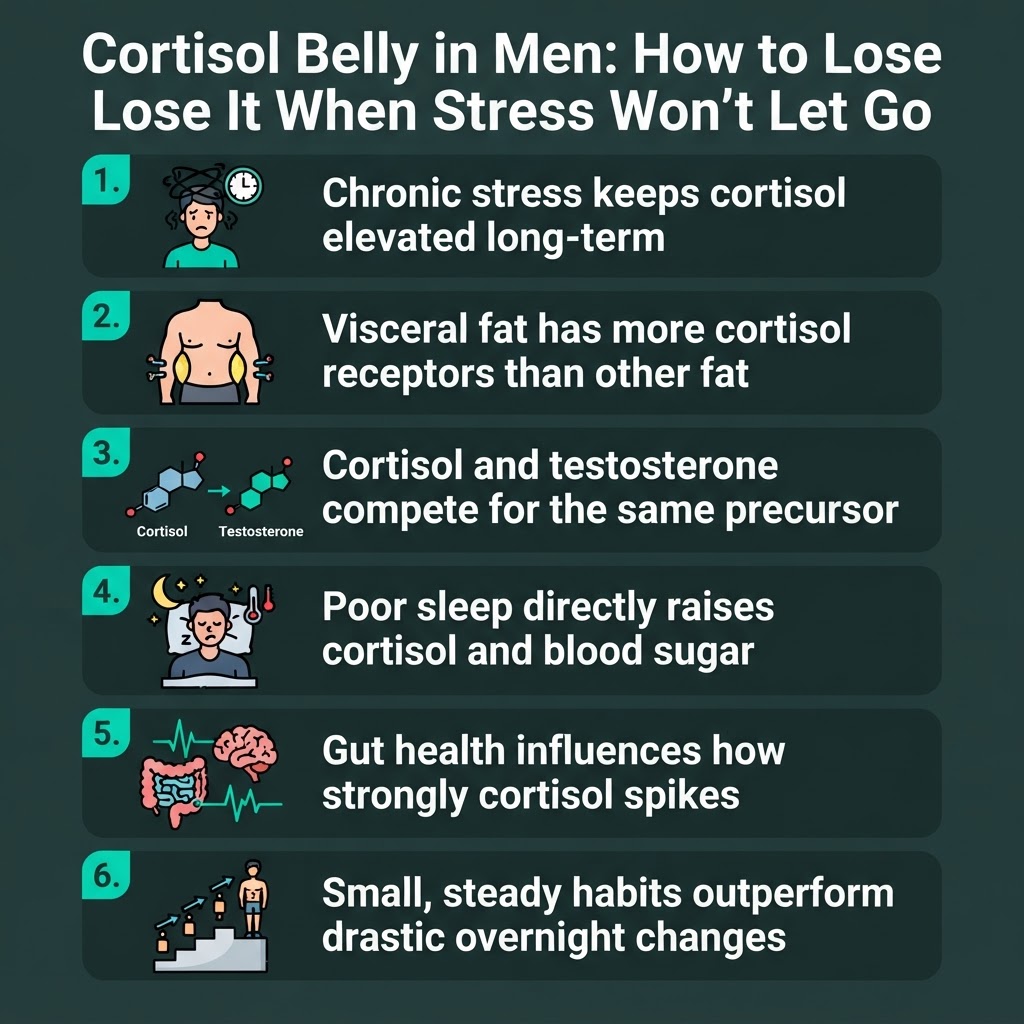
Cortisol is the body's main stress hormone, released by two small glands that sit above your kidneys called the adrenal glands. In short bursts, cortisol is genuinely useful: it raises blood sugar for quick energy, sharpens focus, and helps you respond to a real threat. The problem starts when stress never fully switches off, keeping cortisol elevated for weeks or months rather than minutes. Over time, this chronic elevation changes where and how your body stores fat.
The Stress Control Centre: Your HPA Axis in Plain English
Your brain and adrenal glands communicate through a feedback loop scientists call the hypothalamic-pituitary-adrenal (HPA) axis — essentially your body's internal stress thermostat. Under chronic pressure, as Mayo Clinic explains in its overview of chronic stress, this thermostat can get stuck in the "on" position, a state researchers call HPA axis dysregulation. The result is cortisol that stays high even when there's no tiger chasing you, just a full inbox and a bad night's sleep. This constant low hum of stress hormone is what quietly reshapes your body composition over months and years.
Why Visceral Fat Loves Cortisol
Not all body fat responds to cortisol the same way. The fat that wraps around your abdominal organs — known as visceral fat — has far more cortisol-receiving docking stations, called glucocorticoid receptors, than the fat sitting just under your skin. This means that when cortisol is chronically high, your body is biologically primed to store extra energy specifically around your belly rather than your hips, arms, or thighs. It also explains why cortisol belly often feels firmer and more "ballooned" than ordinary soft fat.
Men with abdominal obesity frequently show a blunted negative feedback response in the HPA axis, exposing visceral fat tissue to disproportionately higher cortisol levels than other fat depots.
— Rosmond R, Björntorp P., Journal of Internal Medicine (2000)
This is part of why two men who weigh exactly the same can look very different. One carries weight fairly evenly across his frame; the other carries almost all of it in front, often rounder and tighter than you'd expect for his overall size. If you've already read our breakdown of belly fat after 40, cortisol is one of the missing pieces in that puzzle — age alone lowers testosterone, but stress independently raises cortisol, and the two together compound the problem considerably.
How to Tell If Stress Is Driving Your Belly Fat
Diet quality still matters enormously, and no amount of stress management will offset a consistent calorie surplus from food and drink. That said, certain patterns suggest cortisol is playing an outsized role in your specific case rather than diet alone.
- Your belly has grown noticeably even though your overall weight has barely changed
- You crave salty or sugary food specifically in the late afternoon or evening
- You wake up tired despite getting 7–8 hours in bed most nights
- You feel wired and restless at night but foggy and flat during the day
- Your waist measurement has increased faster than your hips or chest
If several of these sound familiar, stress physiology is very likely compounding whatever is happening at the dinner table. The gut microbiome also plays a quieter, less obvious role here, which we've explored in detail in our piece on visceral fat and gut bacteria. Reading that alongside this article will give you a more complete picture of why the same calorie intake can produce different waistlines in different men.
The Cortisol-Testosterone Seesaw
Cortisol and testosterone are both ultimately made from the same starting material, a hormone precursor called pregnenolone. Under chronic stress, some researchers describe the body favouring cortisol production, which can come at the relative expense of testosterone and other downstream hormones — a concept sometimes nicknamed the "pregnenolone steal" hypothesis, though the full picture is more nuanced than a simple either-or trade-off. What's clearer is that sustained high cortisol and persistently low testosterone tend to show up together in the same bloodwork.
Lower testosterone, in turn, makes it harder to build or even preserve muscle, and muscle tissue is one of your biggest round-the-clock calorie burners. Less muscle plus more cortisol-driven fat storage is a genuinely frustrating combination, because it works against you from two directions at once. If you want a structured way to support healthy testosterone through daily habits, our testosterone after 40 checklist is a useful companion to the ideas in this article.
Why This Matters Beyond Aesthetics
This isn't only about how your shirt fits or what the scale says. Chronically elevated cortisol alongside low testosterone is associated with poorer insulin sensitivity, more daytime fatigue, and reduced motivation to exercise, which then feeds back into more stress-eating and less physical activity. Breaking this loop usually requires addressing sleep, training load, and gut health together, rather than relying on any single lever in isolation.
Sleep, Cortisol, and the Belly Fat Loop
Sleep debt is one of the most powerful — and most underestimated — drivers of elevated cortisol in modern men. A classic sleep-restriction study limited healthy young men to roughly four hours of sleep for just six consecutive nights and found measurable hormonal and metabolic disruption by the end of the week.
Sleep debt in healthy young men was associated with increased evening cortisol concentrations and reduced glucose tolerance, resembling patterns seen in early-stage metabolic disease.
— Spiegel K, Leproult R, Van Cauter E., The Lancet (1999)
In other words, short sleep doesn't just leave you tired; it actively shifts your hormones toward fat storage and blood sugar problems within days, not months. We've gone deeper into the sleep-hormone connection in how your microbiome affects your sleep, which is worth reading alongside this piece if sleep is a known weak point for you.
The Gut-Cortisol Connection
Your gut and your stress response are more connected than most men realise. The gut communicates directly with the brain via the vagus nerve and through signalling molecules produced by gut bacteria, a relationship researchers call the gut-brain axis. Disruption here — from a poor diet, excess alcohol, or repeated antibiotic use — can amplify the HPA axis response to everyday stressors, meaning the same deadline or argument produces a bigger cortisol spike than it would in a healthier gut.
This is one reason we built our product line around consistent daily gut support rather than one-off fixes. We've written a full explainer on this relationship in the gut-testosterone loop, and a broader look at the male microbiome in why daily probiotics change everything. For men actively trying to manage stress, training load, and hormone support together, our Men's Performance Stack was formulated with this triad in mind, though it's one part of a bigger picture rather than a replacement for sleep and sensible nutrition.
Practical Steps to Lower Cortisol and Lose the Belly
Train Smart, Not Just Hard
Long, high-intensity training sessions without adequate recovery can themselves raise cortisol, particularly when combined with poor sleep or a calorie deficit that's too aggressive for too long. Three to four focused strength sessions a week, with genuine rest days built in, tends to outperform daily exhausting workouts for both hormone balance and long-term fat loss. If you're a committed athlete already pushing hard, our detailed guide on how intense training damages your gut explains why overtraining without recovery can backfire on both performance and body composition.
Eat to Steady Your Blood Sugar
Large swings in blood sugar — a sugary breakfast followed by a mid-morning crash — trigger additional cortisol release as your body scrambles to correct glucose levels. Protein and fibre at each meal slow this swing considerably and keep cortisol from spiking unnecessarily throughout the day.
- Anchor breakfast with protein (eggs, Greek yoghurt, or a protein shake) instead of cereal alone
- Keep alcohol to occasional, moderate amounts — it disrupts both sleep quality and next-day cortisol
- Add fibre-rich vegetables at lunch and dinner to slow sugar absorption
- Avoid skipping meals for long stretches, which is itself a mild physical stressor on the body
Build In Deliberate Downregulation
Your nervous system needs active signals that the "threat" has passed, not just the absence of a new crisis. Ten minutes of slow nasal breathing, a short walk outside without your phone, or genuinely consistent sleep and wake times all send this signal clearly. None of these require an app subscription, special equipment, or an extra hour you don't have.
Tracking Real Progress, Not Just the Scale
Because cortisol belly often involves fluid retention and muscle changes alongside fat, the bathroom scale can be a misleading guide on its own. A simple tape-measure reading of your waist at the navel, taken weekly at the same time of day, is a far more honest signal of visceral fat change than total body weight. Expect slow, steady progress over 8–12 weeks rather than dramatic shifts in the first two weeks.
When to See a Doctor
Most "cortisol belly" in men is a product of ordinary modern stress, sleep debt, and training habits, and it genuinely responds to the lifestyle changes above over several months. True cortisol-driven disease, however, is a distinct and more serious medical condition called Cushing's syndrome, usually caused by a tumour or long-term steroid medication use.
Signs that warrant a proper medical work-up include rapid, severe weight gain paired with noticeably thin arms and legs, purple stretch marks, unusual bruising, or muscle weakness when climbing stairs. The Mayo Clinic's overview of Cushing's syndrome is a reliable starting point if any of this sounds familiar, and your doctor can order a simple cortisol test to rule it out. For most men, though, the issue sits firmly in the lifestyle category rather than a hormonal disease.
It's also worth ruling out other contributors to midsection changes, including declining testosterone and prostate-related issues that become more common from your 40s onward. Our guide to prostate health in your 40s covers what else is worth checking at a routine visit, especially if you're already making an appointment about weight or energy concerns.
Your Simplest First Step
If cortisol belly has crept up on you, don't try to overhaul sleep, training, diet, and gut health all in the same week — that's its own source of stress and rarely sticks. Pick the habit with the lowest cost first: commit to a consistent sleep and wake time for the next 14 days, paired with a daily probiotic multivitamin such as the His-Biotics ORIGINAL Multivitamin to support your gut-hormone foundation while the bigger habits catch up. You can browse the full range, including our recovery-focused formulas, at the His-Biotics store.
If you'd like practical, doctor-reviewed updates like this one sent straight to your inbox, subscribe to the His-Biotics newsletter below.