
Somewhere around your 40th birthday, your body quietly turns a dial down. Testosterone, the hormone (a chemical messenger made in the testes that signals for muscle, libido, mood and energy) that shaped so much of your younger years, begins a slow and steady decline. This is not a medical emergency. It is biology, and it is manageable.
As a physician, I see two kinds of men in my clinic: those who accept the decline as inevitable and do nothing, and those who ask a better question — what can I actually control? This article is written for the second group. We will walk through the daily habits with the strongest evidence behind them, in plain language, with no exaggerated promises.
Why Testosterone Naturally Dips After 40
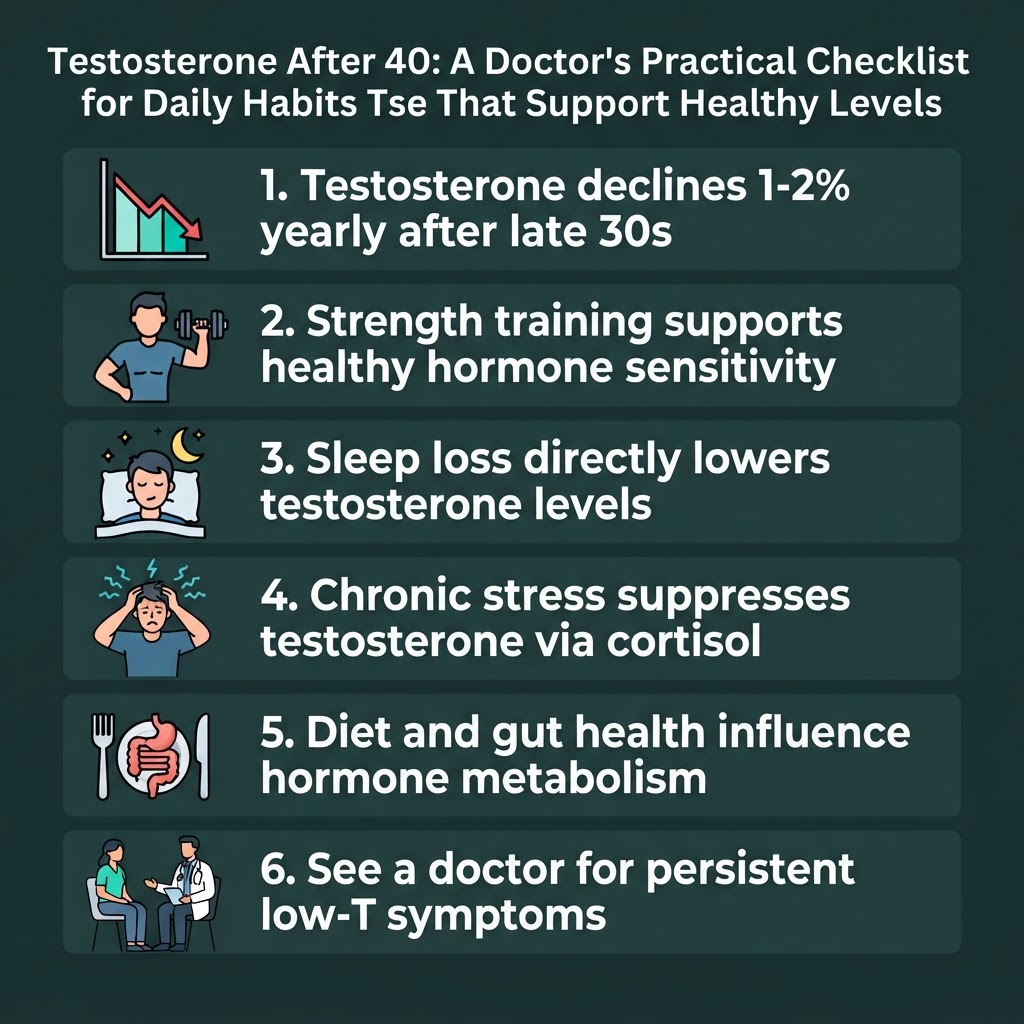
Total testosterone levels in healthy men fall by roughly 1 to 2 percent per year starting in the late 30s, according to long-term data from the Baltimore Longitudinal Study of Aging. That may sound small, but compounded over a decade or two, it adds up to a noticeably different hormonal environment by your 50s and 60s. Free testosterone, the portion of the hormone that is actually available for your cells to use, tends to drop even faster.
Both total and free testosterone levels in men decrease gradually but progressively with age, even in the absence of chronic illness.
— Harman SM et al., Journal of Clinical Endocrinology & Metabolism, 2001
This decline is not the same as clinical low testosterone, sometimes called hypogonadism, which is a diagnosable medical condition. Most men experience the normal age-related dip. The goal of this article is to support that normal trajectory, not to replace medical evaluation if your levels are genuinely low — more on when to see a doctor further down.
The Daily Habits That Actually Move the Needle
There is no shortage of products promising overnight hormone transformations. The honest picture, backed by research, is less dramatic but far more actionable. A handful of daily habits consistently show up in the scientific literature as meaningfully associated with healthier testosterone levels in ageing men.
Strength Training Beats Steady Cardio For This Purpose
Resistance training — lifting weights, bodyweight exercises, resistance bands — creates a brief, natural rise in testosterone and, more importantly, improves the body's long-term sensitivity to its own hormones. This is different from the kind of damage-and-repair cycle intense endurance athletes can experience in the gut, which we cover in detail in How Exercise Destroys Your Gut (And How to Fix It). For general hormonal health, moderate, consistent strength training two to three times a week is the better long-term strategy than occasional, extreme cardio sessions.
The World Health Organization recommends at least 150 minutes of moderate aerobic activity plus muscle-strengthening activities on two or more days per week for adults, a baseline that happens to align well with what we know about testosterone support.
Sleep Is Not a Luxury, It Is a Hormonal Input
Testosterone is produced predominantly during deep sleep, with the largest pulses occurring during REM cycles in the early morning hours. Cut that sleep short, and you cut hormone production short too. This is not a minor effect.
One week of sleep restriction to five hours per night reduced daytime testosterone levels by 10 to 15 percent in healthy young men.
— Leproult R, Van Cauter E, JAMA, 2011
If you are consistently sleeping fewer than six hours a night, no supplement or training programme will fully offset that deficit. We go deeper into the sleep-hormone relationship, including the surprising role of gut bacteria in sleep quality, in How Your Microbiome Affects Your Sleep.
Managing the Cortisol-Testosterone Seesaw
Cortisol is your primary stress hormone, released by the adrenal glands during periods of physical or psychological pressure. Chronically elevated cortisol — from work stress, poor sleep, or overtraining — appears to suppress testosterone production, partly because both hormones share raw materials and signalling pathways in the body. Men under constant, unmanaged stress often show lower testosterone regardless of how well they eat or train.
- Short daily walks outdoors, ideally in morning sunlight
- Breathing exercises or brief meditation, even five minutes
- Setting a hard stop time for work emails each evening
- Limiting late-night screen exposure, which disrupts both cortisol and sleep hormones
None of these require special equipment or significant time investment, which is exactly why they are so often overlooked in favour of more complicated interventions.
What You Eat and Drink Matters More Than Any Supplement
Diet influences testosterone indirectly, mainly through its effect on body weight, inflammation, and micronutrient status. Men carrying excess visceral fat (the fat stored around abdominal organs) tend to convert more testosterone into oestrogen via an enzyme called aromatase, which is one reason waistline management is so closely tied to hormonal health. We explore this specific mechanism, and why it differs from fat distribution in younger men, in Belly Fat After 40: Why It's Different for Men.
- Zinc-rich foods such as oysters, beef, and pumpkin seeds, since zinc deficiency is linked to lower testosterone
- Vitamin D from moderate sun exposure or fortified foods, as low vitamin D status correlates with lower testosterone in several studies
- Healthy fats from olive oil, avocado, and oily fish, which support the cholesterol-based hormone production pathway
- Reduced alcohol intake, since regular heavy drinking is associated with lower testosterone and impaired liver clearance of hormones
Mayo Clinic's overview of male hypogonadism notes that obesity, chronic illness, and certain medications are among the most common modifiable contributors to low testosterone in adult men, reinforcing how much lifestyle factors into the picture before medication ever becomes necessary.
The Overlooked Gut Connection
Your digestive system does more than process food. A healthy, diverse gut microbiome (the trillions of bacteria living in your intestines) supports the metabolic pathways your body uses to regulate hormones, manage inflammation, and absorb the nutrients listed above. We've written extensively about this relationship in The Gut-Testosterone Loop, so we won't repeat the mechanisms here.
What's worth noting for this article is simpler: a gut under chronic strain — from poor diet, stress, or inflammation — makes every other habit on this list work harder to compensate. This is one reason many men find that supporting gut health with a quality, targeted probiotic becomes a useful foundation alongside training, sleep, and diet changes, rather than a replacement for them.
When It's More Than Just Ageing
Some symptoms warrant a conversation with your doctor rather than another lifestyle tweak. Persistent fatigue, a sharp drop in libido, unexplained mood changes, or new difficulty building muscle despite consistent training can sometimes point to clinically low testosterone or another underlying issue. Frequent nighttime urination is a related but distinct symptom worth investigating separately, which we cover in Waking Up to Urinate After 50, and prostate health more broadly in The Prostate Conversation Nobody Wants to Have.
A simple blood test, usually drawn in the morning when testosterone peaks, can clarify whether you're dealing with normal age-related decline or something that needs direct medical attention. This is not a step to skip based on guesswork or online symptom checklists.
Putting It Together: A Simple Daily Checklist
None of this requires a complete life overhaul. Consistency on a few fronts outperforms perfection on any single one.
- Strength train two to three times weekly, even briefly
- Protect seven to eight hours of sleep nightly
- Get 10–15 minutes of morning sunlight most days
- Keep alcohol intake moderate and intentional
- Support gut health daily alongside your diet and training
If you want a closer look at how specific probiotic strains and ingredients fit into a men's daily routine, our formulation breakdown in Inside the Capsule explains exactly what's in our capsules and why.
Your Simplest First Step
You don't need to adopt every habit on this list today. Pick the one you're most likely to actually keep — often sleep or a daily walk — and build from there over the next few weeks. For many men over 40, pairing those habits with a daily multivitamin and probiotic formulated for this exact life stage, such as the His-Biotics AGELESS 50+ Multivitamin, is a practical way to support the nutritional foundation while the bigger lifestyle habits take hold. You can browse the full range at the His-Biotics store if you'd like to compare formulations for your stage of life.
If you found this useful, consider subscribing to the His-Biotics newsletter below for more straightforward, doctor-written guidance on men's hormonal health.