
Why Erections Start Long Before the Bedroom
Most men assume an erection is a simple mechanical event — desire shows up, blood flows, job done. In reality, an erection is one of the most sensitive vascular (blood vessel) events the male body performs. It depends on tiny blood vessel linings relaxing and opening on command, and that lining is surprisingly influenced by what's happening two feet away in your intestines.
This is not a fringe theory. Urologists have long used erectile difficulty as an early warning sign for heart disease, because the same small vessels that struggle to fill the penis are often the first vessels in the body to show strain. What's newer — and less talked about — is the growing evidence that gut bacteria help set the stage for whether those vessels work well or poorly in the first place.
Erectile dysfunction often precedes a diagnosis of cardiovascular disease by several years, making it a useful early clinical signal rather than an isolated complaint.
— Thompson IM et al., Journal of the American Medical Association (JAMA), 2005
Erections Are a Vascular Event, Not Just a Hormonal One
To get an erection, the lining of the penile blood vessels — called the endothelium — needs to release a gas called nitric oxide. Nitric oxide signals the surrounding muscle to relax, which lets blood rush in and fill the erectile tissue. If that lining is inflamed, stiff, or damaged, the nitric oxide signal weakens, and blood flow struggles to keep up even when desire and testosterone are completely normal.
This is why so many men with healthy testosterone levels still struggle with firmness or staying power — the issue often sits in the plumbing, not the hormone panel. We've covered hormone-independent causes in more detail in Low Libido in Men: 7 Causes That Have Nothing to Do With Testosterone, but vascular health deserves its own spotlight because it is so directly shaped by gut bacteria.
What Actually Damages the Endothelium
The endothelium is sensitive to chronic, low-grade inflammation — the kind that doesn't cause pain but quietly stiffens vessels over months and years. High blood sugar, poor sleep, smoking, and visceral fat (the fat packed around your organs) are well-known contributors. Gut bacteria sit on this same list, because an imbalanced gut can leak inflammatory signals into the bloodstream around the clock.
How an Unbalanced Gut Leaks Inflammation Into Your Blood Vessels
Your intestinal lining is meant to act like a selective filter, letting nutrients through while keeping bacterial debris out. When the gut lining becomes more permeable — a state often nicknamed "leaky gut" — fragments of bacteria called lipopolysaccharides (LPS) slip into the bloodstream. The immune system treats this as an ongoing low-level emergency, releasing inflammatory chemicals that circulate through every vessel in the body, including the ones in the pelvis.
This process doesn't announce itself with obvious symptoms. A man can feel generally fine while his blood vessels are quietly becoming less responsive. Over time, this is the same mechanism linked to visceral fat accumulation, which we explored in Visceral Fat and Gut Bacteria Explained: The Hidden Microbial Driver of Your Midsection.
- Bloating or irregular digestion alongside reduced firmness
- Low energy that doesn't match your sleep or workload
- Slower recovery after exercise or stress
- Waistline growth despite a stable diet
None of these on their own prove a gut-vascular problem, but together they're worth paying attention to, especially if erectile changes showed up around the same time as digestive changes.
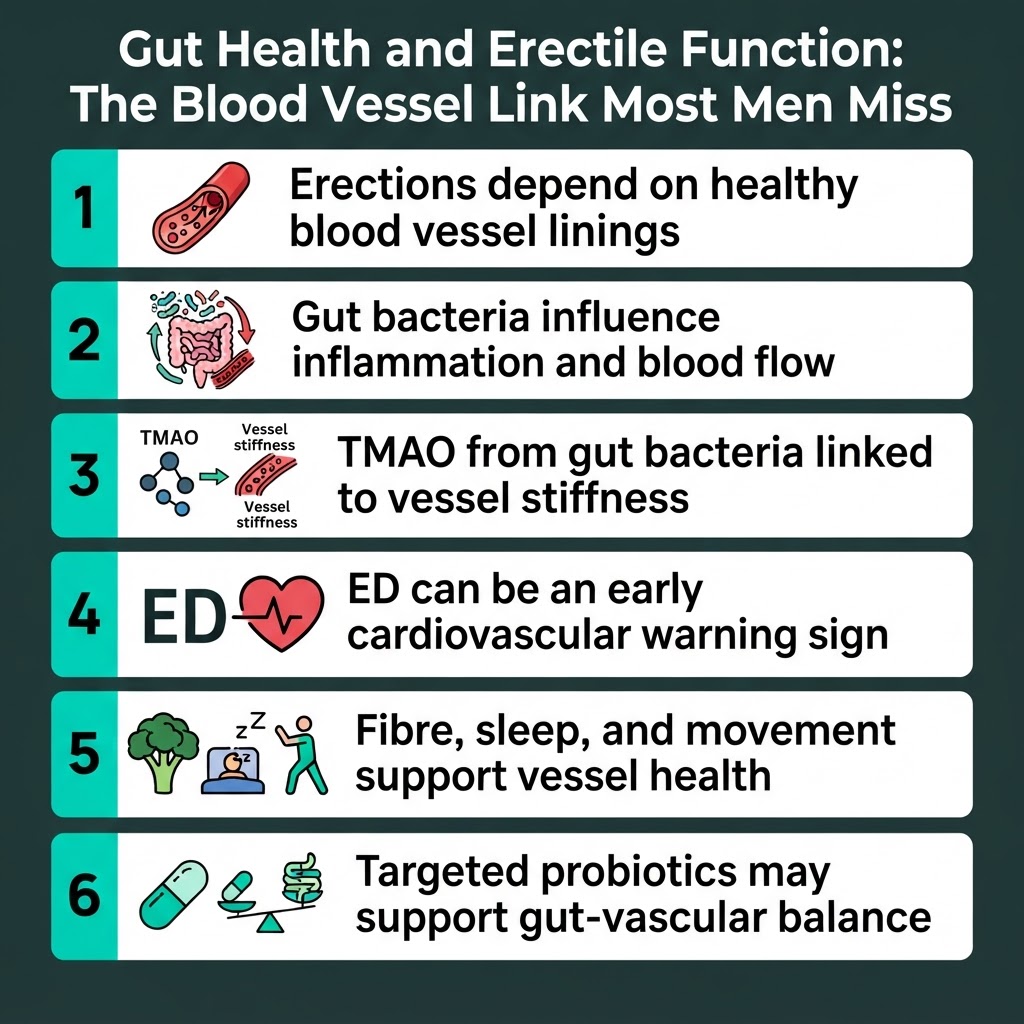
TMAO: The Gut-Made Compound Cardiologists Are Watching
One of the clearest molecular links between gut bacteria and blood vessel health is a compound called TMAO (trimethylamine N-oxide). Certain gut bacteria convert nutrients from red meat, eggs, and some dairy into a precursor that your liver then turns into TMAO. Elevated TMAO levels are associated with stiffer arteries and higher cardiovascular risk.
Elevated levels of the gut-microbial metabolite TMAO were independently associated with an increased risk of major adverse cardiovascular events.
— Tang WH et al., New England Journal of Medicine, 2013
Because the blood vessels serving the penis are smaller and more sensitive to resistance than larger arteries, many researchers believe they show strain from compounds like TMAO earlier than the heart does. This supports the clinical pattern we already see: erectile changes as an early signal, not a late one. You can read more about the Mayo Clinic's overview of erectile dysfunction as a vascular marker at Mayo Clinic.
The Gut-Hormone Side of the Story
While this article focuses on blood flow, it's worth remembering that gut bacteria also influence testosterone production through their effect on inflammation and nutrient absorption, which indirectly shapes desire and performance. We mapped that hormonal pathway separately in The Gut-Testosterone Loop: How Daily Digestion Habits Quietly Shape Your Hormones. Vascular health and hormonal health aren't competing explanations — they typically run in parallel and reinforce one another.
What the Research Actually Shows So Far
It's important to be precise about what's established versus emerging. The erectile dysfunction–cardiovascular link is well documented in large studies going back decades. The gut microbiome's specific contribution to that vascular strain is a newer, fast-growing area of research, with strong mechanistic evidence (LPS, TMAO, short-chain fatty acids) but fewer long-term human trials specifically measuring erectile outcomes.
What we can say confidently is that supporting a balanced gut is a reasonable, low-risk strategy that overlaps heavily with standard cardiovascular advice: less processed food, more fibre, better sleep, and less chronic inflammation. The World Health Organization's general guidance on cardiovascular risk reduction, available at who.int, lines up closely with what gut-health researchers are now recommending for vascular support.
Practical Steps That Support Both Gut and Blood Vessel Health
None of these steps are a quick fix, and none replace a conversation with your doctor if erectile changes are sudden, severe, or paired with chest pain or shortness of breath. But as a foundation, the following habits are consistently linked to both a healthier gut lining and better endothelial function.
- Prioritise fibre-rich plants daily to feed beneficial bacteria and reduce LPS leakage
- Limit ultra-processed food, which is associated with higher gut permeability
- Walk or move daily — physical activity improves both gut diversity and vessel flexibility
- Protect sleep, since poor sleep raises inflammatory markers within days
- Consider a targeted probiotic formulated for men's gut and hormonal pathways
On that last point, strain selection matters. Not every probiotic on a shelf is studied for gut-lining support or inflammation reduction, which is why we broke down exactly what's inside a men's-specific formula in Inside the Capsule: A Doctor's Breakdown of His-Biotics Ingredients and Strains. If digestive discomfort is also part of your picture, our buying guide for men with bloating walks through how to choose sensibly.
When It's Not Just the Gut
Gut health is one meaningful piece of a larger puzzle, not the whole picture. Stress, relationship context, certain medications, sleep apnea, and genuine hormonal shifts can all play a role, and ruling these out with a physician remains important. The goal of understanding the gut-vascular link isn't to replace medical care — it's to add one more actionable, evidence-aligned lever you can pull while that bigger picture gets sorted out.
Your Simplest First Step
If you take away one thing from this article, let it be this: supporting your gut lining is also supporting the blood vessels responsible for performance, and that starts with consistent daily habits rather than a single dramatic change. A practical first move is adding a men's-specific probiotic formulated with strains and nutrients studied for gut and performance support, such as the Men's Performance Stack, alongside the fibre, movement, and sleep habits outlined above. You can also browse the full range at the His-Biotics store to find the formula that fits your stage of life.
If you'd like practical, doctor-reviewed updates like this sent straight to your inbox, consider subscribing to the His-Biotics newsletter below.