
If you've searched this question, you've probably seen bold claims attached to probiotic bottles promising a "natural testosterone boost." As a physician, I understand why this is appealing — testosterone affects energy, mood, muscle, and libido, and nobody wants to rely on injections if a daily capsule could help. But before you buy anything, you deserve a straight answer about what the science actually says, not what a sales page implies.
This article walks through the real research, separates mouse data from human data, and explains what a reasonable, evidence-based expectation looks like. I'll also show you how this connects to broader patterns I've covered in The Gut-Testosterone Loop, because the gut's influence on hormones is real — it's just more nuanced than a single magic strain.
Why This Question Keeps Coming Up
Gut health has become one of the biggest stories in medicine over the past decade. Researchers have linked the gut microbiome — the trillions of bacteria living in your digestive tract — to everything from mood to immune function. So it's a logical next step for people to ask whether these same bacteria influence testosterone, the primary male sex hormone responsible for muscle mass, libido, and metabolic function.
The honest answer is: probiotics may support the conditions in which healthy testosterone production is more likely, but they are not a direct testosterone-boosting drug. That distinction matters, and it's the difference between a marketing claim and a medical one.
What We Actually Know From Animal Studies
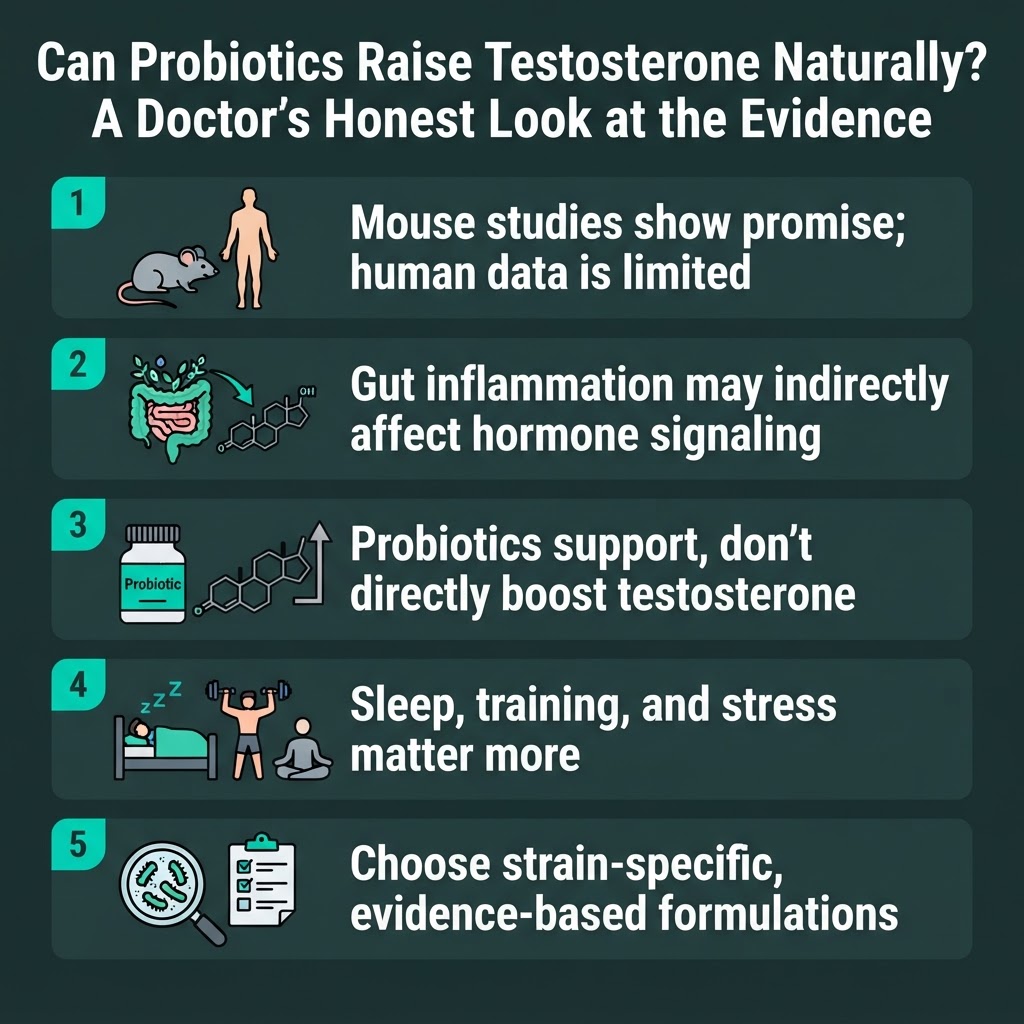
Much of the excitement around "probiotics and testosterone" traces back to rodent research. In these studies, aging mice given specific Lactobacillus strains showed higher testosterone levels and larger testicular size compared to mice that didn't receive the probiotic. The researchers proposed that healthier gut bacteria reduced low-grade inflammation, which in turn supported the testes' ability to produce hormones normally.
This is genuinely interesting science. But mice are not small humans, and their gut-hormone pathways, diets, and lifespans differ enormously from ours. Extrapolating a mouse result directly to a man taking a probiotic capsule is a leap most honest researchers are not willing to make yet.
"Animal models are valuable for generating hypotheses, but translation to human endocrine outcomes requires controlled human trials before any clinical claim can be made."
— Endocrine Society, Clinical Practice Guideline commentary
What the Human Evidence Actually Shows
Human trials specifically testing "probiotics for testosterone" are limited and small. Most existing human research on probiotics in men has focused on digestive symptoms, immune markers, or metabolic outcomes like blood sugar and weight — not testosterone as a primary endpoint. Where testosterone has been measured as a secondary marker, results have been mixed and modest at best.
This doesn't mean probiotics do nothing for men's hormonal health. It means the current evidence doesn't support marketing language that implies a guaranteed, measurable testosterone increase in men from taking a probiotic alone. You can review the broader research landscape yourself through the PubMed database on probiotics and testosterone.
Why Human Trials Are Harder to Run
Testosterone naturally fluctuates based on sleep, stress, age, and even time of day, which makes it a noisy outcome to measure in a short trial. Researchers would need large groups of men, tightly controlled diets, and months of follow-up to detect a reliable probiotic effect if one exists. Most probiotic research simply isn't funded at that scale.
This is a common problem across supplement research generally, not a criticism unique to probiotics. It's one reason doctors are cautious about turning preliminary animal data into consumer promises.
The Real Mechanism: Gut Bacteria, Inflammation, and Hormone Pathways
So if probiotics aren't a direct testosterone switch, why does the gut matter at all? The connection runs through inflammation and gut barrier function. When the lining of your intestine becomes more permeable — sometimes informally called "leaky gut" — bacterial fragments called lipopolysaccharides (LPS, a component of certain bacterial cell walls) can leak into the bloodstream and trigger low-grade, chronic inflammation.
Chronic inflammation is known to interfere with the signaling pathway between your brain and testes that regulates testosterone production. In theory, a healthier gut lining and a more balanced microbiome reduce this inflammatory burden, which may support the hormone production environment rather than directly manufacturing more hormone. This is a supportive, indirect mechanism — not a stimulant effect.
- Gut bacteria influence inflammation levels throughout the body.
- Chronic inflammation can disrupt the brain-testes signaling pathway.
- A more balanced gut environment may support — not force — healthy hormone production.
- Sleep, stress, and body composition remain larger drivers of testosterone than gut flora alone.
This is also why chronic stress matters so much in this conversation. If you're dealing with ongoing tension or poor sleep, it's worth reading Cortisol Belly in Men: How to Lose It When Stress Won't Let Go, because elevated cortisol competes with testosterone production through a related hormonal pathway.
What "Raising Testosterone Naturally" Really Means in Practice
When people search this exact phrase, they're usually hoping for a simple fix: take a capsule, feel more energetic, build muscle more easily. The realistic picture is less dramatic but more useful. Testosterone support is cumulative — it comes from multiple small, boring habits stacking together over weeks and months.
Gut-supportive probiotics are one piece of that stack, alongside sleep, resistance training, and body fat management. If you want a structured daily framework, I laid one out in Testosterone After 40: A Doctor's Practical Checklist, which covers the habits with the strongest evidence behind them.
"No single supplement replaces the fundamentals of sleep, training, and body composition when it comes to healthy testosterone levels in adult men."
— Mayo Clinic, Male Hypogonadism Overview, 2023
Where Probiotics Fit Realistically
Probiotics are best understood as supportive infrastructure, not a hormonal intervention. They may help with digestive regularity, nutrient absorption, and reducing gut-related inflammation — all of which create a better internal environment for hormone systems to function as they should. Men dealing with ongoing bloating or irregular digestion may find it useful to start with The Best Probiotic for Men With Bloating: A Doctor's Buying Guide before layering on hormone-specific expectations.
This framing isn't disappointing — it's actually empowering. It means you have real, evidence-backed levers to pull, rather than waiting on a single supplement to do all the work.
How to Choose a Probiotic If Hormonal Support Is Your Goal
Not all probiotics are formulated with the same intent, and strain selection matters more than the word "probiotic" on the label. If gut-related hormonal support is part of your goal, look for products built around strains studied for gut barrier integrity and inflammation modulation, combined with nutrients that support testosterone metabolism such as zinc and vitamin D.
- Check for named, specific strains rather than vague "proprietary blends."
- Look for formulations that pair probiotics with zinc, magnesium, or vitamin D.
- Favor products with published colony-forming unit (CFU) counts, not just marketing language.
- Avoid products that explicitly promise a testosterone number increase — that's a regulatory red flag, not a clinical fact.
This is the exact thinking behind formulations like the His-Biotics ORIGINAL Multivitamin Capsules, which combine targeted strains with foundational nutrients rather than relying on a single ingredient to carry unrealistic expectations. The goal is supporting your body's own systems, not replacing them.
Red Flags: Marketing Claims to Be Skeptical Of
Because testosterone is such an emotionally charged topic for men, it attracts aggressive marketing. Learning to spot overreach protects both your wallet and your expectations. If a product claims it will "double your testosterone in two weeks" or guarantees specific hormone numbers, that's a sign the marketing has outrun the science.
Compare that to language grounded in actual research: "supports gut health," "associated with reduced inflammatory markers," or "may help maintain a healthy hormonal environment." These phrases sound less exciting, but they're the ones a careful physician can actually stand behind. For a deeper look at how legitimate products should be evaluated, see Inside the Capsule: A Doctor's Breakdown of His-Biotics Ingredients and Strains.
A Note on Energy vs. Hormones
Many men who feel "low testosterone" are actually experiencing chronic fatigue driven by poor sleep, stress, and gut-related inflammation rather than a clinically low hormone level. If that sounds familiar, the patterns described in Why Men in Their 30s Feel Exhausted All the Time: A Doctor's Energy Audit may be more relevant to what you're actually experiencing day to day.
It's worth getting an actual blood test before assuming testosterone is the issue. The MedlinePlus testosterone test overview explains what a proper diagnostic workup looks like.
Putting It All Together: A Realistic Expectation
So, can probiotics raise testosterone naturally? The most accurate answer a doctor can give is: probiotics may support a gut environment associated with lower inflammation, which is one of several factors that influence healthy testosterone regulation — but they are not a proven, direct hormone-raising intervention in human trials. Treat them as one supportive pillar among several, not a standalone solution.
Men who combine gut-supportive habits with resistance training, adequate sleep, and stress management tend to see the most meaningful shifts in energy and body composition — testosterone-related outcomes included. This layered approach is also why many men pair a daily probiotic with structured training support, such as the Men's Performance Stack, rather than expecting any single capsule to do the whole job.
Your Next Step
If this article has given you a more realistic picture, the simplest first step isn't to chase a miracle supplement — it's to support your gut consistently for a few months and track real markers like energy, digestion, and training recovery. Start with the His-Biotics ORIGINAL Multivitamin Capsules, or browse the full range at the His-Biotics store to find the formulation that matches your goals.
If you'd like more evidence-based breakdowns like this one sent directly to you, consider subscribing to the His-Biotics newsletter below.