The Hidden Performance Killer: Exercise-Induced Gut Permeability
You train hard, eat clean, and sleep eight hours. Yet your recovery still feels sluggish, your inflammation markers stay elevated, and your energy never quite peaks when it should. Most athletes blame their programming or their macros. As a clinician who has worked extensively with male athletes and high-performers, I can tell you the problem is often sitting much deeper — literally — inside your gut wall. Exercise-induced gut permeability, colloquially called leaky gut in athletes, is one of the most underappreciated barriers to athletic performance and one of the most directly addressable through targeted microbiome support.
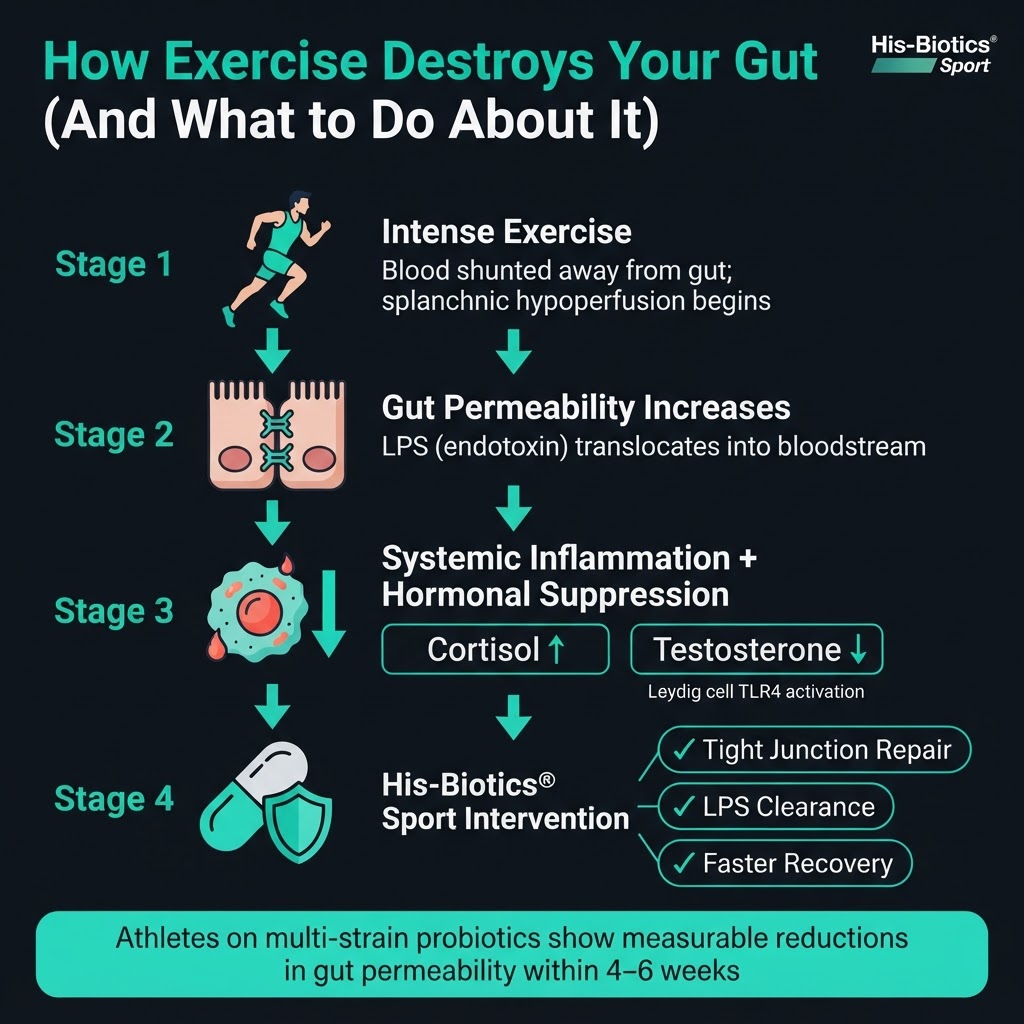
During intense or prolonged exercise, blood is shunted away from the gastrointestinal tract to fuel working muscles. This splanchnic hypoperfusion causes the tight junctions between intestinal epithelial cells to loosen, allowing bacterial endotoxins — particularly lipopolysaccharide (LPS) — to translocate into systemic circulation. The result is a low-grade but chronic inflammatory state that suppresses testosterone synthesis, impairs muscle protein synthesis, prolongs soreness, and taxes the immune system. Crucially, this is not a fringe theory; it is well-documented in the exercise physiology literature. A landmark paper published in the Journal of Applied Physiology (Costa et al., 2017) confirmed that endurance athletes running in heat experienced significant increases in intestinal permeability and circulating LPS, directly correlating with gastrointestinal symptoms and systemic inflammation markers.
What makes this particularly relevant for men is the interplay between gut barrier integrity and the hypothalamic-pituitary-gonadal axis. Elevated LPS activates Toll-like receptor 4 on Leydig cells in the testes, suppressing luteinising hormone sensitivity and blunting testosterone production — a mechanism I explore in depth through the Morning Man Protocol. In practical terms: a compromised gut is a compromised hormonal engine. And for athletes stacking creatine, BCAAs, and training volumes, a permeable gut can actively work against every investment you're making in your performance stack.
How Your Supplement Stack Interacts with Gut Integrity
Creatine monohydrate is among the most extensively researched ergogenic aids in existence. Its benefits for power output, ATP resynthesis, and high-intensity repeat performance are unequivocal. However, the conversation around creatine gut health is rarely had with the nuance it deserves. At higher doses — typically above 10g per day during loading phases — creatine can draw water into the intestinal lumen via osmotic pressure, increasing the likelihood of bloating, cramping, and loose stools. More importantly, this osmotic disruption can itself exacerbate tight junction dysfunction, compounding the permeability already induced by hard training.
Branched-chain amino acids present a similarly double-edged dynamic. BCAAs — leucine, isoleucine, and valine — are marketed aggressively to athletes for muscle protein synthesis signalling, and rightly so. Leucine in particular is a potent mTORC1 activator. But the gut microbiome is not a passive bystander in BCAA metabolism. Research published in Cell Metabolism (Neis et al., 2015) demonstrated that gut microbiota actively catabolise BCAAs, and dysbiosis — an imbalanced microbial community — can shift this metabolism toward the production of toxic by-products including propionate and ammonia in excess, contributing to systemic inflammation. The conclusion is uncomfortable but clear: if your microbiome is dysbiotic, BCAA probiotics co-supplementation is not optional — it is mechanistically logical.
This is precisely why I formulated His-Biotics® Sport as a purpose-built synbiotic stack for male athletes. The goal was not simply to add probiotics to a performance formula as a marketing tick-box, but to engineer a gut microbiome environment in which your existing supplement investments — creatine, BCAAs, protein — are actually absorbed, metabolised, and utilised efficiently. Good gut health for athletes is not a wellness trend; it is a prerequisite for ergogenic efficacy.
The Science of Sports Probiotics: What the Evidence Actually Shows
The field of sports probiotics has matured considerably in the last decade. Early scepticism — much of it justified given the low-quality, single-strain products flooding the market — is giving way to robust clinical data, particularly for multi-strain, clinically dosed formulas. Emerging gut microbiome research is revealing that specific bacterial strains exert discrete, mechanistically distinct effects on athletic performance, and that strain selection matters enormously.
A randomised controlled trial published in the Journal of the International Society of Sports Nutrition (Jäger et al., 2016) found that supplementation with Bacillus coagulans GBI-30, 6086 in conjunction with protein significantly improved muscle recovery, reduced delayed-onset muscle soreness (DOMS), and enhanced protein absorption compared to protein supplementation alone. This is not a marginal finding — it speaks directly to the mechanism by which gut bacteria produce proteolytic enzymes, modulate intestinal permeability, and influence the bioavailability of ingested substrates. For any male athlete consuming 160–200g of protein per day, the practical upside of optimised protein absorption is enormous.
Beyond recovery, there is compelling and growing evidence linking the gut microbiome to testosterone regulation. A search of PubMed research on probiotics and testosterone yields dozens of emerging studies examining how specific Lactobacillus and Bifidobacterium strains modulate androgen metabolism, oestrogen reactivation in the gut, and cortisol clearance — all of which have downstream effects on net anabolic drive. Exercise recovery probiotics are therefore not simply about softer stools and fewer cramps; they are about creating the systemic hormonal conditions under which training adaptations can actually occur at full magnitude.
The Role of Adaptogens: Where Gut Health Meets Stress Resilience
No discussion of athletic performance gut optimisation would be complete without addressing the cortisol axis. Intense training is a stressor — a necessary and productive one — but only if cortisol is appropriately modulated in the post-exercise window. Chronically elevated cortisol does four things that every serious athlete should fear: it catabolises muscle tissue, suppresses testosterone production, increases gut permeability further, and dysregulates the gut-brain axis, impairing motivation and recovery-linked sleep architecture.
KSM-66® Ashwagandha (Withania somnifera) is one of the most evidence-supported adaptogens for exercise-induced stress management. The clinical studies on KSM-66® Ashwagandha include a double-blind, randomised trial published in the Journal of the International Society of Sports Nutrition demonstrating significant improvements in muscle strength, recovery, and testosterone levels in resistance-trained men over an eight-week supplementation period. The mechanism is partly HPA-axis modulation — reduced cortisol — and partly direct androgenic activity at the nuclear receptor level. Critically, cortisol suppression also has a beneficial secondary effect on gut barrier integrity, as glucocorticoids at chronic low-level elevation are known to increase intestinal permeability directly.
Including KSM-66® alongside a targeted probiotic and prebiotic matrix in His-Biotics® Sport was a deliberate clinical decision. The adaptogen addresses the neuroendocrine driver of gut permeability — cortisol — while the probiotic strains address the gut barrier itself and the microbiome ecology that underpins both recovery and hormonal health. These are not isolated ingredients bolted together; they are synergistic mechanisms converging on the same outcome: a male body that recovers faster, performs harder, and maintains hormonal integrity under the biological stress of elite training.