When Training Breaks Down More Than Muscle
Every serious athlete knows the feeling: you've pushed hard in the gym, nailed your nutrition window, hit your creatine and BCAA targets — and yet recovery feels sluggish, inflammation lingers, and performance plateaus. What most men never consider is that the missing variable isn't in their training programme or supplement stack. It's in their gut. Specifically, it's in what happens to the intestinal lining when you train at high intensity, and why gut health for athletes is rapidly becoming one of the most clinically significant areas in performance medicine.
As a physician working at the intersection of male hormonal health and the gut microbiome, I've watched this field evolve from fringe theory to hard science. The evidence is now unambiguous: strenuous exercise transiently increases intestinal permeability — what's colloquially known as leaky gut — and this physiological response has measurable downstream consequences on recovery, inflammation, immune function, and even testosterone signalling. Understanding this mechanism doesn't require a medical degree, but acting on it does require more than a generic probiotic from the supermarket shelf.
The Science of Exercise-Induced Gut Permeability
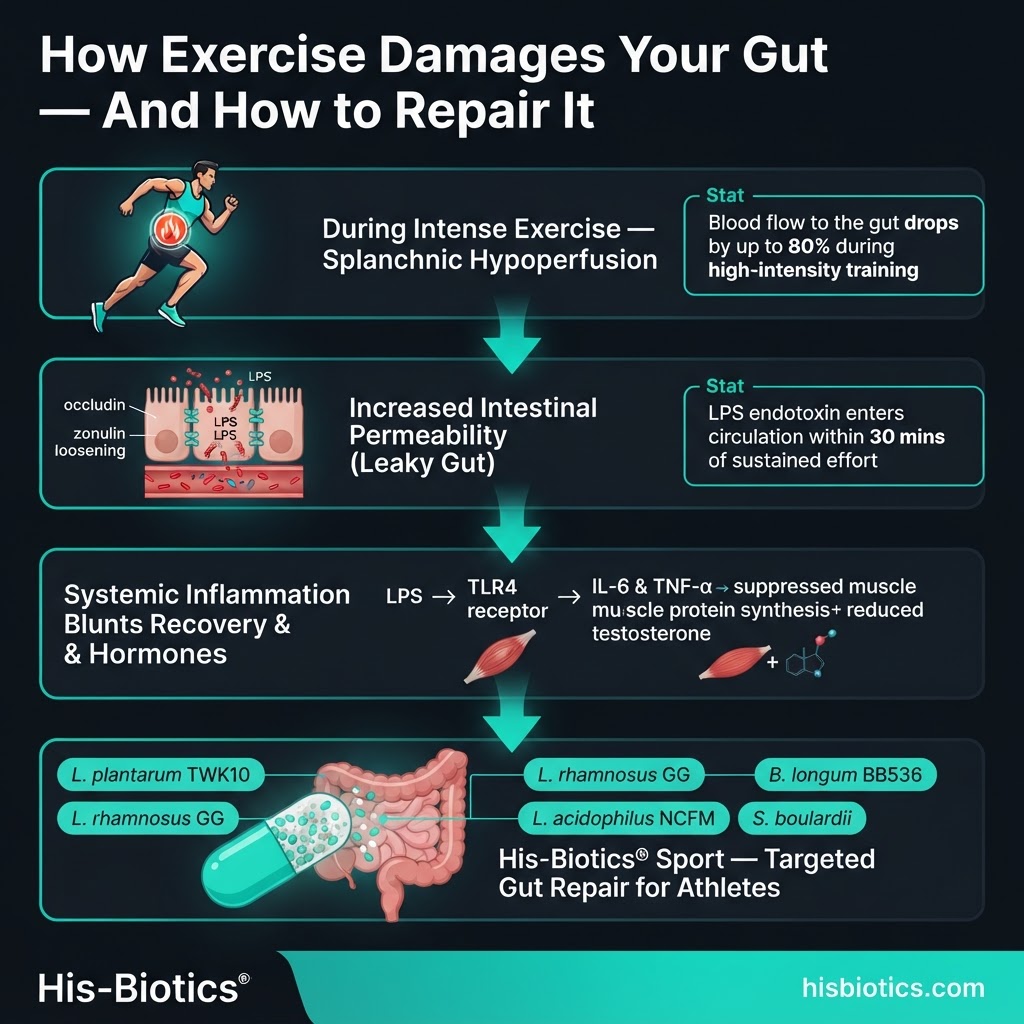
During intense or prolonged exercise, the body redirects blood flow away from the gastrointestinal tract toward the working muscles, heart, and lungs. This splanchnic hypoperfusion — a reduction of blood supply to the gut — causes oxidative stress to the epithelial cells lining the intestine. The tight junction proteins that normally hold these cells together, including occludin and zonulin, begin to loosen. The result is increased intestinal permeability: a state where bacterial endotoxins, particularly lipopolysaccharide (LPS), can translocate from the gut lumen into systemic circulation.
A landmark study published in the European Journal of Applied Physiology (2012) by Zuhl and colleagues demonstrated that endurance exercise at 60–80% VO2 max significantly elevated plasma LPS concentrations and intestinal permeability markers within 30 minutes of sustained effort. What's particularly relevant for strength athletes is that resistance training is not exempt — high-intensity weight training sessions produce comparable gut permeability responses, especially in a fasted or calorie-restricted state. This isn't a minor inconvenience; elevated circulating LPS triggers systemic inflammatory cascades via toll-like receptor 4 (TLR4) activation, elevating cytokines like IL-6 and TNF-α that directly impair muscle protein synthesis and blunt anabolic hormone responses.
The gut microbiome research emerging from institutions like the Monash University Sports Dietetics Unit has further shown that athletes with lower microbial diversity exhibit worse intestinal permeability profiles and longer inflammatory recovery windows. This means your microbiome isn't just passively affected by training — it actively determines how resilient your gut wall is under physiological stress. Building that resilience requires targeted, evidence-based intervention.
Creatine, BCAAs, and What They Actually Do to Your Gut
The two most universally used sports supplements — creatine monohydrate and branched-chain amino acids (BCAAs) — have well-established performance credentials. But their interaction with gut health in athletes is a nuanced story that most supplement brands would rather not explore in depth. Let's be clinically honest about both.
Creatine and gut health have a complicated relationship. Creatine monohydrate is osmotically active, meaning it draws water into the gut lumen during absorption. At standard loading doses (20g/day split into 4 doses), a significant proportion of men experience bloating, cramping, and loose stools — symptoms that reflect altered gut motility and osmotic shifts rather than true gut pathology. More importantly, a 2021 review in Nutrients highlighted that creatine at physiological concentrations may actually support gut epithelial cell energy metabolism, given that the creatine-phosphocreatine shuttle plays a role in maintaining ATP availability in rapidly dividing intestinal cells. The practical takeaway: lower-dose creatine (3–5g daily) without a loading phase is better tolerated and may be synergistic with a healthy microbiome environment rather than antagonistic to it.
BCAAs and probiotics present an equally interesting dynamic. Leucine, isoleucine, and valine are metabolised in part by gut bacteria before reaching systemic circulation. Certain Lactobacillus and Bifidobacterium strains are known to upregulate BCAA uptake transporters in the intestinal epithelium, potentially improving the bioavailability of these amino acids for muscle protein synthesis. A 2020 study in Frontiers in Nutrition found that Lactobacillus plantarum TWK10 supplementation in male athletes significantly increased muscle mass, grip strength, and exercise endurance compared to placebo — effects the researchers partly attributed to enhanced nutrient absorption at the gut level. This is precisely why the conversation around BCAA probiotics is gaining serious traction in sports science circles.
The Osmotic Load Problem
One often-overlooked issue for athletes using multiple supplements simultaneously is cumulative osmotic load on the gut. When creatine, BCAAs, electrolytes, and protein powders are consumed in rapid succession — particularly in the 30-minute post-workout window — the combined osmotic and fermentative burden on the small intestine can exacerbate exercise-induced permeability rather than support repair. This is where a robust microbial ecosystem acts as a buffer: Lactobacillus and Bifidobacterium species produce short-chain fatty acids (SCFAs) like butyrate that directly fuel colonocytes, reinforce tight junction integrity, and reduce TLR4-mediated inflammation. Without an adequate probiotic foundation, your post-workout nutrition strategy may be undermining the very recovery it's designed to support.
Sports Probiotics: What the Evidence Actually Supports
The phrase sports probiotics has become something of a marketing buzzword, which makes it harder for athletes to distinguish genuinely evidence-backed formulations from well-packaged placebo. As someone who has reviewed the PubMed research on probiotics extensively, I want to be precise about what strain specificity means in practice and why it matters more than CFU count.
Not all probiotics are created equal, and the sports-performance literature makes this unmistakably clear. The strains with the strongest evidence base for exercise recovery probiotics include Lactobacillus acidophilus NCFM, Bifidobacterium longum BB536, and Lactobacillus rhamnosus GG — each with distinct mechanisms relevant to athletic physiology. Lactobacillus rhamnosus GG, for instance, has been shown in multiple randomised controlled trials to reduce intestinal permeability markers following endurance exercise. Bifidobacterium longum BB536 has demonstrated immune-modulating effects that reduce the incidence of upper respiratory tract infections — a common and often underappreciated consequence of overtraining and immune suppression in competitive athletes.
Critically, the strain must survive transit through the acidic gastric environment to reach the distal small intestine and colon where it exerts its effects. This is where delivery technology becomes as important as strain selection. Velobiotics™ developed their proprietary microencapsulation technology specifically to address this challenge — encasing live bacterial cultures in a pH-sensitive lipid matrix that remains intact through the stomach and releases in the intestinal environment where colonisation actually matters. Standard uncoated probiotics lose between 60–90% of viable organisms during gastric transit; microencapsulation raises survival rates dramatically, meaning the CFU count on the label more accurately reflects what reaches the target tissue.
Key Strains for Male Athletic Performance
- Lactobacillus plantarum TWK10: Demonstrated improvements in muscle mass, VO2 max, and exercise endurance in male subjects in peer-reviewed trials.
- Lactobacillus rhamnosus GG: Reduces exercise-induced intestinal permeability and supports immune resilience during heavy training blocks.
- Bifidobacterium longum BB536: Modulates systemic inflammation post-exercise and reduces upper respiratory infection risk in athletes.
- Lactobacillus acidophilus NCFM: Enhances nutrient absorption, including amino acids and minerals critical to muscle function and hormonal synthesis.
- Saccharomyces boulardii: A probiotic yeast that stabilises gut barrier function and is particularly effective during travel, antibiotic use, or dietary disruption common in competitive sport.
The Gut-Hormone Axis: Why Athletic Performance Gut Health Affects Testosterone
The conversation about athletic performance gut health cannot be separated from male hormonal biology. The gut microbiome influences testosterone levels through multiple pathways — modulating bile acid metabolism, influencing hypothalamic-pituitary-gonadal (HPG) axis signalling, and regulating the enzyme activity of bacteria that participate in androgen metabolism. When gut permeability is elevated and systemic LPS is high, cortisol rises via adrenal activation of the inflammatory stress response. Chronically elevated cortisol is directly antagonistic to testosterone production at the level of the Leydig cell.
This is not theoretical. A 2019 study in the Journal of the International Society of Sports Nutrition found that elite male athletes with higher microbial diversity had significantly better cortisol-to-testosterone ratios during competition periods than those with lower diversity, independent of training load. For men who are both serious about performance and concerned about hormonal optimisation — a demographic that represents the core His-Biotics® community — this intersection of gut integrity, inflammation, and androgen signalling is where the real marginal gains exist. Supplementing with adaptogenic botanicals like KSM-66® Ashwagandha compounds these benefits; the clinical studies on KSM-66® Ashwagandha demonstrate significant reductions in serum cortisol alongside measurable increases in testosterone in stressed male subjects — a profile perfectly suited to the overtrained, under-recovered athlete.
For men following a structured approach to daily hormonal and gut health optimisation, the Morning Man Protocol outlines exactly how to layer gut-supportive, hormone-optimising interventions across the day to create compounding benefit rather than isolated supplementation. The sequence and timing of probiotic, adaptogen, and nutritional inputs matters more than most athletes appreciate.
His-Biotics® Sport: An Evidence-Led Formula for the Serious Athlete
Designing a probiotic formula specifically for male athletic performance required moving beyond the standard consumer-grade approach of throwing high CFU counts at undifferentiated Lactobacillus strains. His-Biotics® Sport was developed with a specific physiological brief: support gut barrier integrity under exercise-induced stress, enhance nutrient absorption to maximise the return on investment from creatine and BCAA protocols, reduce systemic inflammation during recovery windows, and support the cortisol-testosterone axis through microbiome-mediated pathways.
The formula combines clinically-dosed performance strains — including Lactobacillus plantarum TWK10 and Bifidobacterium longum BB536 — with prebiotic substrate to ensure colonisation, digestive enzymes to reduce the gut burden of high-protein athletic diets, and KSM-66® Ashwagandha as a validated adaptogen targeting the cortisol-testosterone relationship. Every capsule is protected by Velobiotics™ microencapsulation technology, ensuring that what's on the label reaches where it needs to go. This is not a probiotic that happens to be marketed to athletes — it is a formula built from the gut-physiology of athletic men upwards.
If you're serious about understanding how gut health is affecting your training, recovery, and hormonal output, I'd encourage you to explore our athlete formula in the context of your full supplement and training stack. The synergies between gut integrity, protein metabolism, and hormonal health are where the most underexploited performance gains exist for serious male athletes in 2024.
Key Takeaways
- Exercise-induced gut permeability is real and measurable: High-intensity training reduces blood flow to the gut, loosens tight junctions, and allows bacterial endotoxins (LPS) into circulation — triggering inflammation that directly impairs muscle recovery and hormonal signalling.
- Creatine and BCAAs interact with gut physiology: Lower-dose creatine (3–5g/day) is better tolerated and potentially gut-supportive; BCAA absorption is enhanced by specific Lactobacillus strains, making a probiotic foundation functionally synergistic with your supplement stack.
- Strain specificity is everything in sports probiotics: Lactobacillus plantarum TWK10, L. rhamnosus GG, and Bifidobacterium longum BB536 have the strongest evidence base for athletic performance and recovery — generic probiotic blends are not equivalent.
- Microencapsulation determines real-world efficacy: Without pH-resistant delivery technology, up to 90% of probiotic organisms die in the stomach before reaching the intestine. Velobiotics™ microencapsulation solves this fundamental problem.
- The gut-hormone axis is a performance variable: A compromised gut microbiome elevates cortisol and suppresses testosterone — an equation that undermines every other aspect of a male athlete's performance and recovery strategy.
- His-Biotics® Sport is built for this specific physiology: Combining performance strains, prebiotic substrate, digestive enzymes, and KSM-66® Ashwagandha in a microencapsulated delivery system, it addresses the full gut-to-hormone performance pathway.
Ready to close the gap between your training effort and your recovery results? Take the Total Gut Score quiz at hisbiotics.com to understand your current gut health baseline, or go directly to the His-Biotics® Sport product page to review the full formula and clinical rationale. Your gut is not a passive bystander in your performance — it is the foundation everything else is built on.
— Dr. Chomba Chuma, MD & Founder, His-Biotics® by Velobiotics™