Exercise, Leaky Gut & Recovery: What Every Athlete Must Know
Back to Blog
Athletic PerformanceHis-Biotics® Sport

Exercise, Leaky Gut & Recovery: What Every Athlete Must Know

Dr. Chomba Chuma, MD & Founder•21 September 2026•8 min read

Why Your Gut Takes a Beating Every Time You Train Hard

Most serious athletes obsess over split times, protein targets, and recovery windows — yet almost none of them think about what is happening inside their gut during and after intense exercise. The truth is, every high-intensity training session triggers a cascade of physiological stress that goes well beyond your muscles and cardiovascular system. Your intestinal lining — a single-cell-thick barrier that separates the outside world from your bloodstream — takes a significant hit every time you push hard. Understanding this is not optional for the modern performance-focused male. It is foundational to athletic performance gut health and long-term progress.

During intense exercise, blood is shunted away from your digestive tract toward working muscles, the heart, and the lungs. This process, known as exercise-induced splanchnic hypoperfusion, can reduce gut blood flow by up to 80% during maximal efforts. The resulting ischaemia — and the reperfusion that follows when you stop — generates oxidative stress, disrupts tight junction proteins, and increases intestinal permeability. In plain language: your gut becomes leaky. Endotoxins, particularly lipopolysaccharides (LPS) from gram-negative bacteria in the gut, can translocate into systemic circulation, triggering low-grade inflammation that directly impairs recovery, hormonal signalling, and even mood.

A landmark study published in the Alimentary Pharmacology & Therapeutics journal (2012) demonstrated measurable increases in intestinal permeability markers — including intestinal fatty acid-binding protein (I-FABP) — in endurance athletes following prolonged running. The researchers found that subjects who trained in the heat showed the most pronounced gut barrier disruption, underscoring the compounding effect of environmental stress. For men who train consistently year-round, these micro-insults accumulate. What begins as transient leaky gut can evolve into chronic low-grade endotoxaemia — a state now linked to suppressed testosterone production, blunted anabolic signalling, and impaired body composition. This is precisely why gut health athletes should treat the microbiome as a primary training variable, not an afterthought.

The Supplement Stack You're Using May Be Making Things Worse

Before we talk solutions, we need to address something most supplement brands will never tell you. Two of the most widely used performance supplements — creatine and branched-chain amino acids (BCAAs) — are consumed daily by millions of men who have no idea how these compounds interact with the gut microbiome. That is not an argument against these supplements; the evidence base for both is robust. But context matters enormously, especially for men who are already dealing with sub-optimal gut integrity from heavy training loads.

Regarding creatine gut health: creatine monohydrate at standard loading doses (20g/day in divided doses) is well-established to cause gastrointestinal disturbance in a meaningful subset of users — bloating, cramping, and loose stools being the most commonly reported complaints. A 2003 review in the Journal of Strength and Conditioning Research confirmed that GI symptoms are dose-dependent and are exacerbated when creatine is taken in large single doses or without adequate hydration. More relevant to our discussion, emerging evidence suggests that the gut microbiota actually plays a role in creatine metabolism itself, with certain bacterial populations influencing the conversion pathways that determine bioavailability. A disrupted microbiome may therefore reduce the actual performance return you get from your creatine investment.

The story with BCAA probiotics — or rather, the interplay between BCAAs and gut flora — is equally nuanced. BCAAs (leucine, isoleucine, valine) are metabolised not only by skeletal muscle but also by the gut epithelium and resident microbiota. Research published in Nature Metabolism (2019) identified that dysregulated BCAA catabolism, partly driven by microbiome imbalance, was associated with insulin resistance and impaired nitrogen utilisation. For athletes, this means a compromised gut ecosystem can blunt the very muscle protein synthesis response you are paying for every time you scoop BCAAs into your shaker. The fix is not to abandon your supplement stack — it is to build the microbial foundation that allows these compounds to work as intended.

Sports Probiotics: The Science Behind Strain Selection for Athletes

Not all probiotics are created equal, and the gap between a generic supermarket probiotic and a clinically informed sports probiotic formulation is enormous. When I began developing the His-Biotics® range, the central question I kept returning to was: which bacterial strains have demonstrated, in peer-reviewed research, the ability to specifically address the physiological challenges male athletes face — gut barrier integrity, inflammation, nutrient absorption, and hormonal health? The answer required going considerably deeper than CFU counts on a label.

The most compelling evidence currently exists for a handful of specific strains. Lactobacillus rhamnosus GG and Bifidobacterium longum have both demonstrated capacity to upregulate tight junction protein expression — literally reinforcing the physical structure of the gut barrier at the molecular level. Lactobacillus plantarum 299v has been shown in clinical trials to reduce systemic markers of inflammation, including C-reactive protein, following endurance exercise. Meanwhile, Bacillus coagulans strains have shown particular resilience to the hostile gut environment that exercise creates — surviving acid and bile exposure and reaching the colon where they exert their effects. For men interested in the broader hormonal dimension of the gut-performance axis, the growing body of PubMed research on probiotics and testosterone is increasingly compelling, linking microbiome composition to androgen metabolism pathways.

Strain selection, however, is only part of the equation. Delivery technology determines whether those strains survive long enough to do anything useful. This is why every capsule of His-Biotics® Sport uses Velobiotics™ microencapsulation technology — a proprietary process that encases probiotic strains in a protective lipid matrix, shielding them from stomach acid, heat, and moisture until they reach the intestinal environment where they are needed. In standard probiotic supplements, up to 99% of bacteria can be destroyed before they even reach the colon. Our microencapsulation process changes that calculus dramatically, ensuring meaningful viable counts arrive at their intended destination.
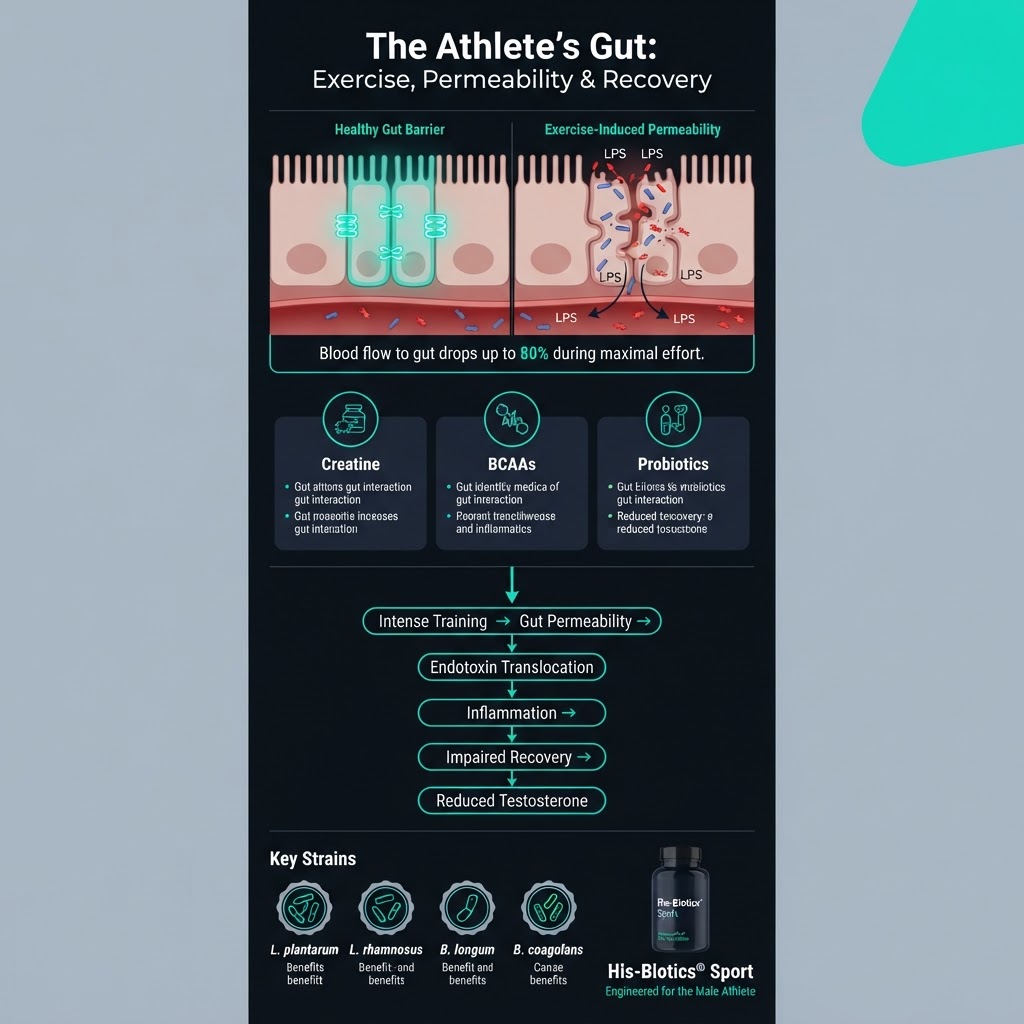

Article infographic

Infographic: Key concepts illustrated

Exercise Recovery Probiotics: What the Research Actually Shows

The clinical evidence for exercise recovery probiotics has matured considerably over the past decade, and the findings are compelling enough that I believe any serious male athlete not incorporating a targeted probiotic protocol is leaving meaningful performance on the table. Let me walk you through what the research tells us specifically about recovery — because this is where the practical implications are most immediate.

A randomised controlled trial published in the Journal of the International Society of Sports Nutrition (2016) followed competitive male athletes over a 12-week period, comparing a multi-strain probiotic protocol against placebo. The probiotic group demonstrated significantly reduced duration of upper respiratory tract infections — a key marker of immune resilience under training load — and reported lower perceived fatigue scores post-competition. Crucially, the probiotic group also showed reduced serum LPS levels, directly confirming attenuation of exercise-induced gut permeability and endotoxin translocation. These are not marginal findings. Fewer sick days and faster recovery between sessions are measurable competitive advantages.

Beyond immune function, the gut-muscle axis is increasingly recognised as a direct recovery pathway. Short-chain fatty acids (SCFAs) produced by fermentative bacteria in the colon — particularly butyrate — serve as fuel for colonocytes, regulate gut barrier integrity, and have demonstrated anti-inflammatory effects systemically. A well-populated, diverse gut microbiome produces more SCFAs, meaning the health of your gut flora has a direct biochemical relationship with how efficiently your muscles recover from training-induced damage. The broader implications of this axis are documented extensively in ongoing gut microbiome research published through Nature — and the trajectory of findings consistently points toward the gut as a central hub of systemic athletic adaptation.

His-Biotics® Sport: Built for the Male Athlete's Specific Physiology

His-Biotics® Sport was not designed as a generic probiotic with athletic branding applied. It was formulated from the ground up with the male performance physiology in mind, addressing the specific stressors — mechanical, thermal, hormonal, and nutritional — that men who train seriously encounter daily. The formula integrates clinically dosed probiotic strains alongside targeted co-factors designed to amplify the gut-performance connection, not just maintain it.

One of the elements I am most proud of in the His-Biotics® Sport formulation is the inclusion of KSM-66® Ashwagandha, the most clinically studied form of ashwagandha root extract available. For athletes, the relevance is multi-layered: KSM-66® has demonstrated in multiple randomised controlled trials the ability to reduce cortisol levels, improve VO₂ max, enhance muscular recovery, and support testosterone levels in men under physical stress. The clinical studies on KSM-66® Ashwagandha are among the most robust in sports nutrition, and pairing it with our targeted probiotic matrix creates a synergy between gut integrity, stress hormone regulation, and anabolic signalling that no other product in the UK market currently offers.

The formula is also designed to complement — not compete with — the supplements you are already using. Men taking creatine will find that a fortified gut barrier reduces the GI disturbance that plagues loading phases. Men using BCAAs will experience improved intestinal absorption of these amino acids when their gut epithelium is functioning optimally. And men following structured training protocols — such as those outlined in the Morning Man Protocol — will find that His-Biotics® Sport slots naturally into a daily stack designed around male physiological rhythms. This is integrative performance medicine, not wellness theatre.

Key Takeaways for the Performance-Focused Male

After years of clinical practice, research, and formulation work, my position is clear: the gut microbiome is not a peripheral health concern for athletes — it is a primary performance variable. Here is a summary of the most actionable points from everything we have covered:

  • Exercise-induced gut permeability is real and measurable. High-intensity and endurance training reliably increases intestinal permeability, allowing inflammatory endotoxins into circulation — suppressing recovery, hormones, and performance.
  • Your supplement stack is only as effective as your gut allows. Both creatine and BCAAs depend on healthy gut function for optimal absorption and metabolism. A disrupted microbiome reduces your return on investment from these compounds.
  • Strain specificity matters more than CFU counts. Choose probiotics with evidence-backed strains — L. plantarum, L. rhamnosus, B. longum, B. coagulans — rather than products that lead with impressive numbers and vague claims.
  • Delivery technology determines real-world efficacy. Velobiotics™ microencapsulation ensures probiotic strains survive the hostile journey to the colon, maximising the clinical benefit of every dose.
  • The gut-hormone axis is a legitimate training lever. Emerging research consistently links microbiome health to testosterone production, cortisol regulation, and anabolic signalling — making gut health central to male hormonal optimisation.
  • Recovery is where championships are won. SCFAs from a healthy microbiome, combined with reduced systemic inflammation, translate directly into faster recovery times and greater training capacity over the long term.

If you are serious about your performance and have not yet made the gut microbiome a structured part of your protocol, the evidence suggests you are operating with a significant and unnecessary handicap. To explore the full formulation and understand exactly what goes into our flagship athletic formula, explore our athlete formula or go directly to the His-Biotics® Sport product page. If you are unsure which formula in the His-Biotics® range is right for your specific goals and training profile, take our Total Gut Score (TGS) quiz — a clinically designed assessment that matches your physiology to the right protocol. Your gut is your engine. It is time to treat it like one.

— Dr. Chomba Chuma, MD & Founder, His-Biotics® by Velobiotics™

#sports probiotics#gut health athletes#exercise recovery#leaky gut#athletic performance#creatine gut health

Get the next article in your inbox

Men's gut and hormone science made simple. No spam, unsubscribe anytime.

👨‍⚕️
Dr. Chomba Chuma, MD & Founder

Dr. Chomba Chuma is the founder of His-Biotics® and a practising physician specialising in men's gut-microbiome health, hormonal optimisation, and performance medicine. With over 15 years of clinical experience, he bridges cutting-edge microbiome science with practical male health strategies.

H
His-Biotics Assistant
online · usually replies in seconds
Today
General wellness information, not medical advice. Chats may be stored to improve service.