
Leaky Gut & the Athlete: How Sports Probiotics Fix the Gap
Back to Blog
Athletic PerformanceHis-Biotics® Sport

Leaky Gut & the Athlete: How Sports Probiotics Fix the Gap

Dr. Chomba Chuma, MD & Founder•22 May 2026•11 min read

Why Your Hardest Training Days Are Also Your Gut's Worst Days

There is a cruel paradox at the heart of high-performance training: the very stimulus that drives adaptation — intense, prolonged exercise — simultaneously dismantles one of your body's most critical defence barriers. Your gut lining, a single-cell-thick wall separating the outside world from your bloodstream, takes a significant hit every time you push hard in the gym, on the track, or in competition. As a clinician who has spent years working at the intersection of the male gut-microbiome, hormonal health, and performance medicine, I have seen this pattern play out repeatedly in the men I treat — and the science is unequivocal. If you are training hard but ignoring your gut, you are leaving recovery, hormonal output, and long-term performance on the table.

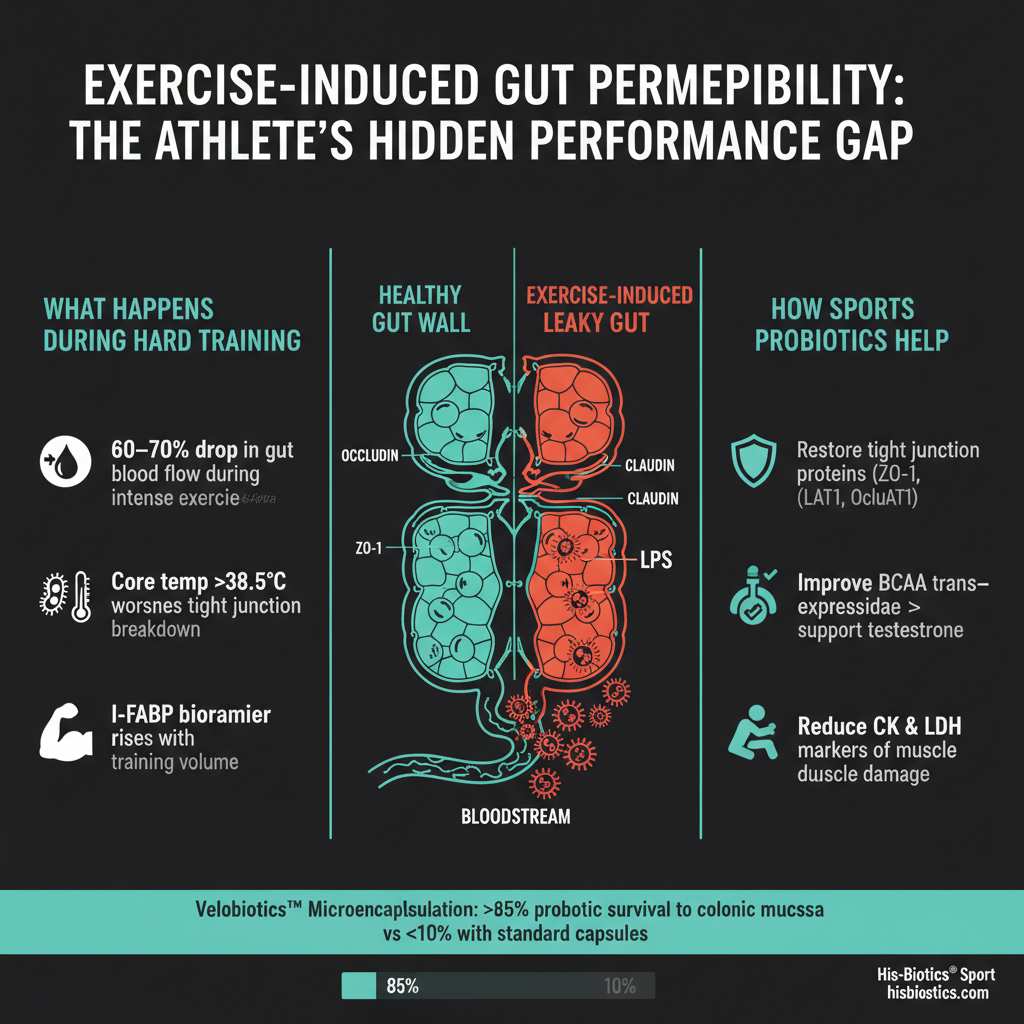
Exercise-induced gut permeability — colloquially known as leaky gut in athletes — is not a fringe concept or wellness buzzword. It is a well-characterised physiological phenomenon, documented extensively in peer-reviewed literature, that occurs when sustained physical effort redirects blood flow away from the gastrointestinal tract and towards working muscles. This splanchnic hypoperfusion (reduced blood flow to the gut) causes epithelial stress, loosens the tight junctions between intestinal cells, and allows bacterial endotoxins, undigested proteins, and inflammatory lipopolysaccharides (LPS) to cross into systemic circulation. The downstream consequences — systemic inflammation, impaired nutrient absorption, blunted anabolic signalling, and disrupted hormone production — are the hidden ceiling on your athletic performance that no training programme alone can remove.

The good news is that the emerging field of gut health for athletes is producing actionable, evidence-based strategies that go far beyond bland dietary advice. The strategic use of sports probiotics, alongside a critical re-evaluation of the supplements most athletes already take — creatine, BCAAs, and protein — can transform the gut from a performance liability into a genuine competitive advantage. This article will walk you through the science, the pitfalls, and the precise protocol we have built into His-Biotics® Sport to address every layer of this problem.

The Physiology of Exercise-Induced Gut Damage: What Actually Happens Inside

Blood Flow Redistribution and Tight Junction Breakdown

During moderate-to-high intensity exercise, cardiac output shifts dramatically. Research published in the American Journal of Physiology — Gastrointestinal and Liver Physiology (2017) demonstrated that splanchnic blood flow can fall by as much as 60–70% during intense endurance exercise, creating a state of localised ischaemia in the gut wall. When oxygen delivery to intestinal epithelial cells drops, the proteins that form tight junctions — occludin, claudin-1, and zonula occludens-1 (ZO-1) — are phosphorylated and structurally destabilised, creating paracellular gaps. These gaps allow LPS, the outer membrane component of gram-negative bacteria, to pass into the portal circulation and trigger systemic toll-like receptor 4 (TLR4) activation — a potent inflammatory cascade.

Crucially, endurance athletes are not the only ones affected. Studies examining resistance-trained men have shown measurable rises in intestinal fatty acid-binding protein (I-FABP) — a validated biomarker of intestinal cell damage — following heavy strength training sessions. The higher the volume and intensity, the greater the I-FABP elevation, and the more pronounced the inflammatory response. This is not minor physiological noise; this is structural damage occurring in the organ responsible for absorbing every gram of protein, every electrolyte, and every micronutrient you are consuming to support your training.

The Microbiome Disruption Cascade

Beyond the physical barrier, the gut microbiome itself is profoundly sensitive to exercise stress. The microbial ecosystem in a chronically over-trained athlete looks strikingly different from one in a well-recovered athlete at the same fitness level — lower populations of Lactobacillus and Bifidobacterium species, reduced short-chain fatty acid (SCFA) production, and a shift towards pro-inflammatory gram-negative dominance. SCFAs — particularly butyrate — are the primary fuel source for colonocytes (the cells lining your colon), and their decline creates a secondary wave of barrier dysfunction that compounds the acute exercise-induced damage. The gut microbiome research emerging from institutions like the Sonnenburg Lab at Stanford is making it increasingly clear that microbial diversity is not optional for athletic longevity — it is foundational.

Heat stress amplifies every one of these mechanisms. When core body temperature rises above 38.5°C — common during intense training, particularly in warm conditions — heat shock protein expression in intestinal epithelium is up-regulated, but tight junction integrity deteriorates further. Elite endurance athletes training in heat, or men who regularly use saunas as a recovery modality (a practice I actively support for other reasons), are particularly vulnerable to compounding gut permeability if their microbiome support strategy is inadequate.

Creatine, BCAAs, and Protein: What Your Gut Thinks of Your Stack

Creatine Gut Health: The Full Picture

Creatine monohydrate is, without question, the most evidence-supported ergogenic supplement in existence. Its effects on phosphocreatine resynthesis, power output, and muscle hypertrophy are not seriously disputed. What is less commonly discussed — including in many sports nutrition circles — is creatine's relationship with gut health. At the loading doses commonly recommended (20 g/day for 5–7 days), creatine draws water osmotically into the intestinal lumen, which is the primary driver of the GI distress — bloating, cramping, and loose stools — that a significant minority of users report. For men who already have compromised gut barrier function from training, this osmotic load on an already-stressed epithelium can meaningfully worsen permeability symptoms.

The practical solution here is not to abandon creatine — far from it — but to dose it more intelligently: 3–5 g daily at maintenance, taken with food, eliminates osmotic loading stress while delivering equivalent long-term muscle saturation. More importantly, pairing creatine with targeted probiotic strains appears to modulate the gut environment in ways that improve creatine's own uptake kinetics. Emerging data suggest that a healthier colonocyte population, supported by SCFA-producing probiotics, improves the expression of creatine transporters (SLC6A8) in intestinal cells, potentially enhancing bioavailability at lower doses. This is one of the mechanistic rationales underpinning our formulation philosophy at explore our athlete formula.

BCAAs and Probiotics: Absorption Is the Battleground

Branched-chain amino acids — leucine, isoleucine, and valine — occupy a central role in muscle protein synthesis signalling, particularly through leucine's activation of mTORC1. However, BCAA absorption is not passive; it depends entirely on the functional integrity of the intestinal epithelium and the carrier transport proteins (LAT1, B0AT1) expressed on the brush border. When tight junctions are compromised and the epithelium is inflamed, transporter protein expression falls, and BCAA bioavailability drops — meaning the leucine dose on the label of your supplement is not necessarily the leucine dose reaching your muscle ribosomes. This is a fundamental gap in how most athletes think about their supplementation stack.

The relationship between BCAA absorption and probiotics is an area of rapidly growing interest. A 2019 study published in Nutrients demonstrated that supplementation with Lactobacillus plantarum TWK10 in endurance athletes significantly improved muscle strength, mass, and exercise performance — effects the authors partly attributed to enhanced amino acid uptake secondary to improved gut mucosal integrity. The strain specificity here matters enormously; not all probiotics have the enzymatic machinery or mucosal adhesion properties to support amino acid transport in the way sports-specific strains do. This is precisely why strain selection in sports probiotics is not a marketing exercise — it is a clinical one, and it is why every strain in His-Biotics® Sport was selected on the basis of published sports-specific evidence.

Article infographic

Infographic: Key concepts illustrated

The Science of Sports Probiotics: Strains, Mechanisms, and Male-Specific Effects

What the Evidence Says About Probiotics for Athletic Recovery

The category of exercise recovery probiotics has matured considerably in the last decade. Early research was hampered by poor strain characterisation, inadequate dosing, and a failure to account for the baseline microbiome composition of subjects. More recent, well-controlled trials have produced compelling findings. A landmark randomised controlled trial published in the Journal of the International Society of Sports Nutrition (2016) found that Lactobacillus acidophilus and Bifidobacterium longum supplementation over eight weeks significantly reduced markers of exercise-induced muscle damage (creatine kinase and LDH) and shortened self-reported recovery time in resistance-trained men. The proposed mechanism: reduced LPS translocation across the gut wall, leading to lower systemic inflammatory signalling and a faster return of anabolic conditions post-training.

For men specifically, the hormonal dimension of gut microbiome health adds another critical layer. The gut microbiome plays a direct role in regulating circulating testosterone levels through several pathways: modulating the activity of the beta-glucuronidase enzyme (which influences oestrogen recirculation and oestrogen-to-testosterone ratios), influencing the hypothalamic-pituitary-gonadal (HPG) axis via gut-derived neurotransmitter production, and regulating systemic inflammation, which is itself a potent suppressor of Leydig cell testosterone output. You can review the growing body of PubMed research on probiotics and testosterone to appreciate how quickly this field is developing — it is no longer speculative to suggest that optimising your gut microbiome is a meaningful strategy for supporting healthy testosterone levels in training men.

Adaptogenic Synergy: The KSM-66® Ashwagandha Dimension

One of the design decisions in His-Biotics® Sport that I am most proud of is the inclusion of KSM-66® Ashwagandha alongside our probiotic matrix. This is not a marketing add-on — it is mechanistically deliberate. KSM-66® is a full-spectrum, root-only ashwagandha extract standardised to ≥5% withanolides, with a clinical trial record that is unusually robust for a botanical ingredient. The clinical studies on KSM-66® Ashwagandha include double-blind, randomised controlled trials demonstrating reductions in serum cortisol of up to 27.9%, meaningful improvements in VO2 max, and statistically significant increases in testosterone in resistance-trained men. Cortisol is the arch-enemy of both gut barrier integrity and testosterone production — it directly up-regulates tight junction permeability and suppresses HPG axis output. By addressing the cortisol burden of intense training at the same time as replenishing the microbiome, we are working on two of the most important levers simultaneously.

The cortisol–gut axis is also why I recommend the Morning Man Protocol to any athlete using our sport formulation — timing your probiotic and adaptogen intake to align with the natural cortisol awakening response (CAR) allows you to blunt the cortisol spike that would otherwise set a pro-inflammatory tone for the day's training. This is precision timing, not guesswork, and it reflects the kind of clinical thinking that distinguishes a performance protocol from a generic supplement routine.

Velobiotics™ Microencapsulation: Getting Live Cultures Where They Need to Go

No discussion of sports probiotics is complete without addressing the fundamental delivery problem: most probiotic bacteria do not survive the journey from your mouth to your colon. Gastric acid, with a pH of 1.5–3.5, is bactericidal to the vast majority of unprotected probiotic organisms. Bile salts in the small intestine deliver a second, often fatal insult. Industry studies suggest that conventional probiotic capsules can lose 90–99% of their declared colony-forming units (CFUs) before the organisms ever reach the colonic mucosa where they are needed. This is the dirty secret of much of the mass-market probiotic industry, and it is why CFU counts on labels are often meaningless without knowing the delivery technology behind them.

At Velobiotics™, we developed our microencapsulation technology specifically to solve this problem. Each probiotic strain in our formulas is individually encased in a multi-layer lipid and polysaccharide matrix that resists acid and bile degradation, maintaining organism viability through the stomach and upper GI tract, and releasing the live culture precisely at the colonic mucosa — the intended site of action. Independent stability testing demonstrates survival rates of over 85% to the target site, compared to single-digit survival rates for conventional capsule delivery. For an athlete demanding clinical-grade outcomes from every element of their stack, this is not a technical detail — it is the difference between a supplement that works and one that is expensive urine.

The microencapsulation matrix itself also has a modest prebiotic effect, providing fermentable substrate that supports the colonisation and proliferation of the delivered organisms. This self-reinforcing delivery and seeding dynamic is particularly important in the post-exercise window, when the gut is most permeable and most receptive to microbial recolonisation — a biological window of opportunity that conventional supplements consistently fail to exploit.

Key Takeaways

  • Exercise-induced gut permeability is real and measurable: Intense training reduces splanchnic blood flow by up to 60–70%, destabilising tight junctions and allowing inflammatory LPS to enter systemic circulation — directly suppressing recovery and hormonal output.
  • Your supplement stack interacts with your gut barrier: High-dose creatine loading creates osmotic stress on an already-compromised epithelium; BCAA absorption is directly dependent on mucosal integrity — both are negatively affected by leaky gut and both improve with targeted probiotic support.
  • Strain specificity is everything in sports probiotics: Not all probiotics perform equally in an exercise context. Published evidence for specific strains — including Lactobacillus plantarum TWK10 and Bifidobacterium longum — shows meaningful improvements in muscle damage markers, amino acid uptake, and recovery time.
  • The gut-testosterone connection is clinically significant for men: Beta-glucuronidase modulation, HPG axis signalling, and systemic inflammation — all influenced by the gut microbiome — are direct regulators of testosterone production in training men.
  • KSM-66® Ashwagandha and probiotics work synergistically: Cortisol drives gut permeability and suppresses testosterone simultaneously. Combining evidence-grade adaptogens with sport-specific probiotics addresses both vectors in a single protocol.
  • Delivery technology determines real-world efficacy: Velobiotics™ microencapsulation achieves over 85% organism survival to the colonic mucosa — the difference between a supplement that is clinically active and one that is scientifically inert by the time it reaches its target.

Ready to Close the Gap Between Training and Recovery?

If you train seriously, your gut deserves the same scientific rigour you apply to your programming, your nutrition, and your sleep. The evidence is clear: exercise-induced gut permeability is a real, quantifiable phenomenon that limits recovery, blunts hormonal output, and impairs the absorption of the very supplements you rely on to perform. The solution is not to train less — it is to build a gut resilient enough to match your ambition. His-Biotics® Sport was formulated precisely for this purpose: a clinically reasoned, strain-specific, microencapsulated probiotic and adaptogen complex designed around the physiology of hard-training men. If you are ready to audit your full performance stack — from morning cortisol management to post-training recovery — start with the Morning Man Protocol, or explore our athlete formula range to find the formulation that fits your training phase. Your gut is not a footnote in your performance story. It is the chapter everything else depends on.

— Dr. Chomba Chuma, MD & Founder, His-Biotics® by Velobiotics™

#sports probiotics#gut health athletes#exercise recovery probiotics#creatine gut health#BCAA probiotics#athletic performance gut#leaky gut athletes#His-Biotics Sport

Get the next article in your inbox

Men's gut and hormone science made simple. No spam, unsubscribe anytime.

👨‍⚕️
Dr. Chomba Chuma, MD & Founder

Dr. Chomba Chuma is the founder of His-Biotics® and a practising physician specialising in men's gut-microbiome health, hormonal optimisation, and performance medicine. With over 15 years of clinical experience, he bridges cutting-edge microbiome science with practical male health strategies.

H
His-Biotics Assistant
online · usually replies in seconds
Today
General wellness information, not medical advice. Chats may be stored to improve service.

