The Hidden Cost of Training Hard: What Exercise Does to Your Gut
Every serious athlete understands the concept of breaking down muscle tissue in order to rebuild it stronger. What very few coaches, nutritionists, or even sports medicine physicians discuss is what happens to the gut wall during that same training session. The intestinal epithelium — a single-cell-thick barrier responsible for nutrient absorption, immune regulation, and toxin exclusion — takes a significant physiological hit every time you push your body to its limits. Understanding this mechanism is not optional for men who are serious about athletic performance gut health; it is foundational.
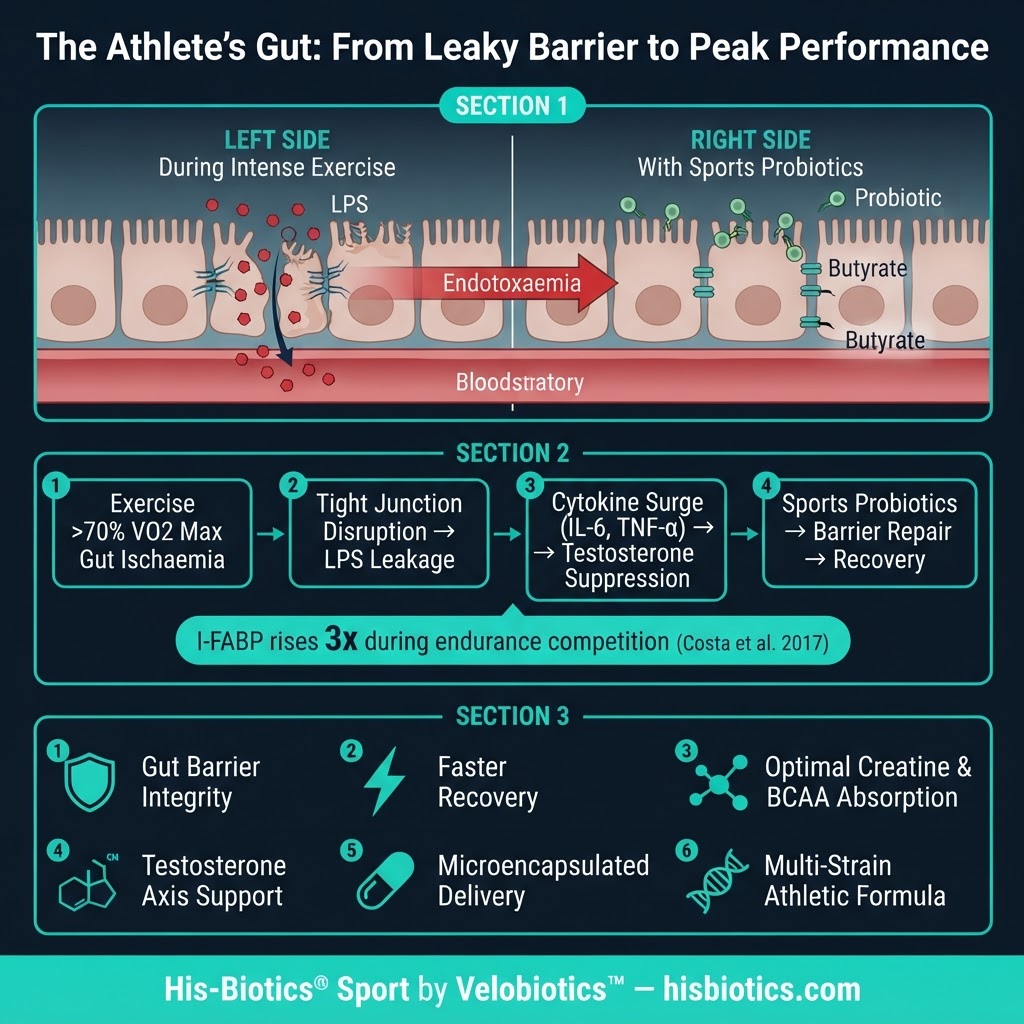
When exercise intensity rises above roughly 60–70% of VO₂ max, blood flow is redirected away from the splanchnic circulation — the network supplying your intestines — toward working skeletal muscle. This is a survival prioritisation, a feature not a bug, but it carries a steep price. Intestinal ischaemia, even transient, triggers oxidative stress within the enterocytes lining the gut wall, disrupts tight junction proteins such as occludin and claudin-3, and initiates a localised inflammatory cascade. The result is what researchers call exercise-induced intestinal permeability, or colloquially, the athlete's leaky gut.
This is not a fringe concept. A landmark 2017 study published in Alimentary Pharmacology & Therapeutics (Costa et al.) measured intestinal fatty acid binding protein (I-FABP), a validated biomarker of enterocyte damage, in endurance athletes during competition. Levels rose dramatically during exercise, confirming acute gut barrier disruption was occurring in otherwise healthy, well-trained individuals. The clinical implication is profound: if your gut lining is compromised during and after training, the very supplements and nutrients you consume for recovery — your creatine, your BCAAs, your protein shake — are being absorbed through a dysfunctional barrier, triggering immune activation rather than tissue repair. For more on how gut microbiome research is reframing our understanding of athletic adaptation, the evidence base is growing rapidly and compellingly.
Creatine, BCAAs, and Gut Health: The Supplement Stack Conversation Nobody Is Having
Creatine monohydrate remains the most evidence-supported ergogenic aid in sports science, with decades of data confirming its role in ATP resynthesis, strength output, and lean mass accrual. BCAAs — branched-chain amino acids, particularly leucine — are equally well-established for stimulating muscle protein synthesis. Most male athletes cycle through both without a second thought about where these compounds end up before they reach the muscle. The truth about creatine gut health is more nuanced than the supplement industry would have you believe.
In men with a compromised gut barrier — and as we've established, that includes virtually every man who trains with genuine intensity — creatine loading protocols can exacerbate gastrointestinal symptoms. Bloating, cramping, and loose stools are not merely inconvenient; they are signals of osmotic disturbance in an already inflamed intestinal environment. More concerning is the immunological dimension: lipopolysaccharide (LPS), a component of gram-negative bacterial cell walls, can translocate through a leaky gut into systemic circulation, triggering endotoxaemia. A 2019 study in the Journal of the International Society of Sports Nutrition (Snipe et al.) demonstrated that endurance exercise in hot conditions caused measurable increases in serum LPS alongside I-FABP, connecting gut barrier failure directly to systemic inflammation markers in athletes.
The case for BCAA probiotics co-administration — taking BCAAs alongside a targeted probiotic formula — is increasingly supported by mechanistic research. Specific Lactobacillus and Bifidobacterium strains produce short-chain fatty acids (SCFAs), particularly butyrate, which directly fuel colonocyte metabolism and upregulate tight junction protein expression. This means the gut wall can be structurally reinforced from the inside, creating a more resilient absorptive surface that allows your creatine and amino acid supplementation to work as intended rather than triggering an immune response. The synergy is not theoretical — it is biochemical.
What Happens When Gut Permeability Goes Unchecked in Athletes
Chronic subclinical endotoxaemia in athletes manifests in ways that are frequently misattributed to overtraining syndrome, poor sleep hygiene, or inadequate caloric intake. Elevated circulating LPS drives systemic production of pro-inflammatory cytokines including IL-6, TNF-α, and IL-1β. These same cytokines suppress hypothalamic-pituitary-gonadal (HPG) axis function, reduce Leydig cell sensitivity to luteinising hormone, and consequently blunt endogenous testosterone production. This is not a speculative chain of events — emerging PubMed research on probiotics is actively mapping the microbiome-testosterone axis with growing precision.
The practical outcomes for the hard-training male include suppressed recovery speed, impaired sleep quality, increased cortisol-to-testosterone ratio, and paradoxically reduced performance adaptation despite consistent training stimulus. Men chasing strength, power, or body composition goals hit a ceiling they can't explain, cycling through new training programmes and supplementation protocols while the root cause — a chronically inflamed, permeable gut — remains unaddressed. This is the clinical pattern I see repeatedly in practice, and it's the reason targeted gut health intervention belongs at the centre of every serious male performance stack.
The Science of Sports Probiotics: Which Strains Actually Matter for Athletes
Not all probiotics are created equal, and this distinction is particularly critical in the sports probiotics context. The vast majority of commercially available probiotic products are formulated for general digestive wellness — they contain species appropriate for managing irregularity or supporting immune function in sedentary populations. The physiological demands of an exercising gut are categorically different, requiring strains with demonstrated capacity to withstand the acidic, high-motility, oxidatively stressed environment of the athlete's intestinal tract.
The evidence base for specific strains in athletes has grown substantially over the past decade. Key findings worth knowing include:
- Lactobacillus acidophilus NCFM® has demonstrated measurable reductions in exercise-induced GI symptoms and improvements in intestinal barrier integrity markers in randomised controlled trials.
- Bifidobacterium longum BB536 has been shown to reduce upper respiratory tract infection incidence in athletes, a critical finding given the immune suppression that follows intense training.
- Lactobacillus rhamnosus GG produces significant quantities of butyrate precursors and has shown capacity to reduce intestinal permeability markers in clinical settings.
- Streptococcus thermophilus enhances protein digestion efficiency, directly relevant to the protein-heavy dietary patterns of strength and endurance athletes.
- Saccharomyces boulardii, a beneficial yeast rather than a bacterium, provides robust anti-inflammatory signalling in the gut mucosa and is particularly resistant to antibiotic disruption.
The challenge with probiotic supplementation has always been delivery. Even strains with excellent clinical evidence fail to deliver meaningful benefit if they are destroyed by stomach acid before reaching the small intestine and colon. This is where Velobiotics™ microencapsulation technology represents a genuine clinical advance. Each bacterial colony within His-Biotics® Sport is encapsulated within a protective lipid matrix that resists gastric acid, bile salt disruption, and thermal degradation, ensuring viable delivery to the distal intestinal tract where colonisation and barrier-support functions actually occur. The difference in viable cell delivery between encapsulated and non-encapsulated products is not marginal — it can be measured in orders of magnitude.