
Leaky Gut in Athletes: Why Your Gut Holds the Key to Peak Performance
Back to Blog
Athletic PerformanceHis-Biotics® Sport

Leaky Gut in Athletes: Why Your Gut Holds the Key to Peak Performance

Dr. Chomba Chuma, MD & Founder•10 June 2026•10 min read

The Hidden Cost of Hard Training: What Happens to Your Gut When You Push Hard

Every serious athlete knows the feeling — the soreness, the fatigue, the sense that your body is waging a quiet war against itself after a brutal session. What most men don't realise is that one of the primary battlegrounds isn't in your quads or your lungs. It's in your gut. Exercise-induced gut permeability — commonly called "leaky gut" in athletic circles — is one of the most underappreciated mechanisms limiting recovery, hormonal output, and ultimately, performance. As a clinician working at the intersection of male physiology and microbiome science, I've watched this single factor silently sabotage men who do everything else right.

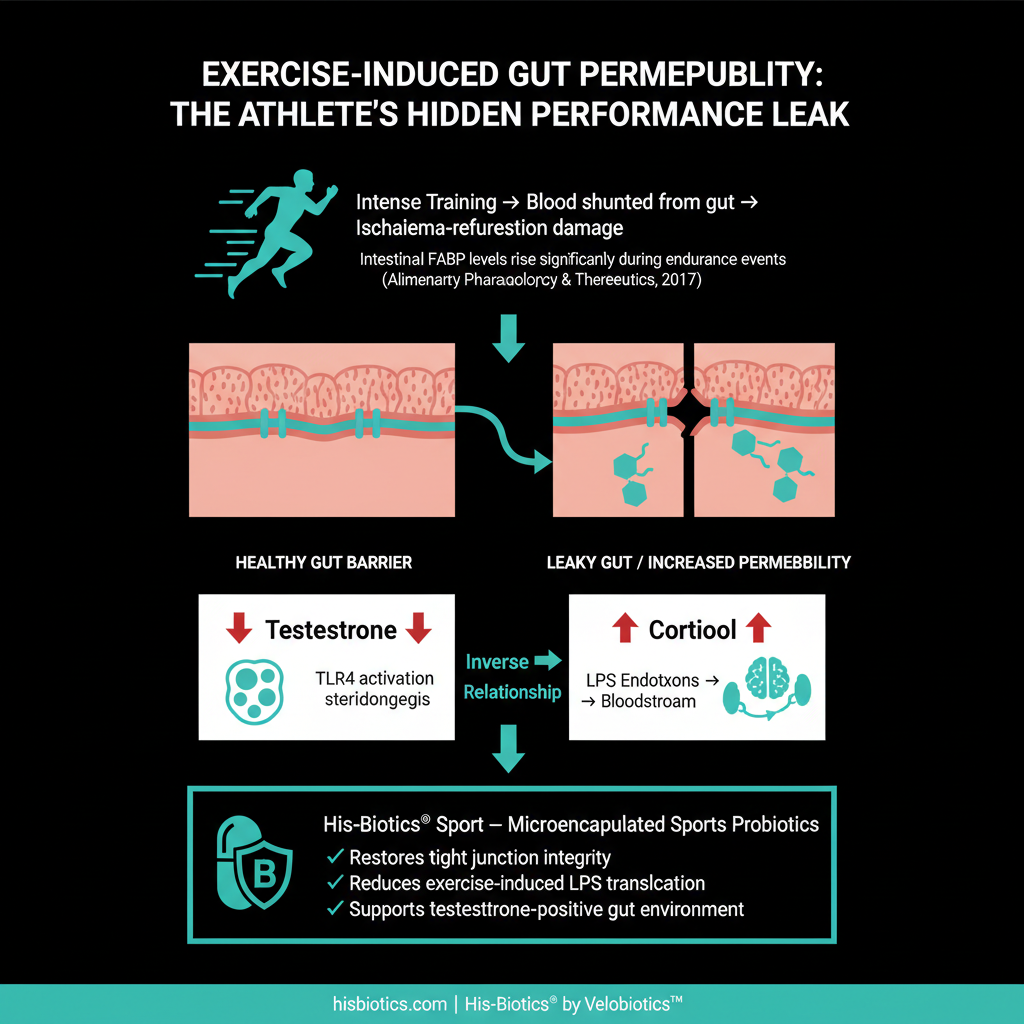
During intense or prolonged physical exertion, blood is shunted away from the gastrointestinal tract and redirected to working muscles. This ischaemia-reperfusion cycle — where blood flow drops and then rushes back — generates oxidative stress that physically disrupts the tight junction proteins holding your intestinal epithelial cells together. A 2017 study published in Alimentary Pharmacology & Therapeutics demonstrated that endurance athletes exhibit significantly elevated intestinal fatty acid-binding protein (I-FABP) — a biomarker of gut wall damage — during and after prolonged exercise, with levels inversely correlating with race performance. In plain terms: the more your gut leaks, the worse you perform.

Once that gut barrier is compromised, bacterial endotoxins — specifically lipopolysaccharides (LPS) from gram-negative bacteria — translocate into systemic circulation. This triggers a low-grade but persistent inflammatory response that competes directly with your anabolic recovery signals. Your body can't effectively rebuild muscle and suppress inflammation at the same time. The result is blunted muscle protein synthesis, elevated cortisol, disrupted sleep, and in many cases, suppressed testosterone — the exact hormonal environment that prevents you from getting stronger, leaner, or faster. This isn't theory; this is why so many hard-training men plateau despite doing "everything right" in the gym and kitchen.

Creatine, BCAAs, and Your Gut — The Supplement Interaction Nobody Talks About

Creatine monohydrate remains one of the most validated ergogenic aids in sports science, and branched-chain amino acids (BCAAs) are standard kit for most serious lifters. But here's what the marketing never tells you: the efficacy of both supplements is intimately tied to the health of your gut microbiome. Creatine gut health is a real and frequently overlooked concern — high-dose creatine loading protocols can cause osmotic stress in the small intestine, drawing water into the gut lumen and triggering bloating, cramping, and loose stools in a meaningful proportion of users. This isn't just inconvenient; it signals that absorption is compromised before creatine even reaches muscle tissue.

BCAA metabolism is even more microbiome-dependent than most people realise. Leucine, isoleucine, and valine aren't simply absorbed passively — their transport, utilisation, and conversion to mTOR-activating metabolites are modulated by gut bacterial populations. Specific Lactobacillus and Bifidobacterium strains have been shown to produce enzymes that enhance amino acid bioavailability and reduce the ammonia burden generated by protein catabolism during intense training. A compromised gut lining doesn't just lose amino acids — it loses the microbial machinery needed to process them effectively. BCAA probiotics, in this context, isn't a marketing phrase; it's a genuine physiological principle grounded in gut-immune crosstalk.

What this means practically is that stacking creatine and BCAAs without addressing gut integrity is like pouring premium fuel into a cracked engine. You're investing in quality inputs while ignoring the system responsible for delivering them. The research on gut microbiome research consistently shows that a resilient, diverse microbiome is the upstream determinant of how well any nutritional intervention — dietary or supplemental — actually works. For male athletes specifically, this connection extends all the way to hormonal regulation, making gut health not just a recovery issue but a performance and testosterone issue.

Sports Probiotics and the Science of Athletic Recovery

The concept of sports probiotics has matured significantly in the last decade. We're no longer talking about generic Lactobacillus acidophilus capsules designed for digestive comfort. We're talking about strain-specific, evidence-graded formulations targeted at the unique physiological demands of training athletes — men whose guts are under daily assault from exertion, caloric restriction, heat, and the chronic stress of competition. The growing body of PubMed research on probiotics now includes trials specifically examining how probiotic supplementation affects athletic endurance, recovery markers, and even hormonal profiles.

A landmark 2019 randomised controlled trial published in the Journal of the International Society of Sports Nutrition found that male athletes supplementing with a multi-strain probiotic for eight weeks showed significantly reduced markers of exercise-induced muscle damage — including creatine kinase and lactate dehydrogenase — compared to placebo. Crucially, the probiotic group also demonstrated attenuated intestinal permeability after a standardised exhaustive exercise test, suggesting that the mechanism of improved recovery ran directly through gut barrier preservation. This is the biological rationale underpinning exercise recovery probiotics as a genuine performance tool, not a wellness trend.

Another study — a 2020 trial in Nutrients — examined Lactobacillus plantarum TWK10 supplementation in recreational athletes and found significant improvements in running endurance, grip strength, and fatigue resistance after six weeks. The researchers attributed these gains in part to enhanced energy metabolism and reduced systemic inflammation, both of which are downstream effects of improved gut integrity and microbiome composition. For gut health athletes looking to build a meaningful competitive edge, these findings represent actionable, peer-reviewed evidence — not anecdote. The gut is not peripheral to athletic performance. For men, it is central to it.

What Makes a Probiotic Formula Genuinely Sport-Ready?

Not all probiotics are created equal — and in the athletic context, formulation quality determines whether a product survives long enough to actually work. The two non-negotiables for any serious sports probiotic are strain specificity and survivability. Most probiotic capsules lose between 40–80% of their viable organisms before they even reach the large intestine, destroyed by stomach acid and bile salts. This is why Velobiotics™ microencapsulation technology is a genuine differentiator: it envelops live probiotic strains in a protective lipid matrix that shields them through the harsh gastric environment, delivering meaningfully higher CFU counts to the sites where they actually colonise and function.

Beyond delivery technology, the formula must include strains with demonstrated relevance to the specific stressors of athletic training — gut barrier support, anti-inflammatory signalling, cortisol modulation, and testosterone-pathway activity. Generic retail probiotics are formulated for general digestive health in a sedentary population. They are not optimised for a man running VO2max intervals three times a week or performing heavy compound lifts under caloric restriction. The difference in both strain selection and dose is significant, and it's the difference between a supplement that moves the needle and one that simply adds to your monthly spend without adding to your performance.

Article infographic

Infographic: Key concepts illustrated

The Gut-Hormone Axis: Why Leaky Gut Tanks Your Testosterone

The relationship between gut permeability and male hormonal health is one of the most compelling and clinically underappreciated dynamics in men's medicine. When LPS endotoxins breach the gut barrier and enter systemic circulation, they bind to toll-like receptor 4 (TLR4) on Leydig cells — the very cells in the testes responsible for producing testosterone. This TLR4 activation has been shown in both animal and human studies to directly suppress steroidogenesis, the biochemical process through which cholesterol is converted into testosterone. In other words, a leaky gut doesn't just impair your recovery — it biologically undermines the hormonal environment that makes you a man.

Cortisol compounds the problem. The same inflammatory cascade triggered by gut-derived endotoxins activates the HPA axis and drives up cortisol secretion. Cortisol and testosterone operate in inverse relationship — when one rises, the other falls. This is why overtrained athletes so frequently present with classic hypogonadal symptoms: low libido, poor motivation, increased body fat, disrupted sleep, and reduced strength gains despite continued training. These men aren't overtraining in the conventional sense — they're under-recovering, and the gut is the missing link in their recovery protocol. Addressing athletic performance gut health isn't optional for serious men; it's foundational.

For men who want to understand how gut health, circadian biology, and male hormone optimisation intersect as a complete daily system, I'd strongly recommend reading through our Morning Man Protocol — a structured framework I developed specifically for men who want to optimise testosterone, cortisol rhythm, and gut function across the entire day, not just around training windows. The protocol integrates probiotic timing, nutritional strategy, and adaptogenic support in a way that makes each component more powerful than any single element in isolation.

Adaptogens, Ashwagandha, and the Stress-Gut Connection

Chronic psychological and physiological stress is one of the primary drivers of gut permeability — a fact that creates a vicious cycle for competitive athletes who are under sustained training load. Elevated cortisol directly increases intestinal tight junction protein degradation, meaning that stress doesn't just suppress testosterone; it physically weakens the gut wall. This is precisely why adaptogenic compounds like KSM-66® Ashwagandha are clinically relevant in an athletic gut health context — not as a peripheral addition, but as a mechanistically integrated component of gut-barrier preservation. The clinical studies on KSM-66® Ashwagandha demonstrate significant reductions in cortisol, improvements in testosterone, and measurable gains in muscle recovery — all of which have upstream benefits for gut integrity in hard-training men.

When you combine a high-quality sports probiotic with cortisol-modulating adaptogens, you address gut permeability from two directions simultaneously: reinforcing the barrier itself through microbial colonisation and tight junction support, while reducing the hormonal signals that degrade it. This dual-mechanism approach is exactly the kind of clinically-informed stack that separates men who recover optimally from those who spin their wheels in a cycle of hard training, slow recovery, and suboptimal results. It is the philosophy embedded in every formulation decision we make at Velobiotics™.

His-Biotics® Sport: Built for the Athletic Male Gut

His-Biotics® Sport is the product I formulated specifically for men who train hard and expect their gut to keep pace with their ambition. It combines a curated panel of sport-validated probiotic strains — including Lactobacillus plantarum, Lactobacillus rhamnosus, and Bifidobacterium longum — at clinically relevant doses, delivered via Velobiotics™ microencapsulation technology to ensure genuine bioavailability at the intestinal level. Every strain was selected based on published evidence for gut barrier support, exercise-induced inflammation reduction, and male-specific hormonal relevance — not on cost or convenience.

The formula is designed to be taken consistently, not cyclically. Gut microbiome remodelling doesn't happen in a week — it's a process that unfolds over four to eight weeks of sustained colonisation and microbial community shift. Men who commit to the protocol report meaningful improvements in bloating and digestive comfort within the first two weeks, followed by progressive gains in recovery speed, sleep quality, and training consistency over the following month. These aren't placebo responses; they're the downstream consequences of a healthier gut producing less inflammatory noise, more short-chain fatty acids, and a more favourable hormonal milieu.

If you're currently using creatine and BCAAs but still struggling with GI discomfort, performance plateaus, or slow recovery between sessions, the missing variable almost certainly sits in your microbiome. If you want to understand the full scope of what we've built for male athletes at every level, I invite you to explore our athlete formula and see how each product in the His-Biotics® range fits into a coherent system of male gut and hormone optimisation — because peak athletic performance is built from the inside out.

Key Takeaways

  • Exercise-induced gut permeability is a real and measurable phenomenon — intense training compromises the intestinal barrier, allowing endotoxins into circulation and triggering systemic inflammation that directly competes with recovery and anabolism.
  • Creatine and BCAA efficacy depends on gut integrity — a damaged or dysbiotic gut impairs absorption, amino acid processing, and the microbial enzyme activity needed to convert supplements into performance gains.
  • Leaky gut suppresses testosterone — gut-derived LPS endotoxins bind to TLR4 receptors on Leydig cells and directly inhibit steroidogenesis, creating a physiological link between gut health and male hormone output.
  • Strain-specific sports probiotics with validated delivery technology outperform generic options — survivability through the GI tract is as important as the strains themselves; Velobiotics™ microencapsulation ensures live cultures reach their target sites.
  • Adaptogens like KSM-66® Ashwagandha synergise with probiotics — by reducing cortisol-driven tight junction degradation, they address gut permeability from the hormonal axis while probiotics address it from the microbial axis.
  • Consistency over four to eight weeks is non-negotiable — microbiome remodelling is a sustained process; the benefits of His-Biotics® Sport compound meaningfully over weeks, not days.

Ready to rebuild your gut from the inside out? Whether you're a competitive athlete or a man who trains seriously and demands faster recovery, smarter supplementation begins with your microbiome. Visit the His-Biotics® Sport product page to read the full formulation details, or take our Total Gut Score (TGS) quiz to identify exactly where your gut health is holding your performance back. Your next performance breakthrough may not be in the gym — it may be in your gut.

— Dr. Chomba Chuma, MD & Founder, His-Biotics® by Velobiotics™

#sports probiotics#gut health athletes#exercise recovery probiotics#creatine gut health#athletic performance gut#leaky gut athletes#BCAA probiotics#male gut microbiome

Get the next article in your inbox

Men's gut and hormone science made simple. No spam, unsubscribe anytime.

👨‍⚕️
Dr. Chomba Chuma, MD & Founder

Dr. Chomba Chuma is the founder of His-Biotics® and a practising physician specialising in men's gut-microbiome health, hormonal optimisation, and performance medicine. With over 15 years of clinical experience, he bridges cutting-edge microbiome science with practical male health strategies.

H
His-Biotics Assistant
online · usually replies in seconds
Today
General wellness information, not medical advice. Chats may be stored to improve service.

