Why Your Hardest Training Sessions Are Wrecking Your Gut
There is a paradox sitting at the heart of high-performance sport that most coaches, nutritionists, and even clinicians rarely discuss: the very training that builds elite physiology also systematically damages the gut. Exercise-induced gut permeability — what the popular press has branded "leaky gut" — is not a fringe wellness concept. It is a well-documented physiological phenomenon that occurs during intense or prolonged physical exertion, and its downstream consequences reach far beyond digestive discomfort. As a clinician who has worked with competitive athletes across endurance, strength, and team sports, I can tell you unequivocally that gut health athletes overlook is often the silent ceiling on their performance.
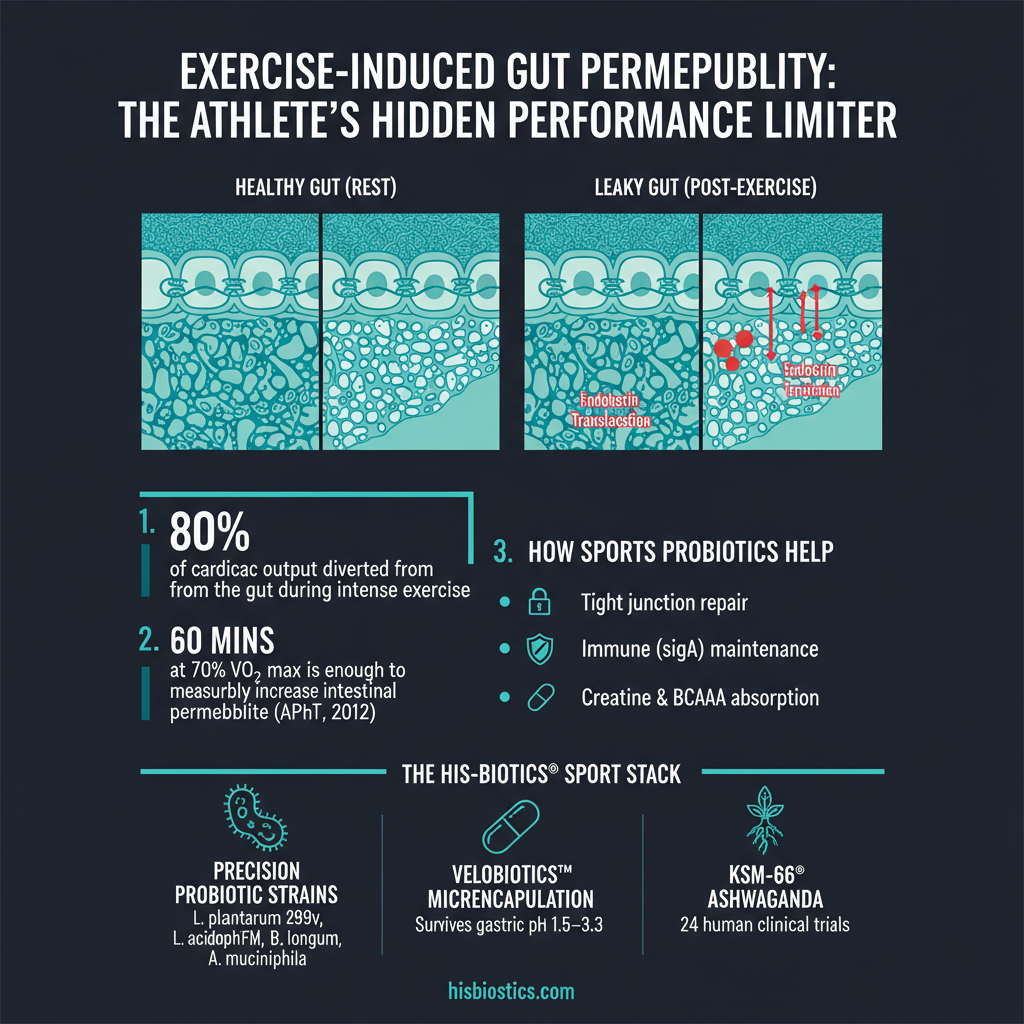
During strenuous exercise, the body redirects up to 80% of cardiac output away from the splanchnic circulation — the blood supply serving your gastrointestinal tract — and redirects it toward working muscles. This ischaemia-reperfusion cycle, repeated across weeks and months of heavy training, triggers a cascade of inflammatory events at the intestinal epithelium. The tight junction proteins that hold gut lining cells together — claudin-3, occludin, and zonulin-1 — begin to dissociate. The result is a measurably more permeable gut wall, confirmed by elevated plasma lipopolysaccharide (LPS) levels and increased urinary lactulose-to-mannitol ratios in exercising subjects. A landmark study published in Alimentary Pharmacology & Therapeutics (2012) demonstrated that a single bout of 60-minute cycling at 70% VO₂ max was sufficient to significantly increase markers of intestinal permeability in trained male cyclists — not beginners, but conditioned athletes.
The consequences of this are not limited to stomach cramps mid-race. Bacterial endotoxins crossing through a compromised epithelium stimulate systemic inflammation via toll-like receptor 4 (TLR-4) signalling, suppressing testosterone biosynthesis, impairing protein synthesis, and blunting the anabolic response to training. For any man trying to optimise body composition, hormonal health, and athletic performance gut function is not optional — it is foundational. This is the clinical reality that drove me to develop His-Biotics® with sport performance as a core pillar of our formulation strategy.
Creatine, BCAAs, and the Gut: What the Labels Don't Tell You
Walk into any sports nutrition retailer and you will find creatine monohydrate and branched-chain amino acids (BCAAs) stacked prominently on the shelves — and rightly so, given the substantial evidence base supporting both. Creatine supplementation is one of the most robustly validated ergogenic aids in the literature, improving high-intensity power output, lean mass accrual, and cognitive resilience. BCAAs — leucine, isoleucine, and valine — play a well-established role in stimulating muscle protein synthesis via the mTORC1 pathway and attenuating exercise-induced muscle protein breakdown. But what your supplement label almost certainly omits is how your gut microbiome mediates the effectiveness — and tolerability — of both.
Creatine gut health interactions are clinically significant. A subset of athletes report gastrointestinal distress — bloating, osmotic diarrhoea, and cramping — particularly during loading phases involving 20–25g per day. The mechanistic explanation is that high luminal concentrations of creatine draw water into the intestinal lumen via osmotic pressure, and in athletes with already-compromised tight junctions, this osmotic stress compounds existing epithelial disruption. Critically, the gut microbiome influences creatine metabolism directly: certain bacterial species, including Prevotella copri and members of the Bacteroidetes phylum, have been implicated in creatine catabolism and conversion to creatinine before absorption — meaning a dysbiotic gut can reduce the net bioavailability of every gram of creatine you ingest.
The BCAA-probiotic relationship is equally compelling. Leucine absorption occurs predominantly via the small intestinal brush border, but intestinal transit time, luminal pH, and microbial metabolite production all modulate the efficiency of that absorption. Research published in Frontiers in Nutrition (2021) demonstrated that Lactobacillus plantarum supplementation over eight weeks significantly improved BCAA plasma kinetics post-exercise and reduced markers of exercise-induced muscle damage compared to placebo in resistance-trained men. The mechanism appears partly mediated by butyrate — a short-chain fatty acid produced by commensal bacteria that directly reinforces tight junction integrity, reducing the inflammatory milieu that otherwise impairs amino acid transport. BCAA probiotics, then, is not a marketing mashup — it is a physiologically coherent strategy. The gut microbiome research emerging from consortia across Europe and North America consistently underscores how profoundly microbial composition shapes nutrient bioavailability in athletes.
The Athletic Microbiome: What Elite Performers Have That You Might Not
One of the most exciting frontiers in sports science over the past decade has been the characterisation of the "athletic microbiome" — the distinct microbial ecosystem that appears to correlate with, and in some cases causally contribute to, superior physical performance. Studies comparing the gut microbiomes of elite rugby players, marathon runners, and Olympic-level rowers against sedentary controls have consistently identified enrichment of specific taxa in high performers: Veillonella atypica, which converts exercise-derived lactate into propionate to fuel further muscle contraction; Akkermansia muciniphila, which fortifies the mucus layer and improves insulin sensitivity; and elevated ratios of butyrate-producing Firmicutes species. A study from the Sonnenburg Lab at Stanford, published in Cell (2021), demonstrated that a high-fermented-food diet rapidly increased microbiome diversity and reduced inflammatory cytokine markers — with implications that are deeply relevant for athletic recovery.
What this body of PubMed research on probiotics and related fields tells us is that the athletic microbiome is not simply a passive reflection of fitness — it is an active participant in it. The gut modulates VO₂ max via oxygen utilisation efficiency, regulates systemic inflammation that determines recovery kinetics, influences testosterone production through the gut-gonadal axis, and shapes psychological resilience via the gut-brain axis. For the male athlete specifically, these mechanisms converge on a critical insight: optimising the microbiome is not a complementary wellness strategy — it is a primary performance lever.
This is where sports probiotics move from theoretical interest to clinical priority. The question is not whether to include probiotics in an athlete's protocol — the evidence base is sufficiently mature to make that a straightforward recommendation. The question is which strains, at what dose, with what delivery technology, and in what combination. Generic probiotic supplements designed for general digestive wellness are simply not engineered to survive the physiological demands of an athlete's gut environment — the pH fluctuations, the accelerated transit times, the exercise-induced hyperthermia that degrades live bacterial cultures before they ever reach the colon.
How His-Biotics® Sport Is Formulated Differently
This is precisely the clinical gap that His-Biotics® Sport was designed to address. Every formulation decision in His-Biotics® Sport was made against the specific physiological demands of male athletic performance — not the general population, not women, not the sedentary individual managing IBS. The strain selection prioritises species with direct evidence in exercise contexts: Lactobacillus acidophilus NCFM for intestinal barrier reinforcement, Bifidobacterium longum for post-exercise immune modulation, Lactobacillus plantarum 299v for BCAA absorption enhancement and inflammatory attenuation, and Akkermansia muciniphila to fortify the mucus layer against ischaemia-reperfusion injury. The CFU load is calibrated for athletic GI environments — not the minimum effective dose for a sedentary gut.
Critically, His-Biotics® Sport incorporates Velobiotics™ proprietary microencapsulation technology, which encases each bacterial strain in a lipid bilayer matrix that is stable across gastric pH ranging from 1.5 to 3.5 — the acidic killing zone where the majority of off-the-shelf probiotics lose 90% or more of their viable colony count before reaching the small intestine. In an athlete who has just completed a hard session and consumed a large post-workout meal, gastric acid secretion is at its peak. Unprotected probiotic strains are essentially dead on arrival. Velobiotics™ microencapsulation ensures that the strains you see on the label are the strains that colonise your gut — a non-negotiable standard in performance medicine.
Beyond the microbial strains, His-Biotics® Sport is co-formulated with KSM-66® Ashwagandha — the most clinically validated form of Withania somnifera on the market, with over 24 gold-standard human clinical trials behind it. The clinical studies on KSM-66® Ashwagandha demonstrate meaningful improvements in VO₂ max, muscle recovery, cortisol modulation, and testosterone levels in resistance-trained men — outcomes that synergise powerfully with a restored gut-gonadal axis. The logic is straightforward: reduce gut-mediated systemic inflammation via precision probiotics, reduce cortisol-driven catabolism via adaptogenic support, and the net result is an athlete who recovers faster, performs harder, and hormonal homeostasis is maintained rather than chronically eroded by training load.
If you want to understand how His-Biotics® Sport fits into a comprehensive daily protocol — including morning cortisol management, sleep-phase recovery, and hormonal optimisation — the Morning Man Protocol outlines exactly how to layer these strategies for compounding benefit. It is the framework I recommend to every male athlete I work with clinically, from amateur CrossFitters to professional endurance competitors.
Exercise Recovery Probiotics: The Evidence for Faster, Smarter Recovery
The clinical case for exercise recovery probiotics has matured considerably in the past five years, moving from small pilot studies to properly powered randomised controlled trials. A double-blind RCT published in the Journal of the International Society of Sports Nutrition (2019) examined the effects of a multi-strain probiotic containing L. acidophilus and B. longum over 12 weeks in male recreational athletes performing structured resistance training. The probiotic group demonstrated significantly lower post-exercise creatine kinase levels — a biomarker of muscle membrane damage — at 24 and 48 hours post-training compared to placebo, alongside reduced self-reported muscle soreness scores and a statistically significant improvement in countermovement jump performance on recovery days. These are not marginal findings. A faster recovery trajectory means more high-quality training sessions per week — and that compounds into superior long-term adaptation.
The mechanisms underlying these recovery benefits are now fairly well delineated. Probiotics contribute to exercise recovery through at least four distinct pathways:
- Tight junction reinforcement: Butyrate-producing strains upregulate the expression of claudin-1 and occludin, physically rebuilding the epithelial barrier that intense exercise disrupts — reducing LPS translocation and the systemic inflammation it drives.
- Immune modulation: Exercise transiently suppresses secretory IgA (sIgA), the mucosal antibody that constitutes the gut's first immunological line of defence. Specific probiotic strains have demonstrated capacity to maintain sIgA levels under exercise stress, reducing upper respiratory tract infection risk — the number one cause of lost training days in endurance athletes.
- Cortisol attenuation: Via the gut-brain axis, certain Lactobacillus species influence HPA axis reactivity, blunting the magnitude of the cortisol spike post-exercise and accelerating the return to anabolic hormonal conditions.
- Nutrient bioavailability enhancement: A healthier epithelium with optimised microbial fermentation activity improves the absorption efficiency of protein, creatine, zinc, and magnesium — all critical substrates for tissue repair and hormonal function.
Understanding these pathways reframes how we think about the recovery window. The 30-minute post-workout period is rightly prioritised for protein and carbohydrate delivery — but it is also a window of peak gut permeability and heightened oxidative stress at the intestinal lining. Delivering the right microbial support consistently — not just acutely — builds a gut lining resilient enough to maximise nutrient extraction from every meal and every supplement, including your creatine and BCAAs. To explore our athlete formula and understand the full His-Biotics® range built around male performance physiology, the product pages detail the complete evidence base behind each formulation decision.
Key Takeaways
If you have absorbed the science above, the clinical priority is clear. Here is what every male athlete should carry forward from this article:
- Exercise-induced gut permeability is real and measurable: Intense training measurably increases intestinal permeability within a single session, elevating systemic LPS, suppressing testosterone biosynthesis, and blunting anabolic signalling — regardless of how trained you are.
- Your creatine and BCAAs are only as effective as your gut allows: Dysbiosis and increased gut permeability reduce the bioavailability of both creatine and BCAAs, meaning a compromised gut is costing you the return on your supplement investment every single day.
- Elite athletes have a distinct microbiome profile — and you can cultivate it: Specific bacterial taxa associated with superior performance, recovery, and body composition can be deliberately enriched through targeted probiotic supplementation and dietary strategy.
- Strain selection and delivery technology matter critically: Generic probiotics are not formulated for athletic GI environments. Microencapsulation technology — as deployed in Velobiotics™ formulas — is the difference between a product that works and one that simply passes through.
- Sports probiotics accelerate measurable recovery outcomes: RCT-level evidence supports reduced muscle damage biomarkers, lower soreness, maintained immune function, and enhanced nutrient absorption in athletes supplementing with multi-strain, evidence-based probiotics.
- The gut-hormone axis makes this a testosterone issue, not just a digestion issue: Gut permeability directly suppresses androgen production via LPS-TLR4 signalling and cortisol dysregulation — making gut optimisation one of the highest-leverage interventions for male hormonal health.
Ready to Train Harder and Recover Smarter?
If this article has made one thing clear, it is that gut health is not a peripheral concern for the serious male athlete — it is the infrastructure upon which every other performance intervention depends. Your creatine, your BCAAs, your protein timing, your sleep, your testosterone levels: all of it is filtered through the gut before it becomes results. When that filter is compromised by training stress, the entire system underperforms. Rebuilding and fortifying that foundation with precision, clinically-formulated sports probiotics is not optional for the athlete who wants to train at the edge — it is the edge.
His-Biotics® Sport was built specifically for this purpose — for men who take their training seriously enough to take their gut health seriously. Formulated with exercise-validated probiotic strains, protected by Velobiotics™ microencapsulation technology, and co-powered by KSM-66® Ashwagandha, it is the most comprehensively engineered gut-performance product in the His-Biotics® range. Visit the product page today, or take our Total Gut Score (TGS) quiz to receive a personalised recommendation based on your training load, dietary habits, and performance goals. Your gut is ready to become your competitive advantage — give it what it needs.
— Dr. Chomba Chuma, MD & Founder, His-Biotics® by Velobiotics™