Why Hard Training is Quietly Wrecking Your Gut
There is a paradox sitting at the centre of high-performance training that most coaches, nutritionists, and even clinicians overlook: the very exercise that builds your cardiovascular system, sculpts your physique, and raises your testosterone can simultaneously tear apart the lining of your intestinal wall. This is not hyperbole — it is measurable, reproducible physiology. As a clinician who has worked with competitive athletes and weekend warriors alike, I have seen this gut-performance disconnect be the hidden ceiling on recovery, body composition, and long-term hormonal health in more men than I can count. Understanding exercise-induced gut permeability — and what you can do about it — may be the most underrated lever in athletic performance medicine today.
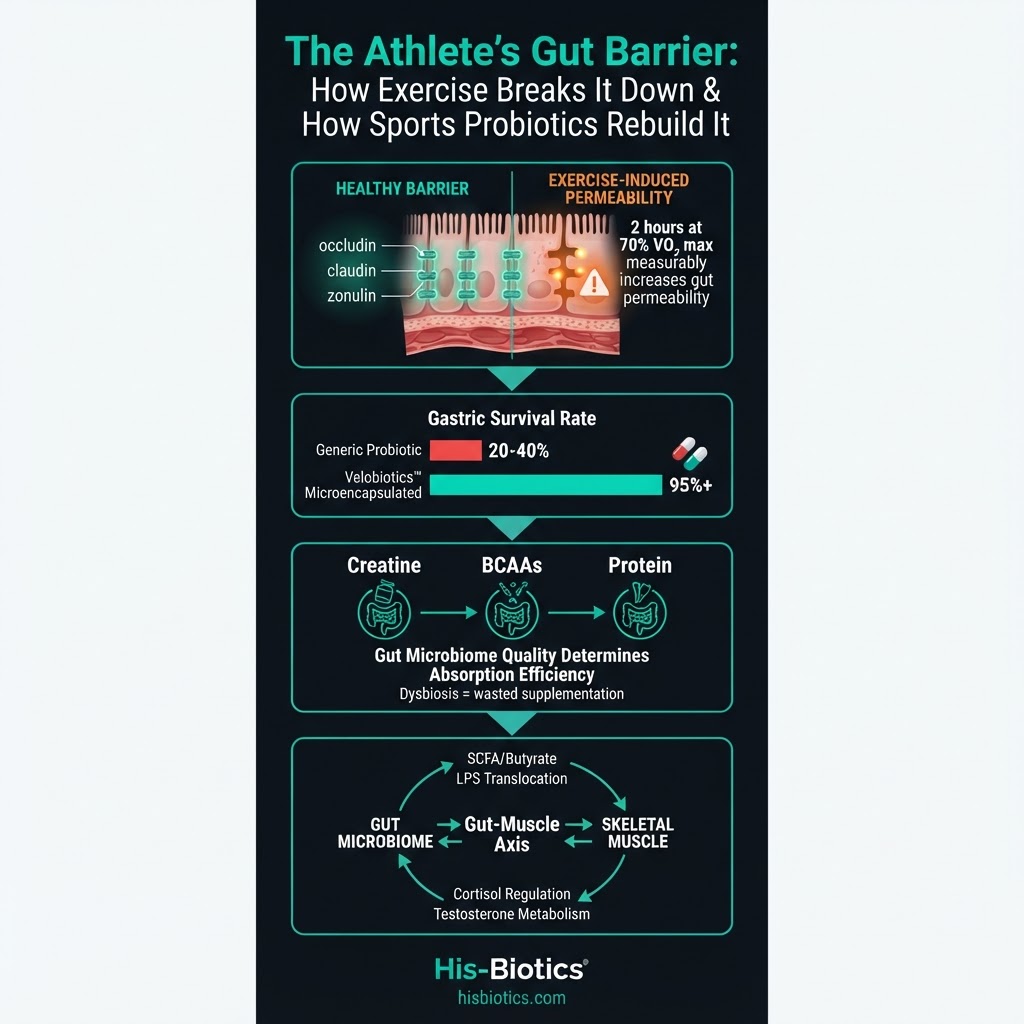
When you train hard, particularly during prolonged endurance efforts, high-intensity interval sessions, or heavy resistance blocks, your body redirects blood flow away from the digestive tract and toward the working muscles. This splanchnic hypoperfusion — reduced blood supply to the gut — triggers a cascade of cellular stress along the intestinal epithelium, the single-cell-thick barrier separating your gut contents from your bloodstream. The tight junction proteins that hold those epithelial cells together — occludin, claudin, and zonulin — begin to loosen. The result is increased intestinal permeability, colloquially known as leaky gut, and for active men, it is far more common than the general population realises.
A landmark study published in Alimentary Pharmacology and Therapeutics (2017) by Pals et al. demonstrated that just two hours of running at 70% VO₂ max was sufficient to measurably increase intestinal permeability in trained male runners, with serum zonulin and intestinal fatty acid binding protein (I-FABP) both rising significantly post-exercise. These are not obscure biomarkers — they are clinical signals that your gut wall has been stressed, that bacterial endotoxins like lipopolysaccharide (LPS) may be translocating into your bloodstream, and that a systemic inflammatory response is now underway. This matters enormously for recovery, immune function, cortisol regulation, and ultimately, testosterone production. The gut and your hormonal axis are more tightly coupled than most men appreciate, and emerging gut microbiome research continues to confirm just how central this relationship is.
The Supplement Stack Problem: Creatine, BCAAs, and Your Gut Lining
Most men who train seriously are also supplementing seriously. Creatine monohydrate and branched-chain amino acids (BCAAs) are two of the most widely used sports supplements on the planet, and for good reason — the evidence base for both in terms of muscle performance and protein synthesis is robust. However, what the supplement industry rarely discusses is how these compounds interact with a gut that is already under exercise-induced stress, and why optimising creatine gut health and BCAA absorption is inseparable from gut microbiome status.
Creatine loading protocols, particularly in the early phases, are notorious for causing gastrointestinal side effects — bloating, cramping, osmotic diarrhoea — in a significant subset of users. The mechanism involves the osmotic load creatine places on the small intestinal lumen, drawing water into the gut and altering luminal pH. When this occurs against the backdrop of exercise-induced permeability, the inflammatory signal is compounded. Research published in the Journal of the International Society of Sports Nutrition (2021) highlighted that gut microbiome composition directly influences how efficiently creatine is absorbed and whether gastrointestinal distress occurs — individuals with higher populations of Lactobacillus and Bifidobacterium species showed significantly better creatine tolerability and uptake consistency. This is a compelling argument for addressing the gut environment before or alongside creatine supplementation, not as an afterthought.
BCAAs present a related but distinct challenge. Leucine, isoleucine, and valine are typically consumed in large boluses around training, often in a context where gut permeability is at its peak. The gut microbiome plays a pivotal role in regulating BCAA metabolism — specific bacterial species produce enzymes that either facilitate or impede the catabolism of these amino acids. A dysbiotic gut — one low in beneficial species and overrun with opportunistic pathogens — can actually shunt BCAAs toward inflammatory metabolic pathways rather than anabolic ones, meaning your expensive amino acid supplement may be feeding inflammation rather than muscle. Pairing BCAA supplementation with a clinically validated sports probiotic is not a marketing gimmick; it is a mechanistically sound strategy. The idea of BCAA probiotics synergy is one I discuss regularly in clinical consultations, and the evidence base is growing rapidly.
Sports Probiotics: What the Science Actually Says
The field of sports probiotics has matured considerably over the past decade, moving from speculative wellness territory into genuinely evidence-informed clinical practice. When we talk about sports probiotics, we are specifically referring to probiotic strains that have been clinically validated in athletic or physically active populations — not the same strains you would select for irritable bowel syndrome or antibiotic-associated diarrhoea. Strain specificity matters enormously, and this is where many off-the-shelf gut supplements fail the athlete entirely.
A systematic review published in Nutrients (2019) by Jäger et al. examined the evidence across multiple randomised controlled trials and found that specific probiotic strains — particularly Lactobacillus rhamnosus, Bifidobacterium longum, and Bacillus coagulans — demonstrated measurable benefits in athletic populations, including reduced upper respiratory tract infection incidence, improved intestinal barrier integrity markers, decreased exercise-induced inflammation, and in several trials, enhanced protein absorption and recovery metrics. Crucially, the review emphasised that delivery mechanism was as important as strain selection — probiotics that did not survive gastric transit delivered little benefit regardless of the CFU count on the label. This is why the technology behind how a probiotic is manufactured is as clinically relevant as what is inside the capsule.
At Velobiotics™, we developed our proprietary microencapsulation technology specifically to address this delivery gap. Conventional probiotic capsules lose between 60–80% of their live bacteria during transit through the stomach's acidic environment. Our microencapsulation process coats each probiotic cell in a protective lipid bilayer matrix that maintains viability through gastric acid, releasing the strains only once they reach the small and large intestine where they can actually colonise, compete with pathogens, and perform their mechanistic functions. For the athlete supplementing with His-Biotics® Sport, this means the CFU count you see on the label is the CFU count that arrives where it needs to go — not the fraction that survives an unprotected journey through your stomach acid. This distinction separates a probiotic that works from one that merely exists on a shelf.
The research on probiotics and male hormonal health adds another compelling dimension. Emerging data — including studies you can explore via PubMed research on probiotics and testosterone — suggests that gut microbiome composition influences the enterohepatic circulation of androgens, including testosterone and its metabolites. A healthier gut microbiome is associated with more favourable testosterone-to-oestrogen ratios, better stress hormone regulation, and reduced systemic inflammation — all of which directly impact athletic performance, recovery speed, and body composition. For the serious male athlete, gut health is not a digestive issue in isolation; it is a hormonal and performance issue.