Why Hard Training Is Quietly Destroying Your Gut
Every serious athlete knows the feeling: you train hard, eat right, sleep enough — and still wake up sluggish, inflamed, or struggling to recover. What most performance coaches won't tell you is that your gut is often the first casualty of intense physical training. Exercise-induced gut permeability — colloquially known as leaky gut — is not a fringe wellness concept. It is a measurable, physiologically documented consequence of sustained high-intensity exercise, and it may be the silent saboteur behind your plateau. Understanding this mechanism is the first step toward genuinely optimising athletic performance gut function.
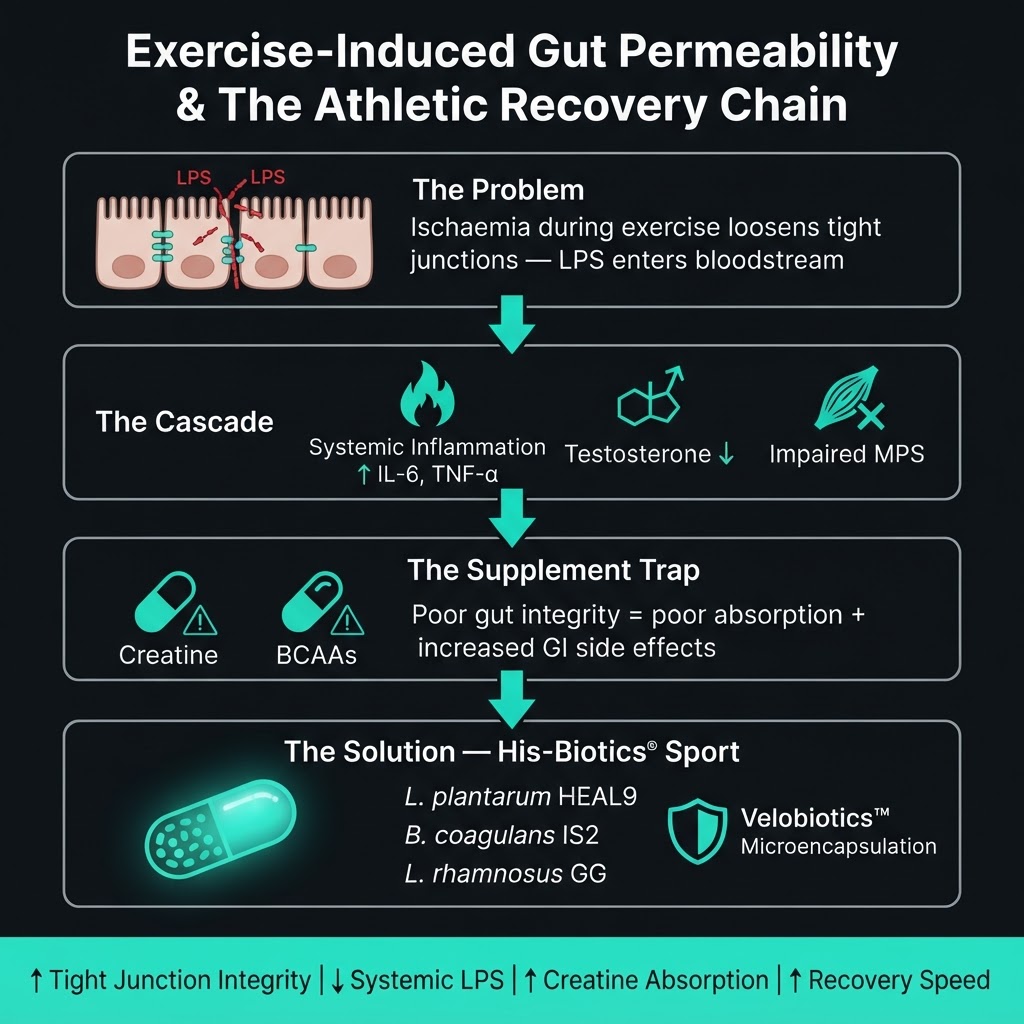
When you train at 70–85% VO2 max or higher, blood is shunted away from the gastrointestinal tract toward working muscles. This ischaemic stress — reduced blood and oxygen supply to the gut lining — triggers a cascade of cellular damage. The tight junction proteins that seal the intestinal epithelium, including occludin, claudin-1, and zonulin, begin to loosen. The result is increased intestinal permeability: bacterial endotoxins, particularly lipopolysaccharide (LPS) from gram-negative bacteria, translocate across the gut wall and enter systemic circulation. A 2017 study published in Alimentary Pharmacology & Therapeutics confirmed elevated plasma LPS and intestinal fatty acid-binding protein (I-FABP) in endurance athletes post-race, providing objective biochemical evidence that gut barrier compromise is a genuine, post-exercise phenomenon — not merely anecdotal.
This matters enormously because LPS in circulation triggers systemic inflammation via toll-like receptor 4 (TLR4) activation. The resulting cytokine surge — elevated IL-6, TNF-α, and IL-1β — does not just cause the soreness you feel the next morning. It actively inhibits testosterone synthesis, disrupts cortisol rhythms, impairs muscle protein synthesis signalling, and suppresses the immune response. In short, a compromised gut does not merely delay recovery — it actively works against it. For men training seriously, this intersection of gut health athletes should be aware of and hormonal performance is particularly consequential.
The Supplement Stack You're Taking May Be Making It Worse
Here is where things get clinically interesting — and uncomfortable. The very supplements most athletes rely on for performance and recovery can exacerbate gut permeability when the microbiome is already compromised. Creatine monohydrate is one of the most well-researched ergogenic aids in sports science, but the conversation around creatine gut health is almost entirely absent from mainstream sports nutrition discourse. Creatine requires active uptake via the sodium-dependent creatine transporter (SLC6A8), and when gut integrity is poor, unabsorbed creatine reaching the colon becomes a substrate for bacterial fermentation, producing osmotic effects that drive the bloating, cramping, and diarrhoea that many athletes attribute incorrectly to the creatine itself.
Branched-chain amino acids present a similarly nuanced picture. BCAAs — leucine, isoleucine, and valine — are widely used for muscle protein synthesis support and reducing exercise-induced muscle damage. However, research published in Nature Metabolism in 2019 by Fontana and colleagues identified that chronically elevated circulating BCAAs, particularly when microbial metabolism is disrupted, are associated with impaired insulin sensitivity and altered serotonin precursor availability. Since approximately 90–95% of serotonin is synthesised in the gut, an imbalanced microbiome directly affects the tryptophan-serotonin pathway that BCAAs compete with for transport across the blood-brain barrier. The result? Poor sleep, mood dysregulation, and blunted recovery — all from a BCAA protocol that should theoretically be helping. Exploring the intersection of BCAA probiotics interactions is therefore not a luxury; it is a necessity for any athlete serious about optimising outcomes.
Non-steroidal anti-inflammatory drugs (NSAIDs) compound the problem further. Many athletes self-medicate with ibuprofen or aspirin to manage training soreness, not realising that NSAIDs independently increase intestinal permeability by inhibiting cyclooxygenase enzymes essential for maintaining the protective prostaglandin layer of the gut mucosa. When you layer NSAIDs on top of exercise-induced ischaemia and a high-dose supplement protocol, you create a perfect storm of gut barrier disruption that no amount of protein shakes can overcome. The solution begins in the microbiome — and that requires a targeted, evidence-based approach to sports probiotics.
What the Science Says About Sports Probiotics and Recovery
The field of exercise recovery probiotics has matured considerably over the last decade. We are no longer talking about generic Lactobacillus acidophilus capsules from the pharmacy shelf. Strain-specific research now gives us a far more precise picture of which microbial interventions actually move the needle in athletic populations. A landmark randomised controlled trial published in the Journal of the International Society of Sports Nutrition (2016) by Jäger et al. demonstrated that Bacillus coagulans MTCC 5856 supplementation in resistance-trained men significantly reduced muscle damage markers (CK, LDH) and DOMS scores compared to placebo, while also improving protein absorption from whey supplementation. This is a critical finding — the probiotic did not just support gut health in isolation; it enhanced the functional utility of dietary protein for muscle recovery.
Beyond direct muscle recovery effects, PubMed research on probiotics increasingly demonstrates bidirectional communication between the gut microbiome and the hypothalamic-pituitary-gonadal axis. Specific strains, particularly Lactobacillus reuteri, have been shown in murine models and early human data to support testicular Leydig cell function and modulate systemic testosterone levels — a finding with significant implications for male athletic performance and recovery. Emerging gut microbiome research continues to illuminate how microbial metabolites, including short-chain fatty acids like butyrate, directly influence systemic inflammation, cortisol clearance, and mitochondrial efficiency in skeletal muscle tissue.
The mechanism here is elegant and worth understanding clearly. Butyrate, produced primarily by Faecalibacterium prausnitzii, Roseburia intestinalis, and Eubacterium hallii, serves as the primary energy substrate for colonocytes — the cells lining the colon. When these cells are well-fuelled, they maintain tight junction integrity with precision. Butyrate also inhibits histone deacetylase (HDAC) enzymes, producing epigenetic anti-inflammatory effects that extend systemically. For athletes, this means a microbiome rich in butyrate-producing strains is not just good for digestion — it is functionally anabolic in its anti-inflammatory effects, preserving the hormonal and muscular architecture that training is designed to build.
How His-Biotics® Sport Addresses the Athletic Gut Problem
His-Biotics® Sport was formulated with precisely this clinical picture in mind. After reviewing the available literature and working with male athletes across performance and recovery phases, it became clear that a generic multi-strain probiotic was insufficient. What was needed was a targeted, male-specific formula that addressed the unique interplay between intense physical training, supplement absorption, hormonal regulation, and gut barrier integrity — all simultaneously. The formula contains a curated consortium of clinically validated strains including Lactobacillus plantarum HEAL9, Bacillus coagulans IS2, and Lactobacillus rhamnosus GG, selected specifically for their roles in reducing exercise-induced inflammation, improving protein utilisation, and supporting intestinal tight junction expression.
Critically, the efficacy of any probiotic is entirely contingent on delivery. Probiotic strains are extraordinarily sensitive to gastric acid, bile salts, and heat — the vast majority of generic capsule formulations lose 60–90% of viable colony-forming units before they ever reach the small intestine or colon. His-Biotics® Sport utilises Velobiotics™ microencapsulation technology, a proprietary lipid-bilayer encapsulation process that shields each strain from gastric degradation, ensuring targeted release in the proximal small intestine where colonisation and immunomodulatory signalling begin. This is not a marketing differentiator — it is a pharmacokinetic necessity for clinical-level outcomes. You can explore our athlete formula in full to understand the complete strain rationale and delivery system.
The formula also incorporates KSM-66® Ashwagandha, an adaptogen with a robust evidence base for athletic recovery. Clinical studies on KSM-66® Ashwagandha demonstrate statistically significant reductions in serum cortisol, improvements in VO2 max, and enhanced muscle recovery when supplemented in physically active men — outcomes that synergise directly with probiotic-mediated gut barrier restoration and systemic inflammation reduction. When cortisol is chronically elevated from training stress, it suppresses testosterone production and impairs gut barrier function via glucocorticoid-mediated tight junction protein downregulation. Addressing both the upstream hormonal environment and the downstream gut architecture simultaneously is what distinguishes a genuine performance formula from a collection of independent ingredients.
Practical Strategies for Protecting Your Gut While Training Hard
Understanding the science is one thing — translating it into daily practice is another. As someone who has worked clinically with athletes ranging from amateur weekend warriors to competitive professionals, the following framework represents the most pragmatic and evidence-informed approach to maintaining gut integrity through hard training blocks. These strategies work synergistically with sports probiotics supplementation and form the foundation of what we call the Morning Man Protocol — a structured daily routine designed to front-load gut, hormone, and recovery support before the demands of training and life accumulate.
- Pre-exercise gut priming: Take your probiotic 30–45 minutes before training, not after. Emerging evidence suggests that pre-exercise probiotic dosing may attenuate the acute ischaemic stress response to the gut by supporting tight junction integrity before the blood redistribution challenge begins.
- Hydration and electrolytes as gut protectants: Dehydration of even 2% body weight significantly worsens exercise-induced gut permeability. Sodium and potassium help maintain the electrochemical gradient necessary for tight junction protein phosphorylation and gut barrier function. Plain water is insufficient in sessions exceeding 60 minutes.
- Strategic creatine dosing with gut support: Take creatine with the largest meal of the day, ideally post-training, rather than pre-workout. Co-administration with food slows gastric transit, improves SLC6A8-mediated absorption in the small intestine, and reduces the colonic load available for bacterial fermentation. Pairing creatine with a probiotic containing Lactobacillus plantarum strains has been shown to reduce creatine-associated GI discomfort in sensitive individuals.
- Reduce NSAID dependence: Where possible, replace NSAID use with targeted cold-water immersion, compression, and nutrition-based anti-inflammatory strategies. If NSAIDs are clinically necessary, probiotic and glutamine co-supplementation can partially offset their gut-permeabilising effects.
- Post-training fermented foods: Kefir, natural yoghurt, and sauerkraut in the post-training meal provide a natural bolus of live cultures that complement supplement-based probiotic protocols. The synbiotic effect — combining probiotic organisms with prebiotic fibre (e.g., inulin, FOS) — significantly enhances colonisation rates of introduced strains.
- Sleep as a gut repair window: The majority of intestinal epithelial cell turnover occurs during slow-wave sleep. Chronic sleep restriction below 7 hours per night independently increases gut permeability by suppressing melatonin-mediated intestinal repair mechanisms. Sleep is not passive recovery — it is active gut restoration.
Reading the Signs: When Your Gut Is Holding Back Your Gains
Many male athletes are living with subclinical exercise-induced gut permeability without recognising it as the source of their performance and recovery issues. The symptoms are often misattributed to overtraining syndrome, poor programming, or inadequate nutrition. However, a closer clinical examination reveals a distinct symptom cluster that points unmistakably toward gut barrier compromise as the primary driver of the performance ceiling. If you are consistently experiencing any combination of the following, your gut architecture warrants serious attention as part of your performance strategy.
- Persistent post-training fatigue beyond 24–48 hours that is disproportionate to training load, often accompanied by brain fog and motivational flatness — hallmarks of systemic LPS-driven neuroinflammation.
- Morning testosterone symptoms — low libido, poor morning erections, reduced competitiveness — without any obvious hormonal pathology on blood work, suggesting subclinical microbiome-HPG axis disruption.
- Frequent upper respiratory tract infections during and after heavy training blocks, reflecting the immunosuppressive effect of systemic endotoxaemia on mucosal immunity.
- GI symptoms specifically triggered by exercise — urgency, bloating, cramping, or loose stools during or immediately after intense sessions — which are direct manifestations of ischaemia-reperfusion gut injury.
- Poor supplement response — if you are taking creatine, BCAAs, and protein and not seeing the expected gains, impaired absorption secondary to gut barrier dysfunction and dysbiosis is a clinically plausible explanation that deserves investigation.
Key Takeaways
- Intense exercise causes measurable gut permeability through ischaemia-reperfusion injury to the intestinal epithelium, allowing bacterial endotoxins to enter systemic circulation and drive inflammation — directly impeding recovery and testosterone production.
- Common sports supplements including creatine and BCAAs interact meaningfully with the gut microbiome; optimising microbial health first dramatically improves their absorption, efficacy, and tolerability.
- Strain-specific sports probiotics — particularly Bacillus coagulans, Lactobacillus plantarum, and Lactobacillus rhamnosus — have demonstrated clinical efficacy in reducing exercise-induced muscle damage, improving protein utilisation, and supporting gut barrier integrity in athletic populations.
- Delivery technology matters profoundly: Velobiotics™ microencapsulation ensures probiotic strains survive gastric transit and reach their target site at therapeutic concentrations — something the majority of off-the-shelf products fail to achieve.
- Practical gut protection strategies — including pre-exercise probiotic timing, strategic creatine co-administration, NSAID reduction, and sleep optimisation — work synergistically to protect the gut barrier through hard training.
- If you are experiencing disproportionate fatigue, poor supplement response, low testosterone symptoms, or exercise-triggered GI distress, gut barrier dysfunction should be treated as the primary suspect and addressed systematically rather than incrementally.
If any of the above resonates with your current experience as an athlete or serious training individual, this is precisely the problem His-Biotics® Sport was built to solve. The formula is not a general wellness supplement — it is a clinically structured intervention for the specific physiological demands of the male training body. I encourage you to take our gut-performance assessment quiz and build a protocol personalised to your training volume, recovery profile, and hormonal status. Your gut is not just your digestive tract — in the context of athletic performance, it is your foundation. Build it accordingly.
— Dr. Chomba Chuma, MD & Founder, His-Biotics® by Velobiotics™