Why Your Hardest Training Sessions Are Wrecking Your Gut
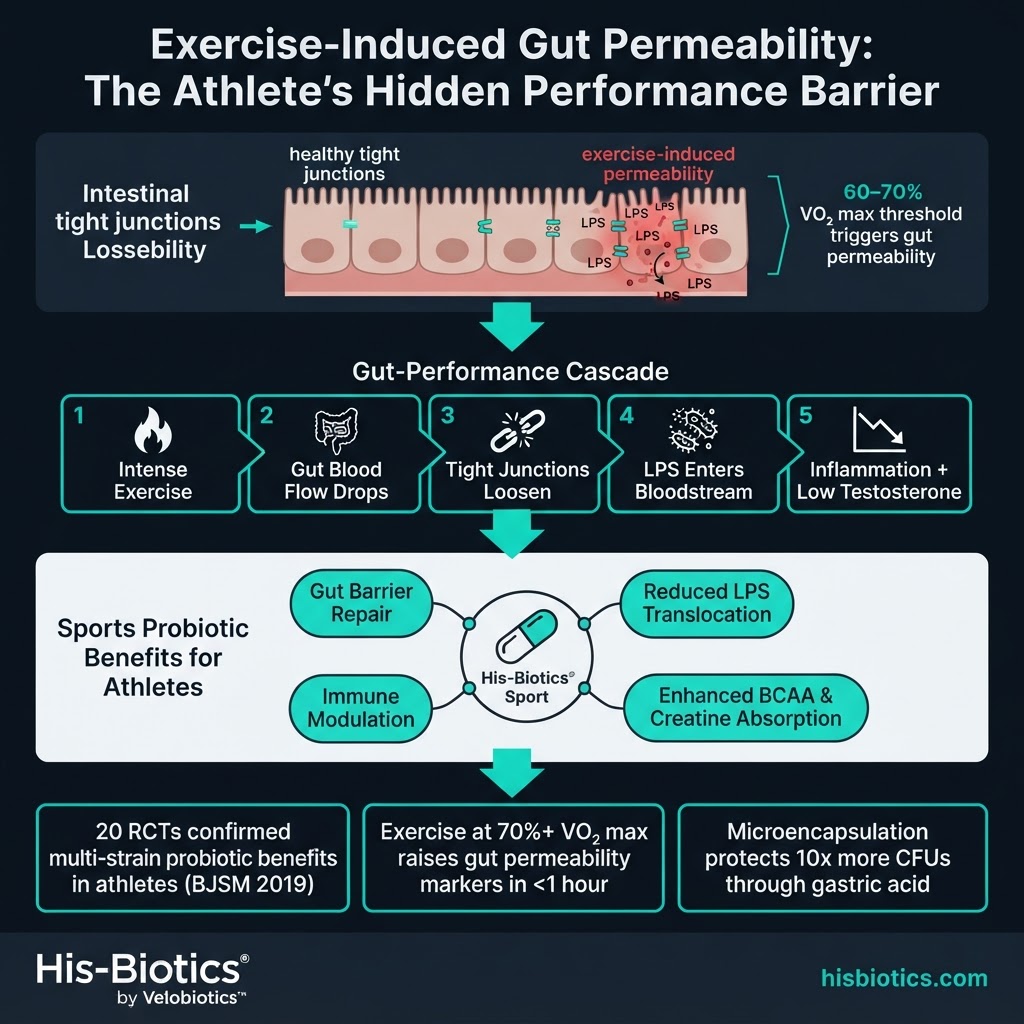
Every time you push past your lactate threshold — whether that's a punishing HIIT circuit, a heavy deadlift session, or a long-distance endurance run — you are doing something remarkable to your gastrointestinal tract. Blood is shunted away from your digestive system and redirected to your working muscles, a process called exercise-induced splanchnic hypoperfusion. The gut lining, suddenly starved of oxygen and blood flow, begins to struggle. Tight junction proteins — the molecular bolts that hold your intestinal wall together — start to loosen. The result is a phenomenon clinicians now recognise as exercise-induced gut permeability, more commonly known in sports medicine circles as leaky gut athletes.
This isn't fringe science. A landmark study published in Alimentary Pharmacology & Therapeutics (2012) by Costa et al. demonstrated that prolonged endurance exercise significantly increased intestinal permeability markers, including plasma zonulin and intestinal fatty acid binding protein (I-FABP), in trained runners. The implications are considerable: when the gut wall becomes permeable, bacterial endotoxins — specifically lipopolysaccharides (LPS) from gram-negative bacteria — can translocate into systemic circulation, triggering a low-grade inflammatory cascade that blunts recovery, suppresses testosterone, and degrades performance over time. If you train hard and frequently, your gut is under attack in ways most sports nutrition advice never addresses.
What's particularly relevant for men who care about both performance and hormonal health is that this inflammatory signalling doesn't stay local. LPS-driven systemic inflammation is a known suppressor of Leydig cell function — the testicular cells responsible for testosterone biosynthesis. So the athlete grinding through six sessions a week may inadvertently be digging a hormonal hole with every rep, unless he's actively protecting his gut barrier. This is the clinical reality that shaped the formulation philosophy behind His-Biotics® Sport — a probiotic formula built specifically around the physiological demands of male athletic performance.
The Science of Exercise-Induced Gut Permeability
To understand why gut health in athletes matters so profoundly, we need to look more closely at the architecture of the intestinal barrier. The gut lining is a single layer of epithelial cells connected by tight junction proteins — occludin, claudin, and zonula occludens — that collectively form a selective barrier. In a healthy state, this barrier allows nutrients through while blocking pathogens and toxins. Under exercise stress, particularly at intensities above 60–70% of VO₂ max sustained for over 60 minutes, this barrier integrity degrades measurably.
Research published in Medicine & Science in Sports & Exercise (2017) by Snipe et al. confirmed that both heat stress and exercise intensity are independent drivers of gut permeability increases, with the two factors compounding each other significantly. Athletes training in warm environments — a reality for many competitive and recreational athletes — face an amplified risk. Core temperature elevation accelerates tight junction protein degradation, while the concurrent reduction in gut perfusion creates the conditions for what amounts to a low-grade ischaemia-reperfusion injury at the gut wall level.
The microbiome dimension adds another layer of complexity that is increasingly supported by gut microbiome research from institutions around the world. The composition of your gut flora directly influences the structural integrity of your intestinal barrier. Species such as Lactobacillus rhamnosus, Lactobacillus plantarum, and Bifidobacterium longum produce short-chain fatty acids (SCFAs) — particularly butyrate — that serve as the primary fuel for colonocytes and upregulate tight junction protein expression. An athlete with a dysbiotic gut — depleted in these keystone species — has a structurally weaker gut wall before training even begins. This is the gut permeability tipping point: the microbiome you cultivate determines your baseline resilience.
Creatine, BCAAs, and Your Gut: The Hidden Interaction
Most male athletes using creatine and branched-chain amino acids (BCAAs) are focused on their muscle-building and recovery benefits, which are well established. Fewer appreciate the gastrointestinal dimension of these supplements — and how their efficacy is fundamentally tied to gut health. Let's address creatine first. Creatine monohydrate is absorbed primarily in the small intestine via specific sodium-dependent transporters. When gut permeability is elevated — as it routinely is post-hard training — creatine absorption efficiency can be compromised. More importantly, high-dose creatine in individuals with existing dysbiosis has been clinically associated with gastrointestinal discomfort, bloating, and loose stools, which are signs that the gut microbiome is not in an optimal state to process the osmotic load.
When it comes to BCAA and probiotic interactions, the science is equally compelling. BCAAs — leucine, isoleucine, and valine — are metabolised in both the gut epithelium and the liver. Gut bacteria, particularly Bacteroidetes species, are involved in BCAA catabolism. Interestingly, elevated circulating BCAAs associated with a dysbiotic microbiome (where bacterial BCAA catabolism is impaired) have been linked in recent metabolomic studies to insulin resistance and mTOR dysregulation. This means the very supplement you're taking to build muscle may be metabolised less efficiently — and potentially counterproductively — when your gut flora is compromised.
Optimising creatine gut health and BCAA metabolism, therefore, starts with the microbiome. A clinically targeted probiotic intervention — specifically using strains with documented mucosal adhesion and tight junction upregulation capacity — can restore the intestinal environment that allows creatine and BCAAs to work as intended. This is not a theoretical position; it reflects the emerging science of sports nutrition pharmacokinetics and the growing body of evidence that the gut is a performance organ in its own right. For men serious about their supplementation stack, ignoring the gut is leaving performance on the table.
Key Nutrients That Support Gut Integrity in Athletes
- L-Glutamine: The primary fuel source for enterocytes; supplementation has been shown to reduce exercise-induced gut permeability markers in clinical trials.
- Zinc Carnosine: A chelated form of zinc with specific mucosal protective properties, demonstrated to reinforce tight junction integrity and reduce NSAID-induced gut damage.
- Butyrate-producing probiotics: Strains including Bifidobacterium longum and Lactobacillus plantarum produce or stimulate production of butyrate, the colonocyte fuel that maintains gut wall structure under physiological stress.
- KSM-66® Ashwagandha: Its adaptogenic cortisol-modulating properties are directly relevant to gut health — chronic cortisol elevation is a known driver of tight junction degradation. Clinical studies on KSM-66® Ashwagandha demonstrate significant reductions in serum cortisol and improvements in stress-related physiology.
- Prebiotic fibre (FOS/Inulin): Feeds keystone bacterial species that produce protective SCFAs, providing the substrate for a resilient gut ecosystem in high-training periods.
Sports Probiotics: What the Research Actually Shows
The term sports probiotics has gained traction in both clinical and commercial contexts, but it's worth being precise about what the evidence supports. Not all probiotic products are created equal, and in the context of athletic performance and gut barrier integrity, strain specificity matters enormously. A 2019 systematic review and meta-analysis published in the British Journal of Sports Medicine by Jäger et al. examined the effects of probiotic supplementation across 20 randomised controlled trials in athletic populations and found that multi-strain probiotic formulas demonstrated the most consistent benefits for upper respiratory tract infection reduction, gastrointestinal symptom management, and markers of gut barrier function — three outcomes that directly bear on athletic availability and recovery quality.
The biological mechanisms are now well characterised. Probiotic species with documented mucosal adhesion — notably Lactobacillus rhamnosus GG and Lactobacillus plantarum 299v — stimulate the expression of tight junction proteins by activating toll-like receptor signalling pathways in intestinal epithelial cells. This upregulation effectively tightens the gut barrier, reducing LPS translocation and the systemic inflammatory burden that impairs muscle repair and hormonal recovery post-exercise. Separately, specific probiotic species modulate the Th1/Th2 immune balance and reduce secretory IgA depletion — an immunoglobulin that lines the gut and upper respiratory mucosa and is chronically depleted in overtrained athletes. You can review a broad range of related research findings through PubMed research on probiotics and testosterone, which reflects the growing interest in the gut-hormone axis.
The delivery mechanism of sports probiotics is just as important as strain selection, and this is where most off-the-shelf products fall critically short. The human stomach creates a profoundly hostile environment for probiotic bacteria — gastric acid and bile salts destroy the vast majority of unprotected CFUs before they reach the colon where they're needed most. Velobiotics™ addresses this through its proprietary microencapsulation technology, which encases probiotic bacteria in a protective lipid and polysaccharide matrix, enabling consistent survival through gastric transit and targeted release in the small intestine and colon. In practice, this means that the viable CFU count on the label of His-Biotics® Sport is the viable count that actually arrives where it needs to — not a fraction of it.
What to Look for in an Exercise Recovery Probiotic
- Clinically validated strains at therapeutic doses: Multi-strain formulas should include species with documented evidence for gut barrier support and immune modulation — not generic Lactobacillus acidophilus at irrelevant doses.
- Acid-resistant delivery technology: Without microencapsulation or equivalent acid-protective technology, label CFU counts are largely fictional by the time bacteria reach the colon.
- Prebiotic co-factors: Probiotics work best when their substrate is provided — prebiotics (FOS, inulin, GOS) sustain colonisation and SCFA production.
- Synergistic performance ingredients: An exercise recovery probiotic formulated for athletes should consider the full recovery ecosystem — including cortisol management, gut barrier repair co-factors, and immune modulation.
- Third-party testing and transparency: In a sports supplement context, label accuracy and contaminant testing are non-negotiable. Seek brands with verifiable testing documentation.
Athletic Performance and the Gut: Connecting the Dots for Male Athletes
The conversation around athletic performance gut health is evolving rapidly, and male athletes in particular stand to benefit from a more integrated understanding of how their gastrointestinal system interfaces with hormonal health, immune function, and recovery capacity. Consider the physiological cascade that follows a period of hard training without adequate gut support: exercise-induced permeability allows LPS into systemic circulation; LPS triggers NF-κB inflammatory signalling; inflammation suppresses Leydig cell function and reduces testosterone output; lower testosterone impairs muscle protein synthesis and recovery; the athlete needs to train harder to maintain performance, further stressing the gut — and the cycle deepens.
This is not a hypothetical scenario. It's the clinical picture I see repeatedly in male athletes who present with persistent fatigue, performance plateaus, frequent illness, and suboptimal body composition despite disciplined training and nutrition. The Morning Man Protocol I developed at Velobiotics™ was born out of precisely this clinical pattern — a systematic, daily approach to male physiological optimisation that places gut health at its centre, because the evidence is unambiguous: you cannot optimise male performance hormones in a gut environment characterised by permeability, dysbiosis, and chronic low-grade inflammation.
The good news is that the gut is extraordinarily responsive to targeted intervention. Within two to four weeks of consistent, strain-appropriate probiotic supplementation combined with foundational dietary support, measurable improvements in gut barrier markers, inflammatory cytokine profiles, and recovery quality are clinically demonstrable. For men stacking creatine, BCAAs, and a structured training programme, adding a purpose-built sports probiotic isn't an optional extra — it's the foundational layer that determines whether everything else works. To see the full formulation philosophy and explore our athlete formula in detail, I encourage you to review the ingredient rationale we've published alongside clinical references.
Key Takeaways
- Exercise-induced gut permeability is a real, measurable phenomenon that occurs at training intensities above 60–70% VO₂ max, particularly during prolonged or heat-stressed sessions — and it has direct downstream consequences for inflammation, hormonal health, and recovery.
- Your gut microbiome is a performance organ. Keystone species produce butyrate and regulate tight junction integrity; a dysbiotic gut means a structurally weaker gut barrier before training even begins.
- Creatine and BCAA efficacy are microbiome-dependent. Gut dysbiosis impairs creatine absorption, drives gastrointestinal discomfort, and may compromise BCAA metabolism — making gut health foundational to your supplementation stack.
- Multi-strain sports probiotics with validated delivery technology are the evidence-based intervention for exercise-induced gut permeability — but strain specificity, dosing, and delivery mechanism all matter enormously.
- Velobiotics™ microencapsulation technology ensures that the probiotic strains in His-Biotics® Sport survive gastric transit and deliver their therapeutic effect at the intestinal level — not in your stomach acid.
- A gut-first approach to male athletic performance addresses the root driver of many common training plateaus: chronic low-grade inflammation, suboptimal testosterone environment, and impaired recovery — all originating downstream of gut barrier dysfunction.
Ready to Perform From the Inside Out?
If you train hard, supplement strategically, and still find yourself hitting recovery walls, battling gut discomfort, or fighting through persistent fatigue and performance plateaus, the conversation needs to start with your gut. The research is clear, the clinical evidence is compelling, and the solution is more targeted than a generic probiotic from a pharmacy shelf. His-Biotics® Sport was formulated by clinicians who understand the specific physiological demands placed on the male gut under athletic stress — combining clinically validated probiotic strains, delivered via Velobiotics™ microencapsulation technology, with synergistic performance co-factors including KSM-66® Ashwagandha and gut barrier support nutrients. If you're unsure where to start or which formula is right for your specific profile, take our Total Gut Score (TGS) Quiz and receive a personalised recommendation built around your training load, gut health history, and performance goals. Your gut is your foundation — build it like you mean it.
— Dr. Chomba Chuma, MD & Founder, His-Biotics® by Velobiotics™