The Hidden Enemy in Your Training Programme: Exercise-Induced Gut Permeability
You track your macros. You optimise your sleep. You time your creatine to the minute. But there is one physiological variable that the vast majority of serious male athletes completely overlook — and it may be the single biggest reason your recovery is slower, your inflammation is higher, and your performance has plateaued. That variable is exercise-induced gut permeability, more commonly known in clinical circles as "leaky gut" — and in high-intensity athletes, it is not a fringe concern. It is a near-universal phenomenon.
As a clinician working at the intersection of gut medicine and male performance, I have reviewed hundreds of cases where otherwise disciplined athletes were unknowingly undermining every supplement they took because their intestinal barrier was compromised. The gut is not merely a digestive organ — it is a central command hub for immune regulation, hormonal signalling, and nutrient absorption. When that barrier breaks down under the stress of intense training, the downstream consequences extend far beyond bloating or discomfort. We are talking about systemic inflammation, impaired testosterone signalling, suboptimal protein utilisation, and delayed recovery. This is why the emerging science of gut health in athletes is no longer optional reading — it is foundational.
In this article, I will walk you through the mechanisms behind exercise-induced gut permeability, explain how your most popular sports supplements interact with your gut microbiome, and show you how strategically targeted sports probiotics — specifically formulated for the demands of male athletic performance — can close the gap between the athlete you are and the athlete you are capable of becoming.
What Happens to Your Gut During Intense Exercise
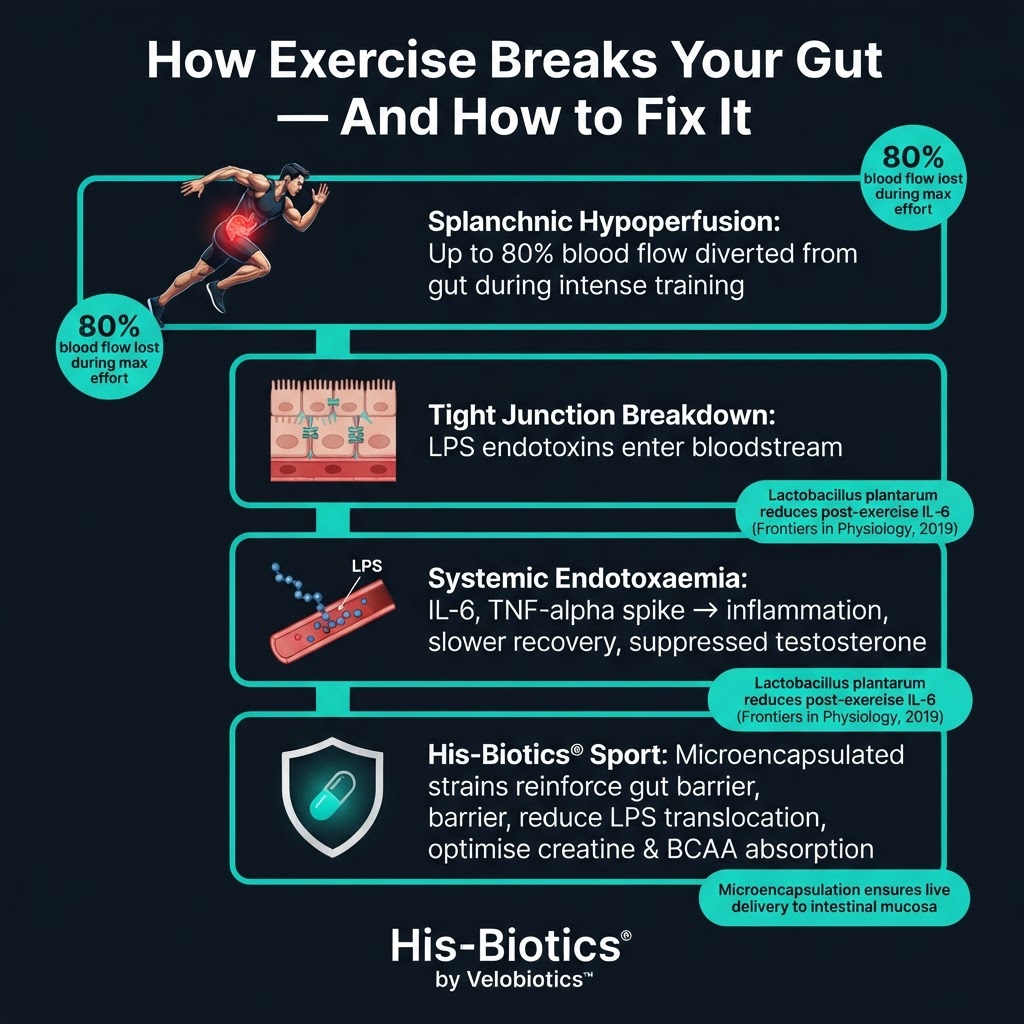
During high-intensity or prolonged exercise — think HIIT, endurance runs, heavy resistance training — your body executes a remarkable act of physiological triage. Blood is redirected away from the splanchnic (gut) circulation and towards the working muscles, heart, and lungs. This process, known as splanchnic hypoperfusion, can reduce gut blood flow by as much as 60–80% during maximal effort. The result is a transient but significant ischaemic insult to the intestinal lining.
The intestinal epithelium — a single-cell-thick barrier that separates your gut contents from your bloodstream — relies on tight junction proteins like occludin and claudin to maintain its integrity. Under the dual assault of reduced blood flow and elevated core temperature, these tight junctions begin to loosen. A landmark study published in Alimentary Pharmacology & Therapeutics (2012) by Pals et al. demonstrated measurable increases in intestinal permeability markers (specifically urinary lactulose-to-mannitol ratios) in runners completing a marathon, confirming that endurance exercise reliably compromises gut barrier function in a dose-dependent manner.
What does this mean in practical terms? It means that bacterial endotoxins — particularly lipopolysaccharides (LPS) derived from gram-negative bacteria in the gut — can translocate into systemic circulation. Once in the bloodstream, LPS triggers a cascade of pro-inflammatory cytokines including IL-6, TNF-alpha, and IL-1β. This is not theoretical inflammation. This is measurable, clinically significant systemic endotoxaemia that drives muscle soreness, blunts anabolic signalling, suppresses testosterone biosynthesis, and delays tissue repair. And it happens — to some degree — every time you train hard.
Creatine, BCAAs, and the Gut: What the Science Actually Says
Let us talk about the supplements sitting on your shelf. Creatine monohydrate remains one of the most evidence-backed ergogenic aids in existence, and BCAAs (branched-chain amino acids) are a staple in the recovery stack of most serious athletes. But here is what most sports nutrition conversations miss entirely: how these compounds interact with your gut microbiome, and how gut permeability affects their efficacy.
Creatine and Gut Health
The question of creatine and gut health is more nuanced than most people appreciate. Creatine is absorbed primarily in the small intestine, and a compromised epithelial barrier can impair transporter function, reducing uptake efficiency. More significantly, high-dose creatine loading protocols (20g/day for 5–7 days) are frequently associated with gastrointestinal distress — bloating, cramping, and osmotic diarrhoea — a direct consequence of poorly absorbed creatine drawing water into the gut lumen. A study published in the Journal of the International Society of Sports Nutrition (2021) noted that gastrointestinal tolerance of creatine is significantly improved when gut microbiome composition is optimised, suggesting that probiotic co-supplementation may enhance creatine bioavailability by supporting mucosal integrity and transporter expression.
Furthermore, some gut bacteria — particularly certain Firmicutes species — are capable of degrading creatine before absorption, converting it to creatinine, a metabolically inert byproduct. This means that in athletes with dysbiotic microbiomes, a meaningful proportion of their creatine dose may literally be wasted. Optimising your gut flora is therefore not merely a digestive concern when it comes to creatine — it is a direct bioavailability issue with measurable performance implications.
BCAAs, Protein Synthesis, and the Microbiome Connection
The relationship between BCAA probiotics — or more precisely, between probiotic supplementation and BCAA metabolism — is an area of rapidly expanding research. BCAAs (leucine, isoleucine, and valine) are metabolised both in enterocytes (gut lining cells) and in the liver, but gut bacteria also play a significant role in their catabolism. Dysbiosis — an imbalance in gut microbial ecology — has been shown to alter BCAA plasma kinetics, reducing the leucine availability that triggers the mTORC1 anabolic signalling pathway responsible for muscle protein synthesis.
Additionally, the gut microbiome directly produces short-chain fatty acids (SCFAs) like butyrate and propionate from fermentable fibres, and these SCFAs have been shown to enhance intestinal tight junction expression, reduce systemic inflammation, and support the enterocyte energy supply that keeps your gut barrier intact under training stress. Athletes with low microbial diversity — a common finding in those consuming high-protein, low-fibre diets — produce less butyrate, maintain weaker gut barriers, and paradoxically extract less nutritional value from the very high-protein diets they depend upon.
The broader implications for athletic performance gut health are clear: your gut microbiome is not just a passenger in your nutrition strategy — it is an active co-processor of the substrates you are consuming. Feeding it strategically is as important as hitting your macros.
The Case for Sports Probiotics: Beyond the Generic Lactobacillus
Not all probiotics are created equal — and this point cannot be overstated when we are talking about the specific physiological demands of male athletes. The gut microbiome research published over the last decade has moved well beyond the blanket recommendation of "take a probiotic." We now understand that strain specificity, delivery mechanism, colony-forming unit (CFU) viability at the site of action, and the synergistic relationship between probiotic strains all determine whether a supplement meaningfully shifts gut ecology or simply passes through unimpeded.
The key strains most rigorously studied in the context of athletic recovery and gut barrier integrity include Lactobacillus plantarum (particularly PS128 and HEAL9 strains), Bifidobacterium longum, Lactobacillus rhamnosus GG, and Saccharomyces boulardii. A compelling 2019 study published in Frontiers in Physiology found that Lactobacillus plantarum supplementation in male athletes significantly reduced exercise-induced intestinal permeability markers, attenuated post-exercise LPS translocation, and was associated with lower levels of circulating IL-6 — a key inflammatory cytokine — 24 hours post-training. These are not trivial findings. They represent a direct, mechanistically plausible pathway through which exercise recovery probiotics can accelerate the return to training readiness.
Beyond barrier integrity, the role of probiotics in testosterone and anabolic hormone homeostasis is gaining serious traction. The PubMed research on probiotics now includes multiple studies examining the gut-testes axis — a bidirectional signalling pathway through which gut microbial metabolites influence Leydig cell function and androgen biosynthesis. Optimising this axis through targeted probiotic intervention is a clinically meaningful strategy for men looking to maintain peak hormonal performance alongside their training demands.
Why Delivery Mechanism Is Everything
Here is where I want to be direct about something that frustrates me as a clinician: the majority of probiotic products on the market — including many marketed specifically to athletes — fail at the most fundamental level of probiotic science. They do not survive the journey. Stomach acid (pH 1.5–3.5) destroys the vast majority of unprotected probiotic strains before they reach the distal small intestine and colon where they are needed. A probiotic that does not arrive at its target site alive is, by definition, inert.
This is precisely why Velobiotics™ developed their proprietary microencapsulation technology — a lipid-based protective matrix that shields each probiotic strain from gastric acid, bile salts, and mechanical disruption during transit, ensuring guaranteed delivery and colonisation at the intestinal mucosa. This is not a marketing claim — it is a fundamental requirement of probiotic efficacy, and it is the technological backbone behind His-Biotics® Sport. Without this level of protection, you are likely paying for probiotics that never make it to the finish line.
His-Biotics® Sport: Engineered for the Male Athlete's Gut
His-Biotics® Sport is not a reformulated general wellness probiotic with a new label. It is a clinically designed, male-specific multi-strain probiotic formulated to address the precise gut-physiology challenges that high-intensity training creates. Every element of the formula — from strain selection and CFU load to the inclusion of complementary adaptogens — has been chosen based on the peer-reviewed evidence base for male athletic performance and gut barrier resilience.
The formula includes a performance-optimised probiotic matrix delivered via microencapsulation, alongside KSM-66® Ashwagandha — the most clinically studied full-spectrum ashwagandha extract available. The clinical studies on KSM-66® Ashwagandha demonstrate significant reductions in cortisol, improvements in VO2 max, and meaningful increases in serum testosterone in resistance-trained males — making it a genuinely synergistic companion to a gut-targeted probiotic in the context of male performance medicine.
The rationale here is systemic: when you reduce LPS-driven systemic inflammation via a stronger gut barrier, lower cortisol via adaptogenic support, and improve nutrient bioavailability through a healthier microbial ecosystem, you create the internal conditions for genuine adaptation. Faster recovery. Stronger anabolic signalling. Better creatine and BCAA utilisation. More consistent training output. This is what athletic performance gut optimisation looks like in practice — not one magic bullet, but an integrated physiological strategy.
For those looking to build on this foundation with a broader daily performance and hormonal health routine, I would also direct you to the Morning Man Protocol — a structured daily regimen designed to stack gut health, hormonal optimisation, and peak male vitality in a systematic, evidence-informed way.
Practical Protocol: Gut-Optimised Sports Supplementation
Knowing the science is one thing. Applying it is another. Based on my clinical experience and the current evidence base, here is how I recommend male athletes approach the integration of gut health strategies into their existing supplementation and training protocols.
Supplement Timing and Gut Support
- Take your probiotic consistently: His-Biotics® Sport should be taken daily — not just on training days. Gut ecology shifts require consistent bacterial colonisation pressure over 4–8 weeks before measurable microbiome changes are established. Sporadic use yields sporadic results.
- Time creatine away from high-fat meals: Fat slows gastric emptying and can reduce creatine absorption kinetics. A lean pre- or post-workout window is optimal for creatine uptake — and a healthier gut barrier means more of that creatine reaches muscle tissue rather than being degraded by dysbiotic bacteria.
- Pair BCAAs with fermentable fibre: Adding prebiotic fibres (inulin, FOS, or resistant starch) to your nutrition plan feeds the butyrate-producing bacteria that maintain gut barrier integrity, creating a reinforcing loop that enhances BCAA uptake and reduces intestinal permeability over time.
- Hydrate aggressively during training: Dehydration compounds splanchnic hypoperfusion. Even mild dehydration (2% body weight loss) measurably worsens exercise-induced gut permeability. Adequate fluid intake is one of the most underutilised gut-protective strategies in sports nutrition.
- Consider a low-FODMAP approach during heavy training blocks: Highly fermentable carbohydrates consumed close to intense training sessions can exacerbate gut symptoms and increase luminal gas production at a time when gut motility is already compromised by exercise. Strategic carbohydrate selection in the 2–3 hours pre-training can meaningfully reduce GI distress.
Signs Your Gut Is Undermining Your Training
Many athletes normalise gut symptoms as an inevitable side effect of hard training. They should not. The following signs are clinical red flags that your gut barrier integrity may be compromised and is actively limiting your performance and recovery:
- Persistent post-training bloating or cramping that lasts more than 60–90 minutes after exercise
- Unexplained fatigue that is disproportionate to training load and sleep quality
- Recurrent upper respiratory infections, suggesting immune suppression driven by intestinal LPS translocation
- Brain fog or mood disruption in the 24–48 hours following high-intensity sessions
- Poor appetite despite high training volumes, or paradoxically elevated appetite with poor satiety signalling
- Slow recovery times that have worsened progressively despite optimised training and nutrition
If two or more of these describe your experience, gut permeability is almost certainly part of the picture — and it warrants both dietary investigation and targeted probiotic intervention with a formula specifically designed for training demands.
Key Takeaways
The relationship between gut health and athletic performance is not a wellness trend. It is a mechanistically established, clinically meaningful connection that every serious male athlete should understand and address. Here is the distilled version of everything we have covered:
- Exercise-induced gut permeability is a near-universal phenomenon in high-intensity male athletes, driven by splanchnic hypoperfusion and tight junction disruption during training — and it causes measurable systemic inflammation via LPS translocation.
- A compromised gut barrier directly reduces creatine and BCAA bioavailability — meaning your most important ergogenic supplements may be underperforming not because of the supplements themselves, but because of the gut ecosystem processing them.
- Sports probiotics must be strain-specific, viably delivered, and consistently dosed to exert meaningful effects on gut barrier integrity, systemic inflammation, and anabolic hormone signalling in male athletes.
- Velobiotics™ microencapsulation technology ensures that the live probiotic strains in His-Biotics® Sport survive gastric transit and reach the intestinal mucosa — the non-negotiable requirement for clinical efficacy that most probiotic products fail to meet.
- KSM-66® Ashwagandha synergises with gut-targeted probiotics by addressing cortisol-driven suppression of gut mucosal immunity and anabolic hormone production — a dual-front strategy for male performance optimisation.
- Consistent daily probiotic use over 4–8 weeks, combined with adequate hydration, prebiotic fibre intake, and strategic supplement timing, represents the most evidence-supported approach to closing the gut-performance gap for serious male athletes.
If you are ready to stop leaving performance on the table and start treating your gut as the high-performance organ it is, I invite you to explore our athlete formula and learn exactly how His-Biotics® Sport was built to meet the specific physiological demands of men who train hard and recover harder. Your gut is the foundation. Build it right.
— Dr. Chomba Chuma, MD & Founder, His-Biotics® by Velobiotics™