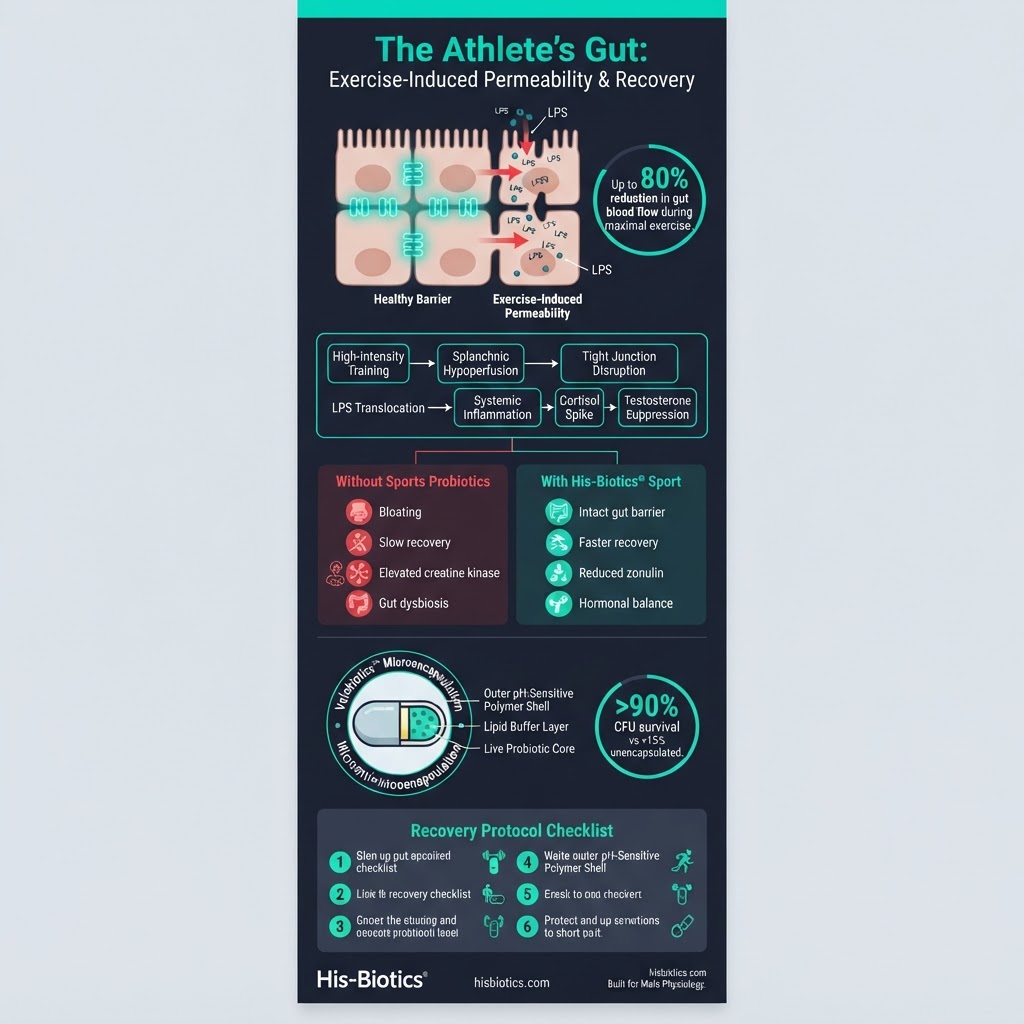
Why Your Gut Takes a Beating Before Your Muscles Do
Every serious athlete knows the feeling: a gruelling session leaves you exhausted, inflamed, and — if you've ever pushed through a marathon, a heavy lifting block, or back-to-back HIIT sessions — occasionally nauseous, bloated, or running for the nearest toilet. What most men don't realise is that these aren't just signs of physical fatigue. They are warning signals from a gut lining under siege. Exercise-induced gut permeability, colloquially known as leaky gut in athletes, is one of the most underappreciated barriers to genuine athletic performance, and the science behind it is compelling enough to change how you think about your recovery stack entirely.
When you train at high intensity, blood is shunted away from the gastrointestinal tract and redirected to working muscles, the heart, and the lungs. This process — called splanchnic hypoperfusion — can reduce gut blood flow by up to 80% during maximal exercise. The resulting ischaemia and subsequent reperfusion on rest causes oxidative stress directly to the intestinal epithelial cells, the single-cell-thick barrier that separates the contents of your gut from your bloodstream. Tight junction proteins like occludin and claudin-1, which hold those cells together like molecular velcro, begin to loosen. Bacterial endotoxins, partially digested food antigens, and inflammatory compounds called lipopolysaccharides (LPS) can then translocate into systemic circulation — triggering an immune response that blunts recovery, elevates cortisol, and suppresses testosterone production at exactly the moment you need those hormones working for you.
A landmark study published in Alimentary Pharmacology & Therapeutics (2017) found that endurance athletes showed significantly elevated intestinal fatty acid-binding protein (I-FABP) — a biomarker of gut epithelial damage — immediately post-exercise, with levels correlating directly to exercise intensity. What's more, the same subjects showed measurable increases in plasma LPS within two hours of completing a race. This isn't a fringe finding. Reviewing the broader gut microbiome research literature, it becomes clear that the athletic gut is a dynamic, fragile ecosystem that responds — for better or worse — to every training session you complete.
The good news is that the gut is remarkably adaptive. Train intelligently, support your microbiome strategically, and that same gut lining can become a performance asset rather than a liability. This is the clinical conversation I have with every high-performing male patient who comes through my door complaining that their training has plateaued, their recovery feels broken, or their libido has nosedived despite doing everything right in the gym.
The Supplement Stack Problem: Creatine, BCAAs, and Your Gut Microbiome
Let's talk about the supplements sitting on your kitchen counter right now. Creatine monohydrate and branched-chain amino acids (BCAAs) are the two most widely used performance supplements in men's sport — and for good reason. The evidence for creatine's role in phosphocreatine resynthesis, strength output, and lean mass accretion is among the most robust in exercise science. BCAAs, particularly leucine, drive muscle protein synthesis through mTORC1 activation and reduce perceived exertion during prolonged training. But here's what the fitness industry rarely tells you: both of these supplements interact directly with your gut microbiome, and not always in ways that favour performance.
Creatine and gut health have a nuanced relationship. At standard loading doses (20g/day for five to seven days), creatine is known to cause GI distress in a significant subset of users — cramping, osmotic diarrhoea, and bloating. Mechanistically, high luminal creatine concentrations draw water into the intestinal lumen and may transiently alter the gut microbiota composition. A 2021 study in Nutrients examining creatine supplementation and the gut microbiome found shifts in Firmicutes-to-Bacteroidetes ratios in male subjects following a loading protocol, with some subjects showing reduced populations of short-chain fatty acid (SCFA)-producing bacteria — the very bacteria responsible for fuelling colonocyte function and maintaining tight junction integrity. In other words, the supplement designed to help you train harder may, in some men, be quietly undermining the gut barrier it depends on.
The picture with BCAAs is similarly layered. While leucine, isoleucine, and valine are essential for muscle protein synthesis, excess BCAA supplementation — particularly in the absence of adequate dietary fibre — has been associated with altered tryptophan metabolism and reduced serotonin availability in the gut-brain axis. A growing body of PubMed research on probiotics and amino acid metabolism suggests that specific probiotic strains can modulate how the gut processes BCAAs — improving absorption efficiency while reducing the fermentation byproducts that drive bloating and loose stools in heavy supplement users. This is precisely the clinical intersection where BCAA probiotics make scientific sense as a combined strategy rather than a marketing gimmick.
The practical implication is this: if you're serious about your training and you're using creatine and BCAAs, you cannot afford to ignore the gut environment those supplements are landing in. A dysbiotic, inflamed, permeable gut is like a leaky fuel tank — you're pouring in premium nutrition and watching half of it disappear before it reaches the engine.
Sports Probiotics: The Science Behind Strain Selection
Not all probiotics are created equal, and this point cannot be overstated enough in the context of athletic performance. The consumer probiotic market is saturated with products containing strains selected primarily for digestive comfort in sedentary populations — Lactobacillus acidophilus NCFM and Bifidobacterium lactis Bl-04 are workhorse strains for IBS and traveller's diarrhoea, but they were never designed with the physiology of a training male in mind. Sports probiotics represent a distinct category: strains and formulations specifically selected based on their demonstrated capacity to reduce exercise-induced intestinal permeability, modulate exercise-related immune responses, and support the hormonal milieu that underpins male athletic performance.
The most compelling strain evidence in this space comes from Lactobacillus rhamnosus and Bifidobacterium longum research in athletic cohorts. A 2019 randomised controlled trial published in the Journal of the International Society of Sports Nutrition found that multi-strain probiotic supplementation in endurance athletes reduced post-exercise plasma zonulin — a validated marker of intestinal tight junction disruption — by approximately 24% compared to placebo over a four-week supplementation period. Zonulin is essentially your gut's emergency alarm system for permeability, and reducing it means the barrier is holding under training stress. Separately, research on Lactobacillus plantarum in male strength athletes has shown improvements in perceived recovery, reduced creatine kinase (a muscle damage biomarker), and — crucially — enhanced lean mass gains over a 12-week period, suggesting that gut microbiome optimisation potentiates the anabolic response to resistance training.
What separates clinically meaningful sports probiotic formulations from the generic supplement aisle? Several factors matter critically:
- Strain specificity: The probiotic strains must have published evidence in exercise or sport-specific contexts, not just general health populations.
- Colony-forming unit (CFU) viability: Many probiotics are dead on arrival — heat, moisture, and stomach acid degrade live cultures before they reach the colon. Delivery technology is everything.
- Synbiotic support: Probiotic strains perform significantly better when paired with prebiotic substrates (inulin, FOS, GOS) that serve as selective fuel for beneficial populations.
- Hormonal compatibility: In male athletes, probiotic selection should account for the gut-testosterone axis — specific strains influence testicular Leydig cell function via gut-derived signals, making strain selection a genuinely andrological decision.
- Adaptogen integration: Combining evidence-based probiotics with cortisol-modulating adaptogens like KSM-66® Ashwagandha — supported by over 22 clinical studies on KSM-66® Ashwagandha demonstrating reductions in serum cortisol and improvements in testosterone and VO2 max — creates a synergistic formulation that addresses both sides of the recovery equation.
This is the clinical framework I applied when developing His-Biotics® Sport. The formulation is not a generic probiotic with a gym logo slapped on the label. It is a purpose-built, multi-strain synbiotic system designed specifically for the physiology of training men — addressing gut barrier integrity, immune modulation, nutrient absorption efficiency, and the hormonal recovery cascade in a single, scientifically coherent product.