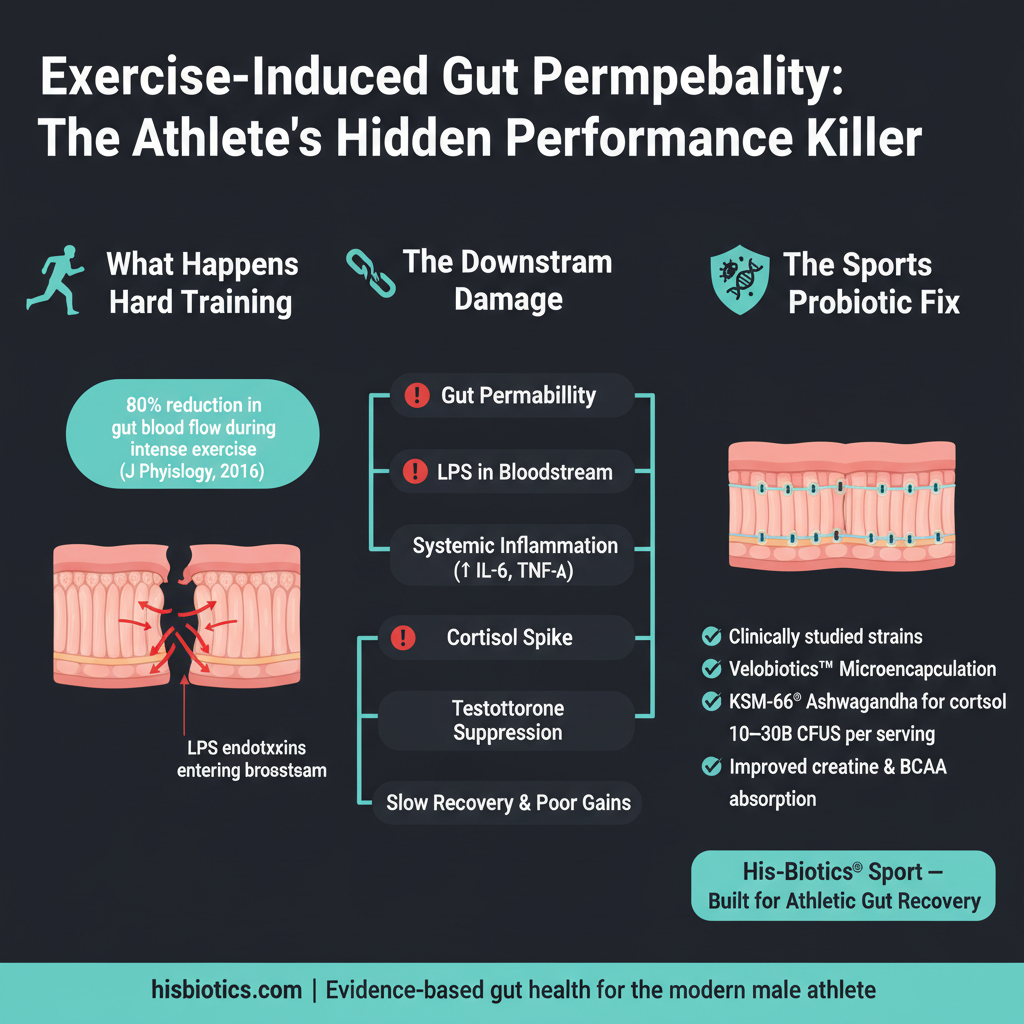
Why Hard Training Is Quietly Destroying Your Gut
You train hard, eat clean, and supplement smart — yet recovery feels slower than it should, inflammation lingers longer than expected, and your performance plateaus despite doing everything right. What if the missing variable isn't in your programme or your protein shake, but inside your gut wall? As both a clinician and a researcher focused on male physiology, I've seen this pattern repeat itself across hundreds of high-performing men: the harder they train, the more their gut health athletes suffer in silence. Exercise-induced gut permeability — commonly called "leaky gut" in athletic contexts — is one of the most underappreciated barriers to elite recovery, and it's time we addressed it head-on.
When you push your body into high-intensity or prolonged endurance exercise, blood flow is deliberately redirected away from the gastrointestinal tract toward working muscles. This process, known as exercise-induced splanchnic hypoperfusion, starves the gut lining of oxygen and nutrients for the duration of the session. Research published in Alimentary Pharmacology & Therapeutics (2017) demonstrated that even a single bout of intense exercise can significantly increase intestinal permeability — measurable within hours — in otherwise healthy, trained athletes. The tight junction proteins that hold your gut lining together, including occludin and claudin-1, begin to unravel under the mechanical and oxidative stress of hard training. The result is a gut barrier that lets through bacterial endotoxins, undigested proteins, and inflammatory compounds that would normally be kept firmly out.
The downstream effects are precisely what most athletes chalk up to "overtraining": systemic inflammation, elevated cortisol, immune suppression, disrupted sleep, and — critically for men — suppressed testosterone production. The gut and the endocrine system are in constant conversation, and when gut integrity breaks down, that conversation turns toxic. This is not a niche concern reserved for ultramarathon runners or elite sportsmen; it affects recreational gym-goers, weekend warriors, and competitive athletes alike. Understanding and addressing athletic performance gut health is, in my clinical view, one of the highest-leverage interventions available to the modern male athlete.
The Science of Exercise-Induced Gut Permeability
Let's get specific about the mechanisms, because vague claims about "gut health" do nobody any favours. During sustained exercise at above 60% of VO₂ max, gastrointestinal blood flow can be reduced by up to 80%, according to research from The Journal of Physiology (2016). This ischaemia triggers a cascade: reactive oxygen species accumulate at the mucosal surface, tight junction proteins are phosphorylated and destabilised, and the mucus layer — your first line of gut defence — thins considerably. The result is a transient but repeated breach in intestinal barrier integrity that, over a training career of weeks and months, becomes a chronic background state of low-grade gut inflammation.
Lipopolysaccharide (LPS), a component of the outer membrane of gram-negative bacteria in the gut, is one of the primary culprits that exploits this weakened barrier. When LPS enters systemic circulation through a permeable gut lining, it binds to toll-like receptor 4 (TLR4) on immune cells, triggering a pro-inflammatory response that elevates cytokines including IL-6, TNF-α, and IL-1β. These are the very same inflammatory markers associated with muscle catabolism, delayed recovery, and hypothalamic-pituitary-gonadal (HPG) axis suppression. For any man serious about hormonal optimisation and performance, this is a direct mechanistic link between gut permeability and suboptimal testosterone levels — a connection the broader sports nutrition world has been slow to acknowledge.
Furthermore, heat stress during exercise compounds the problem. Core temperature rises during training significantly accelerate intestinal permeability, meaning summer sessions, poorly ventilated gyms, or hot-weather competitions carry an added gut-stress burden. Combined with dehydration — which thickens the mucus layer and impairs barrier repair — the picture becomes clear: high-volume training without gut support is a physiological liability. Exploring the latest gut microbiome research makes abundantly clear that the microbial ecosystem itself plays a critical role in both protecting and repairing the intestinal barrier, which is precisely where targeted probiotic intervention becomes not just logical but essential.
Creatine, BCAAs, and the Gut Connection You Didn't Know Existed
Most athletes using creatine and branched-chain amino acids (BCAAs) are focused on the performance and anabolic signalling benefits — and rightly so. But what's rarely discussed in the locker room or the supplement aisle is how these compounds interact with gut physiology, and why that interaction matters enormously for getting the most out of them. Creatine gut health is a topic that divides opinion, largely because high loading doses of creatine monohydrate are well-documented to cause gastrointestinal distress — bloating, cramping, and loose stools — in a significant proportion of users. This isn't a minor inconvenience; it's a signal that the gut environment is struggling.
The mechanism behind creatine-associated GI distress involves osmotic load in the small intestine, altered gut motility, and — in individuals with pre-existing gut permeability — direct mucosal irritation. When your gut lining is already compromised from training, adding a high osmotic load via creatine loading phases can exacerbate the barrier disruption rather than being absorbed efficiently for muscle uptake. The clinical implication is significant: poor gut integrity doesn't just cause GI symptoms, it reduces the bioavailability of creatine itself. You're paying for a supplement your gut can't effectively absorb. The same logic applies to BCAA probiotics synergy — leucine, isoleucine, and valine are absorbed in the small intestine via specific transporter proteins, and an inflamed, permeable gut lining compromises both the transporter function and the intestinal surface area available for absorption.
A 2019 study published in Nutrients found that probiotic supplementation improved intestinal permeability markers and reduced exercise-induced endotoxaemia in trained athletes, with measurable improvements in subjective recovery scores and inflammatory biomarkers. The key implication here isn't just that probiotics are good for the gut — it's that a healthier gut makes every other supplement you take work better. Your creatine gets absorbed. Your BCAAs reach skeletal muscle. Your protein synthesis signalling operates in a less inflamed environment. This is the systems-thinking approach to sports nutrition that I believe every serious male athlete needs to adopt: fix the gut first, and everything downstream improves.
What to Look for in a Sports Probiotic Formula
Not all probiotics are created equal, and the sports probiotic market is cluttered with underdosed, poorly evidenced products that offer little more than a colony count on a label. When evaluating a probiotic for athletic use specifically, there are several non-negotiable criteria that separate genuine performance support from marketing noise. Strain specificity matters enormously — generic Lactobacillus acidophilus formulas designed for digestive comfort have almost no relevance to exercise-induced gut permeability, inflammation modulation, or testosterone pathway support.
- Strain specificity: Look for clinically studied strains such as Lactobacillus rhamnosus GG, Bifidobacterium longum, and Lactobacillus plantarum 299v — strains with documented effects on gut barrier integrity and systemic inflammation.
- Survivability technology: Probiotic bacteria are fragile. Without robust delivery technology, the majority of colony-forming units (CFUs) are destroyed by stomach acid before reaching the small intestine where they're needed.
- Clinically relevant dose: Look for formulas delivering at least 10–30 billion CFUs per serving across multiple strains — single-strain, low-dose products are unlikely to move the needle in an athlete's gut environment.
- Supporting co-factors: The best sports probiotic formulas include prebiotic fibres (to feed colonising bacteria), adaptogenic compounds to manage cortisol (a major driver of gut permeability), and minerals such as zinc and magnesium that support tight junction integrity.
- Evidence base: The formula should draw on published research, not just marketing claims. Reviewing available PubMed research on probiotics reveals a growing body of evidence linking specific strains to hormonal, immune, and performance outcomes in male subjects.