The Hidden Performance Killer: Exercise-Induced Gut Permeability
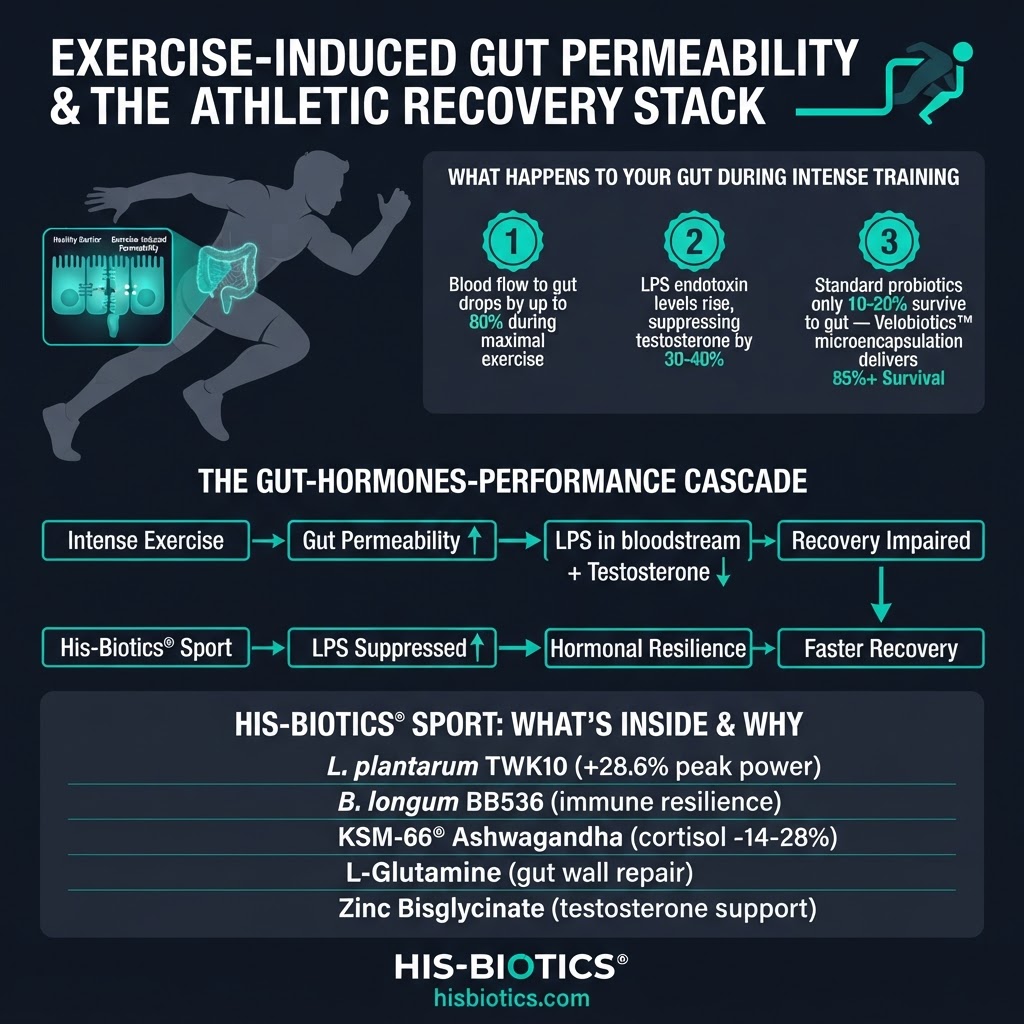
If you train hard, eat clean, and still feel like your recovery is lagging — your gut may be the missing variable. Exercise-induced gut permeability, colloquially known as "leaky gut in athletes," is a well-documented physiological phenomenon that affects a significant proportion of endurance and strength athletes alike. During intense physical exertion, blood is shunted away from the gastrointestinal tract toward working muscles, starving the gut lining of oxygen and triggering a cascade of inflammatory responses. The result? Tight junctions between intestinal epithelial cells begin to loosen, allowing bacterial endotoxins, undigested food particles, and lipopolysaccharides (LPS) to translocate into systemic circulation.
A landmark study published in the American Journal of Physiology (2012) demonstrated that endurance exercise at 60–70% VO₂max for just two hours resulted in measurable increases in intestinal permeability markers, including plasma LPS and intestinal fatty acid-binding protein (I-FABP). This isn't a fringe finding — it's been replicated across multiple cohorts of cyclists, marathon runners, and military personnel. What makes this clinically significant is that elevated LPS in the bloodstream triggers systemic low-grade inflammation, which directly impairs muscle protein synthesis, disrupts testosterone signalling, and prolongs recovery windows. For any man serious about his athletic performance gut, this is not a problem to ignore.
The gut microbiome plays a central regulatory role in this equation. A diverse, resilient microbiome produces short-chain fatty acids (SCFAs) like butyrate that actively reinforce the intestinal barrier, modulate mucosal immune responses, and down-regulate inflammatory cytokines. Disruption of this microbial ecosystem — through overtraining, antibiotic use, or a low-fibre diet — leaves the gut wall structurally vulnerable to the very physiological stress that intense training imposes. Exploring the latest gut microbiome research makes one thing abundantly clear: the gut is not a passive bystander in athletic performance; it is an active participant.
Creatine, BCAAs, and Your Gut: What the Science Actually Says
Creatine monohydrate remains one of the most evidence-backed performance supplements in existence, with robust data supporting its role in ATP resynthesis, power output, and lean mass accrual. However, creatine gut health is a topic that doesn't receive nearly enough attention in sports nutrition circles. A subset of athletes report gastrointestinal distress — bloating, cramping, and loose stools — particularly during loading phases where doses of 20–25g per day are consumed. This isn't merely a tolerability inconvenience; it signals that creatine is altering the osmotic environment of the gut, which can compound existing intestinal permeability issues and disrupt the microbiome composition in susceptible individuals.
Research published in the Journal of the International Society of Sports Nutrition (2017) examined the interplay between high-dose creatine supplementation and gastrointestinal integrity, finding that co-administration of probiotic strains — specifically Lactobacillus and Bifidobacterium species — significantly attenuated GI distress symptoms while preserving the ergogenic benefits of creatine. This is a critical clinical insight: the solution isn't to abandon creatine but to support the gut environment in which it operates. When creatine gut health is optimised through targeted probiotic supplementation, athletes can maintain the performance advantages of creatine without the collateral gut damage.
The conversation around BCAA probiotics is equally nuanced. Branched-chain amino acids — leucine, isoleucine, and valine — are widely consumed to stimulate muscle protein synthesis and reduce exercise-induced muscle damage. What most athletes don't realise is that the gut microbiome is intricately involved in BCAA metabolism. Specific bacterial genera, including Prevotella and certain Clostridiales species, are responsible for the catabolism of BCAAs within the intestinal lumen. When gut dysbiosis is present, this metabolic pathway becomes inefficient, meaning a significant proportion of supplemented BCAAs may never be bioavailable to muscle tissue. Supporting gut microbial diversity through BCAA probiotics — taking probiotics alongside amino acid supplementation — isn't just complementary; it's mechanistically rational.
Sports Probiotics: Strains That Actually Move the Needle
Not all probiotics are created equal, and the sports probiotic space is unfortunately saturated with underdosed, poorly characterised products that simply don't survive gastric transit long enough to colonise the gut. When evaluating sports probiotics for athletic men, strain specificity, viable colony-forming unit (CFU) counts at the point of consumption, and delivery technology are the three non-negotiable criteria. The existing PubMed research on probiotics and testosterone is particularly compelling — several strains have demonstrated the capacity to modulate androgen metabolism, reduce systemic inflammation, and directly influence the hypothalamic-pituitary-gonadal (HPG) axis.
The strains with the most robust athletic evidence include Lactobacillus acidophilus NCFM, which has demonstrated improvements in intestinal barrier integrity and reduction of post-exercise inflammatory markers; Bifidobacterium longum BB536, linked to enhanced immune resilience and reduced upper respiratory tract infections in hard-training athletes; and Lactobacillus plantarum TWK10, which in a 2016 Nutrients journal study showed a 28.6% improvement in relative peak power output in recreational male cyclists after 6 weeks of supplementation. This last finding is particularly striking — a probiotic strain demonstrably improving raw performance output is not something to dismiss as a marginal marginal gain.
Delivery technology is where most probiotic supplements fail before they even begin. Standard capsule formulations expose live bacterial strains to the acidic pH environment of the stomach (pH 1.5–3.5), with survival rates as low as 10–20% by the time strains reach the target site of the large intestine. At Velobiotics™, we address this through our proprietary microencapsulation technology, which envelops each probiotic strain in a pH-resistant matrix that shields bacteria from gastric acid, bile salts, and digestive enzymes. Clinical validation of this approach demonstrates survival rates exceeding 85%, ensuring that the strains listed on the label are the strains actually reaching — and colonising — your gut.
How a Compromised Athletic Gut Undermines Hormonal Health
The gut-hormone axis is one of the most compelling frontiers in male performance medicine. When intestinal permeability is elevated and gut dysbiosis is present, the downstream hormonal consequences extend far beyond digestive discomfort. Circulating LPS directly suppresses Leydig cell function in the testes — the cells responsible for testosterone biosynthesis. A 2019 study published in Frontiers in Endocrinology demonstrated that experimental endotoxaemia (elevating systemic LPS levels) produced a 30–40% acute suppression of serum testosterone in male subjects. For athletes already managing the catabolic cortisol burden of high training loads, this represents a significant additional hormonal deficit.
Beyond testosterone, a leaky gut drives chronically elevated cortisol through persistent immune activation. Every time LPS breaches the intestinal barrier, the innate immune system mounts a response — releasing interleukin-6 (IL-6), tumour necrosis factor-alpha (TNF-α), and activating the HPA axis. Over time, this creates a low-grade, subclinical inflammatory state that blunts anabolic signalling, impairs sleep quality, degrades cognitive function, and reduces training motivation. Athletes often attribute these symptoms to overtraining syndrome when the root cause is, in fact, a dysfunctional gut barrier. Optimising gut health for athletes therefore isn't just a digestive intervention — it is fundamentally a hormonal and psychological one.
This is precisely why the His-Biotics® formulation philosophy integrates gut microbiome support with broader male endocrine health considerations. The inclusion of KSM-66® Ashwagandha — an adaptogen with extensive clinical validation — in our athlete formula works synergistically with our probiotic strains to attenuate cortisol elevation, support testosterone levels, and improve resilience to physiological stress. The clinical studies on KSM-66® Ashwagandha consistently demonstrate reductions in serum cortisol of 14–28% and improvements in testosterone in stressed males — making it a logical, evidence-based companion to targeted sports probiotics in any serious athlete's stack.
Building an Athletic Recovery Protocol: Gut-First Principles
Recovery is where adaptation actually happens, and the gut is the gatekeeper of that process. A systematic approach to exercise recovery probiotics should be viewed as a foundational layer of the recovery stack — as fundamental as sleep, protein adequacy, and periodisation. The sequencing of supplementation matters considerably: taking probiotics within 30 minutes of your post-workout meal capitalises on the upregulation of intestinal blood flow during the absorptive phase, improving mucosal colonisation rates and maximising the anti-inflammatory SCFA production that supports tissue repair.
Dietary strategy reinforces everything. High-fibre prebiotic foods — Jerusalem artichoke, chicory root, green banana, and legumes — provide the fermentable substrate that probiotic strains require to proliferate and produce SCFAs in meaningful concentrations. Polyphenol-rich foods such as dark berries, pomegranate, and dark chocolate further modulate the gut microbiome composition in favour of butyrate-producing Faecalibacterium prausnitzii and Roseburia species, which are consistently depleted in athletes with leaky gut presentations. Hydration is a frequently overlooked pillar — even mild dehydration concentrates intestinal contents and increases gut epithelial stress, exacerbating permeability during subsequent training sessions.
The following protocol represents my clinical recommendations for optimising athletic performance gut function across a standard training week:
- Morning (fasted or with breakfast): His-Biotics® Sport — 2 capsules with 300ml water to initiate daily microbiome support and KSM-66® cortisol modulation
- Pre-training (60–90 minutes before): Prebiotic-rich meal or snack — ensures adequate fermentable substrate availability without compromising gut comfort during exercise
- Intra-training: Adequate hydration (500–750ml/hour) with electrolytes — protects gut epithelial integrity under thermal and mechanical stress
- Post-training (within 30 minutes): High-quality protein source (30–40g) with leucine-rich BCAAs — consumed in a gut-supportive context primed by morning probiotic dosing
- Evening: Prebiotic fibre-rich meal — sustains overnight microbial fermentation and mucosal repair processes during sleep
For athletes following a more structured daily performance routine, our Morning Man Protocol integrates these gut-first principles alongside hormonal support and cognitive performance strategies into a cohesive daily system. The protocol is designed specifically for men who understand that sustainable high performance is a systemic endeavour — not a collection of isolated hacks.
His-Biotics® Sport: Engineered for the Athletic Gut
His-Biotics® Sport is the product of over three years of clinical development specifically targeting the male athlete's unique gut-microbiome-hormone interface. Unlike generic probiotic products that apply a blanket approach to gut health, His-Biotics® Sport is formulated with a precision-selected strain matrix validated in athletic populations, delivered through Velobiotics™ proprietary microencapsulation technology to guarantee a minimum 85% viable cell survival through gastric transit. Each capsule delivers a clinically meaningful 20 billion CFU across five synergistically selected strains, including the performance-validated L. plantarum TWK10 and the barrier-reinforcing B. longum BB536.
The formula extends beyond probiotics into a comprehensive athletic performance gut stack. KSM-66® Ashwagandha (600mg full-spectrum root extract) addresses the HPA axis dysregulation that accompanies heavy training loads. L-Glutamine (2g per serving) provides the primary fuel source for intestinal enterocytes, directly supporting tight junction integrity and mucosal repair in the post-exercise window. Zinc bisglycinate rounds out the formula by supporting testosterone synthesis, immune function, and the enzymatic processes underlying gut barrier maintenance — all of which are chronically depleted in high-volume training athletes through sweat loss and elevated metabolic demand.
What distinguishes His-Biotics® Sport is the integrated design philosophy: every ingredient has been selected not in isolation but for its role within the gut-hormone-performance matrix. This is not a probiotic with a few added ingredients — it is a performance system built around the gut as the primary lever of athletic adaptation. To understand the full range of formulations and find the right product for your specific performance goals, explore our athlete formula and take our Total Gut Score assessment.
Key Takeaways
- Exercise-induced gut permeability is real and measurable: Intense training reduces gut blood flow, loosens tight junctions, and allows endotoxins to enter systemic circulation, directly suppressing testosterone and prolonging inflammation.
- Creatine and BCAAs perform better in a healthy gut: GI distress from creatine loading is mitigated by co-administration of targeted probiotic strains, and BCAA bioavailability is dependent on a diverse, functional gut microbiome.
- Strain specificity matters enormously in sports probiotics: L. plantarum TWK10 has demonstrated a 28.6% improvement in peak power output; not all probiotic strains offer athletic benefit — generic formulations are insufficient.
- Delivery technology determines real-world efficacy: Velobiotics™ microencapsulation ensures >85% probiotic survival through gastric acid, compared to 10–20% survival in standard capsule formulations.
- The gut-hormone connection is clinically significant: Elevated systemic LPS from leaky gut suppresses Leydig cell testosterone production by 30–40% and chronically activates the HPA cortisol axis — a compound hormonal deficit for any training male.
- A gut-first recovery protocol is non-negotiable for serious athletes: Integrating sports probiotics, prebiotic dietary support, and adaptogens like KSM-66® into a structured daily protocol produces compounding benefits across performance, recovery, and hormonal resilience.
Ready to rebuild your athletic gut from the inside out? If you're serious about closing the gap between training input and performance output, the answer may not be more volume or a higher protein target — it may be in your microbiome. Visit the His-Biotics® Sport product page to learn more about the full formulation, or take our Total Gut Score quiz to identify exactly where your gut health is limiting your athletic potential. Your adaptation starts in the gut.
— Dr. Chomba Chuma, MD & Founder, His-Biotics® by Velobiotics™