The Gut Nobody Talks About in the Gym
You track your macros, your sleep, your VO2 max, your one-rep max. But I'd wager you've never once thought about what happens to your gut lining during a brutal training session. As a clinician who has spent years at the intersection of male gut health and performance medicine, I can tell you plainly: exercise-induced gut permeability is one of the most under-recognised barriers to athletic recovery — and it affects far more athletes than we once thought. The gut isn't just where you absorb your protein shake. It is a living, dynamic immunological frontier that, under physiological stress, can begin to fail you.
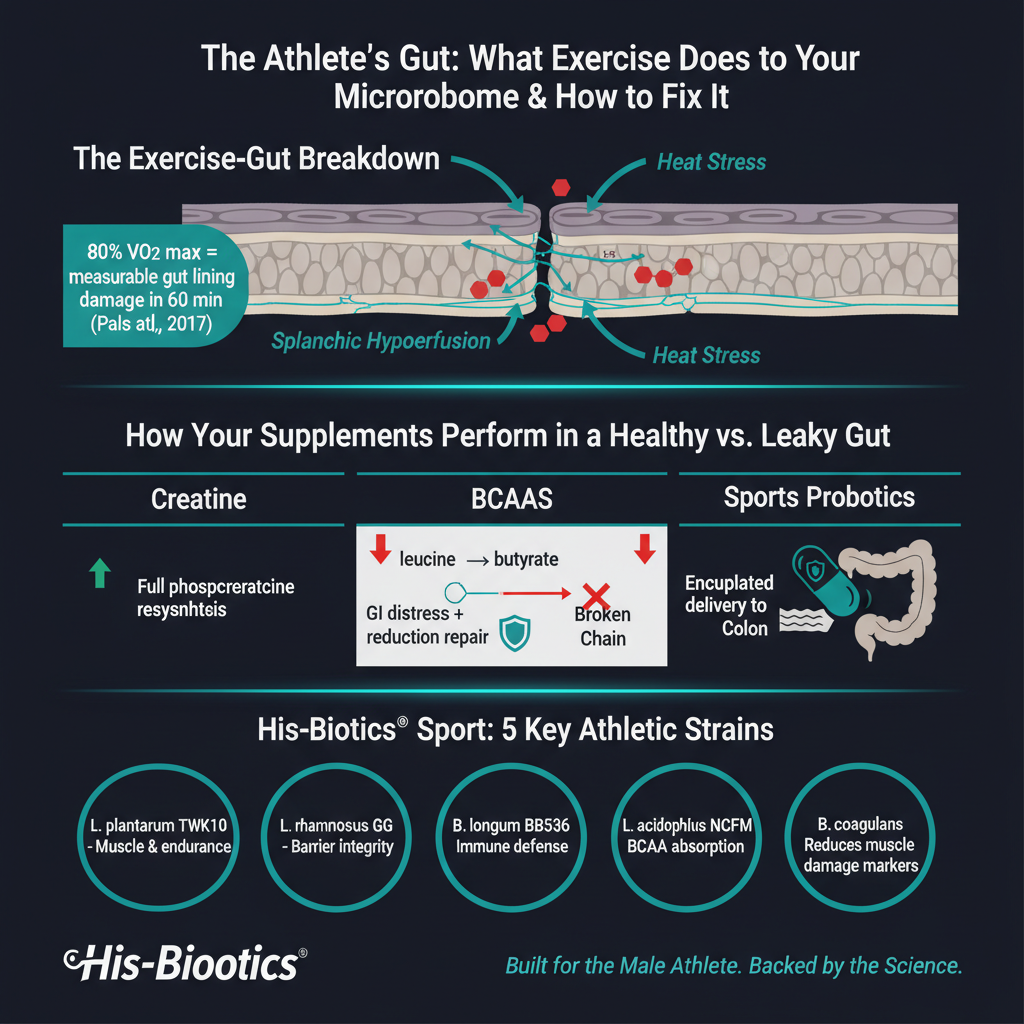
When you push hard in the gym, on the track, or during endurance events, blood is redirected away from the gut and toward working muscles. This process — called splanchnic hypoperfusion — starves the intestinal lining of oxygen and nutrients, weakening the tight junction proteins that normally keep your gut wall sealed. The result is a measurable increase in intestinal permeability: what most people call leaky gut. Bacterial endotoxins, notably lipopolysaccharides (LPS), can then translocate into systemic circulation, triggering low-grade systemic inflammation that directly impairs muscle protein synthesis, blunts testosterone signalling, and prolongs recovery time. The research here is not fringe — it is published, reproducible, and clinically significant.
What makes this particularly relevant for men is that the male gut microbiome appears to respond differently to exercise stress than the female microbiome, influenced partly by testosterone levels and partly by the typically higher training intensities men sustain. This is precisely why I developed His-Biotics® Sport — a formulation built around the specific demands of the male athlete's gut, hormonal milieu, and recovery biology. Understanding the problem is the first step. Let me walk you through the science.
What Exercise Actually Does to Your Gut Lining
A landmark study published in the American Journal of Physiology — Gastrointestinal and Liver Physiology (2017) by Pals et al. demonstrated that even moderate-intensity running at 80% VO2 max for just 60 minutes produces a statistically significant rise in intestinal fatty acid binding protein (I-FABP), a validated biomarker of enterocyte damage. In plain terms: one hour of hard cardio visibly injures the cells that line your gut. This is not a chronic disease finding — this is happening to ordinary, fit, dedicated athletes every single week.
The cascade of events that follows is worth understanding in sequence. First, tight junction proteins — including occludin, claudin-1, and ZO-1 — are downregulated under heat stress and oxidative pressure. Second, the mucus layer produced by goblet cells thins, reducing the first line of defence against luminal bacteria. Third, pattern recognition receptors in the gut-associated lymphoid tissue (GALT) detect the resulting LPS translocation and mount an inflammatory response that is systemic, not localised. Interleukins IL-6 and IL-8 spike, cortisol rises, and anabolic signalling is suppressed. For athletes chasing gains or recovery, this is a hidden saboteur operating entirely below conscious awareness.
A 2019 review in Nutrients by Mach and Fuster-Botella confirmed that gut health in athletes is directly correlated with both performance capacity and immune resilience, with elite endurance athletes showing the highest rates of GI symptoms during competition. The authors specifically highlighted the role of the microbiome in modulating intestinal barrier integrity, noting that certain Lactobacillus and Bifidobacterium strains could attenuate LPS translocation under exercise stress. This is where sports probiotics enter the picture — not as a wellness trend, but as a physiologically grounded intervention.
Creatine, BCAAs, and the Gut: What the Science Says
Most athletes take creatine and branched-chain amino acids (BCAAs) as a matter of course. They're among the most studied ergogenic aids in sports nutrition, and for good reason — the evidence for creatine's role in phosphocreatine resynthesis and for BCAAs' role in reducing muscle protein breakdown is robust. But there is an important and frequently ignored dimension to both: their relationship with gut health in athletes and the microbiome.
Creatine and Gut Health
Creatine monohydrate is generally well-tolerated, but at loading doses of 20–25g per day, a meaningful subset of athletes report bloating, cramping, and osmotic diarrhoea. This is not trivial — gut distress during loading phases disrupts training adherence and can worsen the very intestinal permeability that hard training induces. Emerging research on creatine gut health suggests that the gut microbiome plays a role in creatine metabolism: certain bacterial species possess arginine:glycine amidinotransferase activity, meaning the microbiome participates in endogenous creatine synthesis. A dysbiotic gut — one with reduced microbial diversity — may therefore impair not just creatine absorption but the body's own creatine manufacturing capacity. Optimising the microbiome with targeted sports probiotics before and during creatine supplementation is a strategy that makes both mechanistic and practical sense.
BCAAs, Probiotics, and Muscle Recovery
BCAAs — leucine, isoleucine, and valine — are metabolised primarily in skeletal muscle, but a significant proportion passes through the small intestine where the gut microbiome interacts with them directly. Certain gut bacteria ferment BCAAs into short-chain fatty acids (SCFAs) like butyrate, which in turn feed colonocytes, support tight junction integrity, and reduce intestinal inflammation. This means that a gut abundant in the right microbial species can amplify the recovery benefit of your BCAA supplementation — while a depleted microbiome wastes it. Research linking BCAA probiotics synergy is still emerging, but the mechanistic pathway is well established: gut microbiome research consistently demonstrates that microbial diversity is a prerequisite for optimal amino acid bioavailability and utilisation.
The practical implication is significant. If your gut is inflamed, permeable, or dysbiotic, you are not absorbing your BCAAs at their full potential. You are feeding a compromised system. This is why I always tell my patients: fix the gut first, then stack the supplements. It sounds counterintuitive in a world obsessed with ergogenic loading, but the science backs it unambiguously. Probiotics designed for the athletic male gut are not an add-on — they are the foundation upon which every other supplement works.
What Makes a Sports Probiotic Actually Work?
Not all probiotics are created equal, and this is a point I cannot stress enough. The supplement market is flooded with single-strain, low-CFU capsules that never survive the journey through gastric acid to reach the colon where they're needed. For athletes, this problem is compounded by the fact that intense exercise acidifies the gut environment and accelerates gastric transit — meaning viable delivery of probiotic bacteria is genuinely harder in athletic individuals than in sedentary ones.
This is why formulation technology matters as much as strain selection. At Velobiotics™, we use a proprietary microencapsulation technology that encases each probiotic strain in a protective lipid matrix, shielding bacteria from stomach acid, bile salts, and the osmotic turbulence of the athletic gut. Independent testing confirms that our encapsulated strains achieve significantly higher survival rates to the distal ileum and colon compared to conventional free-form capsules. For athletes, this translates directly into measurable colonisation and clinical effect — not expensive urine.
Strain Selection for the Athletic Male
When selecting strains for exercise recovery probiotics, I look for evidence across three specific domains: intestinal barrier support, immune modulation under exercise stress, and testosterone or hormonal axis interaction. The PubMed research on probiotics and male hormonal health is growing rapidly, with several studies now demonstrating that specific Lactobacillus strains can modulate the gut-testes axis via the enteric nervous system and systemic cytokine pathways. His-Biotics® Sport is formulated around this trifecta — it is not a generic multi-strain blend repurposed for athletes, but a clinically considered formula built from the ground up for the male performance context.
Key Strains and Their Athletic Relevance
- Lactobacillus plantarum TWK10: The most extensively studied sports probiotic strain. Published research in Nutrients (2016, Chen et al.) showed TWK10 supplementation increased muscle mass, reduced fatigue, and improved grip strength versus placebo in a double-blind RCT — effects attributed to enhanced SCFA production and reduced exercise-induced systemic inflammation.
- Lactobacillus rhamnosus GG: Gold-standard evidence for intestinal barrier integrity. Reduces LPS translocation under stress and supports secretory IgA, the immune antibody that guards the gut mucosa during intense training blocks.
- Bifidobacterium longum BB536: Clinically shown to reduce upper respiratory tract infections in athletes — a key concern during heavy training — by supporting mucosal immune defence without overstimulating systemic inflammation.
- Lactobacillus acidophilus NCFM: Supports amino acid absorption in the small intestine, with specific evidence for improved leucine uptake — directly complementing BCAA supplementation strategies.
- Bacillus coagulans MTCC 5856: A spore-forming strain with exceptional acid stability, particularly valuable for athletes given the gastric environment during exercise. Evidence supports reduction of exercise-induced muscle damage markers including creatine kinase.
The Hormonal Connection: Why Gut Health Is a Testosterone Issue
Here is where the conversation gets particularly relevant for men who care about more than just endurance or aesthetics. The gut microbiome is not merely a digestive organ — it is an endocrine organ. Gut bacteria directly influence circulating testosterone through the gut-testes axis, primarily via modulation of LH receptor expression, reduction of pro-inflammatory cytokines that suppress Leydig cell function, and metabolism of sex hormone-binding globulin (SHBG). A chronically inflamed, permeable gut is a testosterone-suppressing gut. Full stop.
This is why my Morning Man Protocol always begins with gut optimisation before we address hormonal interventions directly. I have seen dozens of men undergo testosterone panels, find their levels suboptimal, reach for hormone-adjacent supplements, and achieve mediocre results — because no one addressed the gut dysbiosis and elevated LPS load that was suppressing their hypothalamic-pituitary-gonadal axis from the inside out. Restoring gut barrier integrity can meaningfully shift the hormonal environment within 8–12 weeks, based on both my clinical experience and published microbiome data.
The inclusion of clinical studies on KSM-66® Ashwagandha in our formulation rationale is also relevant here. KSM-66® — the most bioavailable, full-spectrum ashwagandha extract on the market — is clinically proven to reduce cortisol, support testosterone levels, and improve VO2 max. When combined with a targeted probiotic blend that reduces systemic LPS-driven inflammation, the synergistic effect on the male hormonal axis is greater than either intervention alone. This is precision supplementation, not guesswork.
Building Your Athletic Gut Protocol: A Practical Framework
Understanding the science is only valuable if it translates into action. Based on my clinical practice and the emerging body of sports microbiome research, here is how I structure gut health interventions for male athletes — whether they are competitive bodybuilders, weekend warriors, or elite endurance performers. The principles are the same: restore barrier integrity first, colonise with the right strains, then layer your ergogenic supplementation on top of a functioning gut.
Timing and Dosing Considerations
The timing of probiotic supplementation relative to training matters more than most athletes realise. Taking probiotics immediately pre-exercise in the context of high-intensity training may expose them to the very physiological conditions — reduced gut blood flow, acidic environment, rapid transit — that compromise viability. I recommend taking sports probiotics at least 90 minutes before training, or preferably in the post-workout window with your recovery meal, when gut blood flow has normalised and the intestinal environment is more hospitable to colonisation. Consistency across a minimum of 8 weeks is required to achieve meaningful microbiome shifts — this is not an acute intervention but a structural one.
Foundational Steps for Athletic Gut Optimisation
- Audit your gut symptoms: Bloating, loose stools, cramping during or after exercise, or persistent fatigue despite adequate sleep are all flags for intestinal permeability. Don't normalise them as part of heavy training.
- Introduce targeted probiotics first: Before adding or altering creatine or BCAA protocols, establish a 4–6 week probiotic foundation. Your supplement absorption will improve measurably as gut barrier integrity is restored.
- Optimise fibre diversity: Prebiotics — found in chicory root, Jerusalem artichoke, leeks, and green banana — feed the strains you're introducing. Without them, even the best probiotic colonisation is transient.
- Manage training load strategically: Exercise-induced gut permeability peaks at intensities above 70% VO2 max and with training volumes that leave insufficient recovery. Periodisation is gut medicine.
- Reduce NSAID use: Ibuprofen and similar anti-inflammatories independently damage the gut lining and compound the permeability induced by exercise. Use targeted recovery nutrition and cold therapy first.
- Track inflammatory markers: If resources allow, monitoring hs-CRP, I-FABP, and faecal zonulin gives objective data on gut barrier function over time — and provides motivation to stay consistent with your protocol.
Key Takeaways
- Exercise-induced gut permeability is real and measurable: High-intensity training reduces intestinal blood flow, weakens tight junction proteins, and allows bacterial endotoxins to enter systemic circulation — directly impairing recovery, immunity, and hormonal function.
- Creatine and BCAAs work better in a healthy gut: Gut dysbiosis reduces creatine absorption efficiency and impairs BCAA conversion to SCFAs — meaning your most trusted supplements are underperforming if your gut is compromised.
- Not all probiotics survive to act: Free-form probiotic capsules often fail to reach the colon intact, especially in athletes with high gastric acid output and rapid transit. Microencapsulation technology — as used by Velobiotics™ — is the difference between clinical efficacy and expensive placebo.
- The gut-testes axis is real: A dysbiotic, inflamed gut suppresses testosterone signalling via elevated LPS, pro-inflammatory cytokines, and Leydig cell dysfunction. Gut repair is hormonal medicine for men.
- Strain selection determines outcome: Clinically validated strains like L. plantarum TWK10, B. longum BB536, and B. coagulans MTCC 5856 have direct athletic recovery evidence — generic multi-strain blends do not.
- Consistency and timing unlock results: A minimum 8-week commitment, dosed strategically around training, is required for meaningful microbiome-level change and measurable improvement in athletic performance gut function.
If this article has shifted how you think about recovery, I'd encourage you to take the next step with intention. His-Biotics® Sport was formulated specifically for the male athlete who trains hard, demands more from his body, and wants the science to match the effort. It is the only sports probiotic on the market built around the male gut-hormone axis, encapsulated for maximum athletic bioavailability, and backed by the clinical reasoning I apply in practice every day. If you're unsure where to start, explore our athlete formula range to find the right fit for your training phase — or take the Total Gut Score (TGS) Quiz to receive a personalised protocol based on your individual gut health profile. Your microbiome is not a footnote in your performance story. It is the first chapter.
— Dr. Chomba Chuma, MD & Founder, His-Biotics® by Velobiotics™