Why Your Training Programme Is Quietly Destroying Your Gut
You spend hours optimising your training split, your macros, your sleep protocol — and yet something still feels off. Recovery is slower than it should be. Bloating after your post-workout shake. Brain fog on rest days. Low-grade fatigue that no amount of caffeine quite fixes. What most athletes — amateur and elite alike — never consider is that the problem may not be above the neck or in the muscle fibres. It lives in the gut wall. Exercise-induced gut permeability, commonly called "leaky gut in athletes," is one of the most underdiagnosed performance limiters in sports medicine today, and the research on gut health athletes need to understand is finally catching up with what clinicians like me have been observing for years.
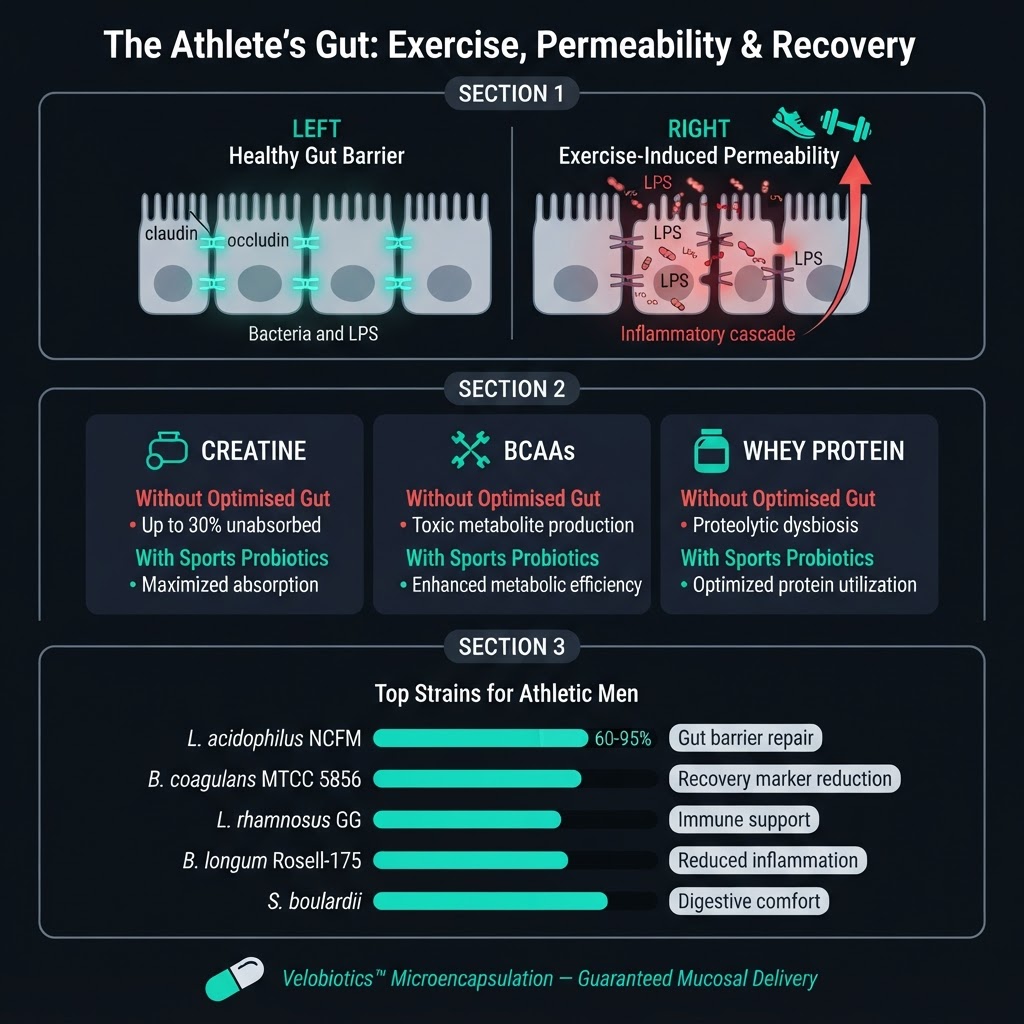
When you push hard — sprinting intervals, heavy compound lifts, long-distance endurance work — your sympathetic nervous system prioritises blood flow to working muscles and away from your gastrointestinal tract. This splanchnic hypoperfusion reduces oxygen delivery to the gut epithelium, the single-cell-thick lining that acts as your body's primary barrier between the external environment and your bloodstream. The result is oxidative stress at the intestinal wall, degradation of tight junction proteins like occludin and claudin-1, and a transient but meaningful increase in intestinal permeability. In plain English: your gut starts to leak. Bacterial endotoxins, undigested food particles, and lipopolysaccharides (LPS) — the inflammatory outer coat of gram-negative bacteria — cross into circulation and trigger a systemic immune response that masquerades as ordinary training fatigue.
A landmark study published in the Alimentary Pharmacology & Therapeutics journal (2012, Costa et al.) demonstrated that high-intensity exercise increased plasma LPS concentrations and markers of intestinal epithelial damage, including intestinal fatty acid-binding protein (I-FABP), in trained endurance athletes within hours of a prolonged bout. What this means practically is that every hard training session is, to a degree, a controlled inflammatory event — one your gut microbiome either helps you recover from or amplifies into something far more damaging. The athletes who train hardest and recover fastest are not simply genetically gifted; many of them have a gut environment that clears inflammatory signals quickly and rebuilds the epithelial barrier between sessions.
The Stack Problem: How Creatine, BCAAs and Protein Powders Interact with Your Gut
Walk into any gym changing room and you'll find the standard supplement trinity: creatine monohydrate, branched-chain amino acids (BCAAs), and whey protein. These are, on the whole, evidence-backed compounds that support muscle protein synthesis, phosphocreatine replenishment, and training adaptation. But their interaction with creatine gut health and the broader gut microbiome is rarely discussed — and it matters more than most coaches or nutritionists acknowledge.
Creatine monohydrate is absorbed primarily in the small intestine via a sodium-dependent transporter (SLC6A8). When creatine is taken in large bolus doses — the classic 20g/day loading protocol — the transporter becomes saturated, and unabsorbed creatine passes into the colon, where it can draw water osmotically (contributing to the bloating and GI distress many athletes report) and alter the local microbial environment. A 2021 review in Nutrients highlighted that the gut microbiota actively metabolises creatine, with certain bacterial populations influencing how efficiently it is absorbed and converted. An athlete with a compromised or low-diversity microbiome is, in this sense, literally wasting a portion of their creatine investment — and potentially producing more osmotic discomfort in the process.
The story with BCAA probiotics synergy is equally compelling. BCAAs — leucine, isoleucine, and valine — are taken to stimulate mTORC1, reduce exercise-induced muscle protein breakdown, and blunt central fatigue during prolonged training. However, emerging gut microbiome research points to a bidirectional relationship: the gut microbiota catabolises BCAAs via dedicated enzymatic pathways, and dysbiotic microbial communities can shunt BCAA metabolism toward the production of toxic metabolites including propionic acid and branched-chain fatty acids that have been linked to systemic insulin resistance and increased neuroinflammatory tone. In simple terms, if your gut flora is out of balance, your BCAAs may be doing your gut more harm than your muscles good. The microbial environment doesn't just receive your supplements passively — it actively processes them, and the outputs depend entirely on what strains are present.
What the Data Says About Whey and Gut Integrity
High-dose whey protein, a staple for muscle-building athletes, presents its own microbiome challenge. Whey is rapidly digested and, in excess, can produce an acidic fermentation environment in the colon, favouring proteolytic bacteria over saccharolytic (fibre-fermenting) species. This shifts the gut ecosystem toward a more inflammatory phenotype — less butyrate production, more ammonia and hydrogen sulphide, reduced Bifidobacterium and Lactobacillus populations. For the athlete already dealing with exercise-induced gut permeability, piling high-protein loads onto a compromised epithelium is, mechanistically, like trying to repair a damaged wall while simultaneously taking a sledgehammer to the brickwork. Targeted supplementation with sports probiotics specifically selected for the athletic gut environment is one of the most logical and evidence-grounded interventions available.
Sports Probiotics: What the Science Actually Supports
Not all probiotics are created equal, and the marketing landscape for gut supplements is — to put it charitably — wildly inconsistent. When I talk about sports probiotics in a clinical context, I mean specific well-characterised strains at clinically relevant doses, delivered in a format that allows them to survive gastric acid and actually colonise the intestinal mucosa. This distinction matters enormously. A yoghurt drink or a generic acidophilus capsule taken after a training session is not the same intervention as a multi-strain, microencapsulated formulation designed around the specific demands of gut health athletes face.
The evidence for specific probiotic strains in athletic populations is growing rapidly. A randomised controlled trial published in the Journal of the International Society of Sports Nutrition (2019, Jäger et al.) found that supplementation with Bacillus coagulans MTCC 5856 significantly reduced exercise-induced muscle damage markers (CK and LDH) and improved recovery perception in resistance-trained men compared to placebo. The proposed mechanism was reduction in intestinal permeability and blunting of LPS-mediated systemic inflammation post-exercise — meaning the probiotic was working precisely at the gut-wall level to interrupt the inflammatory cascade that slows recovery. You can find a broader body of supporting data if you search the PubMed research on probiotics and performance, where the volume of high-quality trials published in the last five years alone is genuinely impressive.
A second key area is upper respiratory tract infection (URTI) prevention. Athletes in heavy training blocks are immunosuppressed — the open-window hypothesis in exercise immunology describes the period immediately post-exercise as one of heightened susceptibility to infection. Multiple meta-analyses, including a 2021 Cochrane-adjacent systematic review in Exercise Immunology Review, have confirmed that multi-strain probiotic supplementation reduces both the incidence and duration of URTIs in athletic populations by measurable margins. For any serious athlete or active man, this is not a trivial finding — one week of illness-forced rest can undo several weeks of progressive overload.
Strain Selection: Why the Species List on the Label Matters
The strains I consider most evidence-supported for athletic men specifically include Lactobacillus acidophilus NCFM (gut barrier integrity and tight junction upregulation), Bifidobacterium longum Rosell-175 (systemic inflammation modulation), Lactobacillus rhamnosus GG (URTI prevention, established safety record), and Bacillus coagulans (spore-forming stability and exercise recovery data as noted above). The advantage of spore-forming strains like Bacillus coagulans for athletes is their thermal and acid stability — they survive not only stomach acid but also the elevated core body temperatures associated with intense training, which can render many conventional Lactobacillus strains less viable.
- L. acidophilus NCFM: Upregulates tight junction proteins, directly addressing exercise-induced permeability at the structural level.
- B. longum Rosell-175: Demonstrated reductions in systemic inflammatory cytokines (IL-6, TNF-α) relevant to post-exercise inflammation.
- L. rhamnosus GG: The most studied probiotic strain globally, with robust data for immune function and gut lining support.
- B. coagulans MTCC 5856: Spore-forming resilience plus direct RCT evidence for reducing exercise-induced muscle damage markers.
- Saccharomyces boulardii: Non-bacterial yeast probiotic with strong evidence for gut barrier restoration and reduction of intestinal permeability markers.