When You Train Hard, Your Gut Pays the Price First
Most serious athletes obsess over split times, rep maxes, and macros — but very few think about what's happening inside their intestines during a brutal training session. The truth is, vigorous physical exercise is one of the most potent triggers of gut barrier disruption known to sports medicine. Within 60 minutes of high-intensity effort, intestinal permeability can increase measurably, allowing bacterial endotoxins, undigested food particles, and inflammatory compounds to leak from the gut lumen into systemic circulation. This phenomenon — commonly called leaky gut, or more precisely exercise-induced intestinal hyperpermeability — is not a fringe concept. It is well-documented, clinically significant, and quietly sabotaging the recovery of countless athletes who are doing everything else right.
As a clinician working at the intersection of gut medicine and performance, I see this pattern constantly. A man is training five or six days a week, eating clean, taking his creatine and BCAAs, and still experiencing bloating, unpredictable energy, poor sleep, and plateaued gains. The missing piece is almost always the gut. When the intestinal barrier is compromised, nutrient absorption falters, systemic inflammation rises, testosterone signalling is disrupted, and the very supplements meant to accelerate recovery end up poorly utilised. Understanding this cascade is not optional for the serious athlete — it is foundational. And the emerging science of gut health athletes need to pay attention to is pointing us toward a clear, actionable solution: sports probiotics engineered specifically for the demands of the trained male body.
In this article, I want to walk you through the mechanisms of exercise-induced gut permeability, explain how your protein supplements interact with your microbiome, and make the case — backed by published research — for why targeted probiotic supplementation is one of the highest-leverage interventions in modern performance medicine. This is not wellness fluff. This is physiology with clinical teeth.
The Biology of Exercise-Induced Gut Permeability
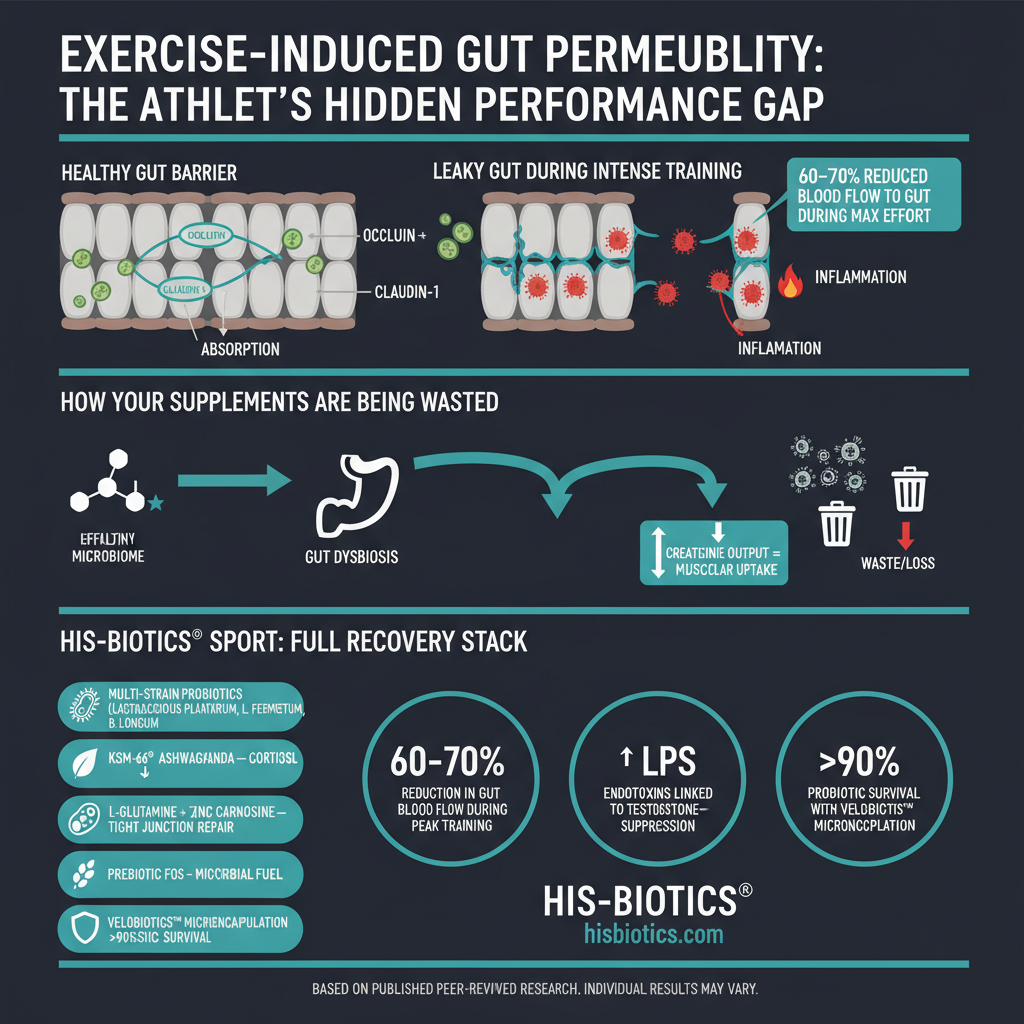
To understand why intense exercise compromises the gut barrier, you need to understand a basic physiological reality: during maximal effort, blood is aggressively redistributed away from the gastrointestinal tract toward the working muscles, heart, and lungs. This splanchnic hypoperfusion — a reduction in blood flow to the gut — can reduce intestinal circulation by as much as 60–70% during prolonged endurance exercise. The resulting ischaemia-reperfusion cycle (restricted blood flow followed by a flood of oxygenated blood upon rest) generates reactive oxygen species that damage the tight junction proteins holding your intestinal epithelial cells together. Proteins like occludin, claudin-1, and zonulin become dysregulated, and the gut wall effectively becomes porous.
A landmark study published in Alimentary Pharmacology & Therapeutics (2012) by Lamprecht and colleagues demonstrated that endurance athletes showed significantly elevated markers of intestinal permeability — including zonulin and fatty acid binding protein — compared to sedentary controls, and that these markers correlated directly with systemic inflammatory cytokines. This is not a trivial finding. It means that the inflammation athletes typically attribute to muscle damage is being compounded by gut-derived endotoxaemia — specifically, lipopolysaccharides (LPS) from gram-negative bacteria crossing the compromised intestinal wall and triggering a whole-body inflammatory response. The gut microbiome research published over the last decade has made clear that the composition of your gut flora directly determines how resilient or fragile your intestinal barrier is under these conditions.
For male athletes specifically, the consequences extend beyond inflammation and recovery time. Chronic low-grade endotoxaemia suppresses Leydig cell function in the testes — meaning less testosterone production at the cellular level. The gut-testes axis is real, it is bidirectional, and it means that protecting your gut barrier is not just a digestive matter; it is a hormonal one. This is why the approach we take at His-Biotics® is fundamentally different from mainstream sports nutrition: we treat the gut as the command centre, not an afterthought.
Creatine, BCAAs, and What Your Gut Actually Does With Them
Creatine monohydrate and branched-chain amino acids (BCAAs) are the two most popular performance supplements in the world, and for good reason — the evidence base supporting both is extensive. But here is what most sports nutrition brands will not tell you: the efficacy of both compounds is profoundly dependent on the health of your gut microbiome. When gut permeability is elevated and the microbial ecosystem is dysbiotic, the absorption and metabolism of these supplements become compromised in ways that directly undercut your investment in them.
Creatine and Gut Health
Creatine is absorbed primarily in the small intestine via sodium-dependent creatine transporters. In a healthy gut with intact tight junctions and a diverse microbiome, this process is efficient. However, research has shown that gut dysbiosis alters the expression of intestinal transport proteins, reducing uptake of creatine and other small molecules. Furthermore, excess unabsorbed creatine that reaches the large intestine is converted by bacteria into creatinine — a metabolic waste product — essentially flushing your supplementation money down the toilet. The common complaints of creatine gut health issues — bloating, cramping, loose stools — are not simply dose-dependent side effects; they are frequently signals of underlying gut dysbiosis amplified by high substrate load. Fixing the gut microbiome first means more creatine reaches the muscle, and less causes digestive chaos.
BCAAs and the Microbiome Connection
The relationship between BCAAs and the gut is equally compelling, and more nuanced than most athletes appreciate. Leucine, isoleucine, and valine are metabolised not only in the liver and muscle tissue but also extensively by gut bacteria. Specific strains — particularly Lactobacillus and Bifidobacterium species — produce short-chain fatty acids (SCFAs) from amino acid fermentation that serve as direct fuel for colonocytes (intestinal lining cells) and help maintain tight junction integrity. A 2019 study in the Journal of the International Society of Sports Nutrition found that probiotic supplementation alongside BCAA intake in trained athletes significantly reduced markers of muscle damage (creatine kinase and lactate dehydrogenase) compared to BCAAs alone, suggesting a genuine synergy between BCAA probiotics co-administration and recovery outcomes. When you stack well-selected sports probiotics with your amino acid protocol, you are not just taking two supplements — you are creating a metabolic environment where each compound works harder.
The practical implication is straightforward: if you are spending money on creatine and BCAAs but neglecting your gut, you are running a high-performance engine on a clogged fuel line. Addressing gut permeability and microbial diversity is not ancillary to your supplementation strategy — it is prerequisite to it.
The Science of Sports Probiotics for Athletic Recovery
Not all probiotics are created equal, and the marketing noise around gut health supplements has made it genuinely difficult for athletes to identify what actually works. The distinction that matters most for performance is strain specificity. Generic multi-strain products designed for digestive comfort in sedentary populations are categorically different from formulations developed around the physiological demands of the trained male gut. Exercise recovery probiotics need to survive the harsh acid environment of the stomach, colonise the intestinal mucosa transiently, reduce LPS-driven inflammation, support tight junction protein expression, and — critically — interact favourably with the high-protein, high-substrate environment that characterises an athlete's gut.
The research here is genuinely exciting. A study published in the British Journal of Sports Medicine (Haywood et al., 2014) demonstrated that supplementation with Lactobacillus fermentum VRI-003 in elite male rugby players significantly reduced the incidence of upper respiratory tract infections during a competitive season — a well-established consequence of exercise-induced immunosuppression mediated partly through gut barrier compromise. More relevant to recovery, a growing body of PubMed research on probiotics is demonstrating that specific strains modulate the hypothalamic-pituitary-gonadal axis, supporting testosterone bioavailability and reducing sex hormone-binding globulin — a finding with direct relevance to athletic performance gut optimisation in men.
What separates elite-grade sports probiotics from the rest comes down to three criteria: strain selection validated in athletic or high-stress populations, a delivery mechanism that ensures live bacteria actually reach the gut intact, and formulation alongside complementary bioactives that address the full recovery cascade — not just the microbiome in isolation.
Why Delivery Technology Is Not a Minor Detail
Here is something that rarely appears on product labels but matters enormously: most probiotic capsules fail before they even reach the gut. The acidic environment of the stomach — with a pH as low as 1.5–2.0 during active digestion — destroys the majority of unprotected bacterial strains before they can exert any therapeutic effect. Standard enteric coating offers partial protection, but it is an imprecise solution for the range of gastrointestinal conditions an athlete's gut experiences throughout the day. At Velobiotics™, we developed our proprietary microencapsulation technology to address this directly. Each probiotic strain in His-Biotics® Sport is individually encapsulated in a protective lipid matrix that maintains bacterial viability through gastric transit, releases precisely in the small intestine, and delivers clinically meaningful colony-forming units to the target site — not to a stomach acid graveyard. This is the difference between a supplement and a delivery system.
His-Biotics® Sport: Built for the Male Athlete's Gut
His-Biotics® Sport is not a repackaged generic probiotic with a different label. It is a clinically designed formulation built around the specific biological pressures that hard training places on the male gut-microbiome-hormone axis. Every strain in the formula was selected based on peer-reviewed evidence in athletic or physiologically stressed populations, and the formula includes complementary bioactives that work in concert with the probiotic core to address recovery from multiple angles simultaneously.
Key Features of the Formula
- Multi-strain probiotic complex: Selected strains of Lactobacillus plantarum, Lactobacillus fermentum, and Bifidobacterium longum — each with demonstrated relevance to intestinal barrier integrity, immune modulation, and protein metabolism in athletic contexts.
- Velobiotics™ microencapsulation: Proprietary lipid-matrix delivery ensuring >90% bacterial survival through gastric transit, so you get what the label says where it needs to go.
- KSM-66® Ashwagandha: The world's most clinically studied root extract, included for its evidence-based effects on cortisol reduction, testosterone support, and exercise recovery — see the clinical studies on KSM-66® Ashwagandha for a full review of the human trial data.
- Gut-barrier support complex: Including L-glutamine and zinc carnosine, both of which have direct mechanistic evidence for supporting tight junction protein expression and reducing exercise-induced permeability.
- Prebiotic substrate: Fructooligosaccharides (FOS) to selectively nourish the beneficial strains delivered in the formula, extending their colonisation window and amplifying SCFA production.
The formulation philosophy is integrative by design. Rather than delivering probiotics in isolation and hoping for the best, His-Biotics® Sport provides the microbial strains, the structural gut support, the anti-inflammatory adaptogen, and the prebiotic fuel simultaneously — creating the optimal conditions for all components to work synergistically. For men following a structured training programme and using creatine and/or BCAAs, this stack represents a meaningful upgrade to how efficiently those supplements are absorbed and utilised. To explore our athlete formula in full and see how it fits within a broader performance nutrition strategy, our product range page walks through the complete science.
Integrating Gut Health Into Your Athletic Recovery Stack
Knowing the science is one thing. Applying it effectively requires a practical framework. The gut health athletes who see the most dramatic improvements are those who treat gut optimisation as a foundational layer — something addressed before and alongside performance supplementation, not as an afterthought when GI symptoms become undeniable. Here is how I advise athletes to think about integration:
- Sequence your supplementation intelligently. Take His-Biotics® Sport with your first meal of the day, before training, rather than immediately post-workout when gastric acid secretion is highest and gut motility is accelerated. This maximises the transit time available for mucosal colonisation.
- Pair with consistent prebiotic intake. Fibre from diverse plant sources — leeks, garlic, green bananas, chicory — feeds the strains you are supplementing and creates a more stable, diverse microbial ecosystem over time. Probiotics without prebiotics are like planting seeds in concrete.
- Monitor your gut response to creatine loading. If you experience GI distress during a creatine loading phase, treat it as a signal of gut dysbiosis rather than simply reducing the dose. Addressing the microbial environment first frequently resolves the issue entirely.
- Consider the Morning Man Protocol as a complementary daily framework. The Morning Man Protocol we developed at His-Biotics® provides a structured, time-specific approach to gut and hormonal support that integrates naturally with a performance supplementation routine — particularly for men who train in the morning and want to optimise both gut barrier function and testosterone output through the day.
- Manage training load periodically. The greatest driver of exercise-induced gut permeability is accumulated training stress without adequate recovery. Gut support supplements are powerful — but they cannot compensate indefinitely for chronically inadequate sleep or extreme overtraining.
- Track subjective markers as proxy indicators. Bloating after protein meals, unusual fatigue, recurrent minor infections, and morning brain fog are all clinically meaningful signals of gut-immune disruption in athletes. They should be taken seriously as early warning signs, not normalised as part of training life.
The broader point I want to make here is that elite athletic performance is a systems problem. The gut is not one variable among many — it is the variable that determines how effectively every other variable performs. Nutrition gets absorbed through the gut. Hormones are regulated partly through the gut. The immune system is educated and maintained through the gut. When you get gut health right, you are not just fixing digestion — you are upgrading the entire operating system.
Key Takeaways
If you take nothing else from this article, let these six points anchor your understanding of the athlete-gut relationship and what to do about it:
- Exercise-induced gut permeability is real and measurable: High-intensity and prolonged training reliably compromises intestinal tight junctions, allowing inflammatory endotoxins into systemic circulation and elevating whole-body inflammation beyond what muscle damage alone accounts for.
- Your creatine and BCAA absorption depends on your gut microbiome: Dysbiosis reduces transporter expression and diverts supplements toward bacterial fermentation rather than muscular uptake — meaning gut health is a prerequisite for supplement efficacy, not a separate concern.
- Strain-specific sports probiotics meaningfully accelerate recovery: Peer-reviewed evidence supports selected Lactobacillus and Bifidobacterium strains in reducing muscle damage markers, supporting immune function, and modulating the hormonal environment in trained men.
- Delivery technology determines real-world efficacy: Without a validated survival mechanism through gastric acid, most probiotic products deliver little more than dead bacteria to the colon. Velobiotics™ microencapsulation solves this problem with a precision lipid-matrix system.
- The gut-hormone axis matters for every male athlete: Chronic gut permeability suppresses testosterone production at the testicular level — making gut barrier repair a direct investment in hormonal performance, not just digestive comfort.
- His-Biotics® Sport integrates the full recovery cascade: By combining validated probiotic strains, KSM-66® Ashwagandha, L-glutamine, zinc carnosine, and prebiotic substrate in one microencapsulated formula, it addresses gut permeability, inflammation, hormonal support, and nutrient absorption simultaneously.
If you are serious about your performance and you have not yet made gut health a non-negotiable part of your stack, this is where I would start. Visit the His-Biotics® Sport product page to review the full formulation details, clinical rationale, and usage guide — or take our Total Gut Score (TGS) quiz to identify exactly where your gut health is limiting your athletic performance and which His-Biotics® formula is most appropriate for your current profile. Your gains are only as good as the gut that absorbs them.
— Dr. Chomba Chuma, MD & Founder, His-Biotics® by Velobiotics™