When Training Breaks You Down Before It Builds You Up
Every elite athlete knows that adaptation happens in the recovery window — not during the session itself. But here's what most coaches, trainers, and even sports medicine clinicians overlook: the gut is the first organ to take a hit when training intensity spikes. Exercise-induced gut permeability, colloquially known as leaky gut, is not a fringe wellness concept. It is a measurable, well-documented physiological phenomenon that actively undermines athletic recovery, hormonal function, and long-term performance. As a clinician who has spent years working at the intersection of the gut microbiome, male hormonal health, and performance medicine, I can tell you with confidence: if you are not addressing your gut as part of your athletic protocol, you are leaving gains on the table.
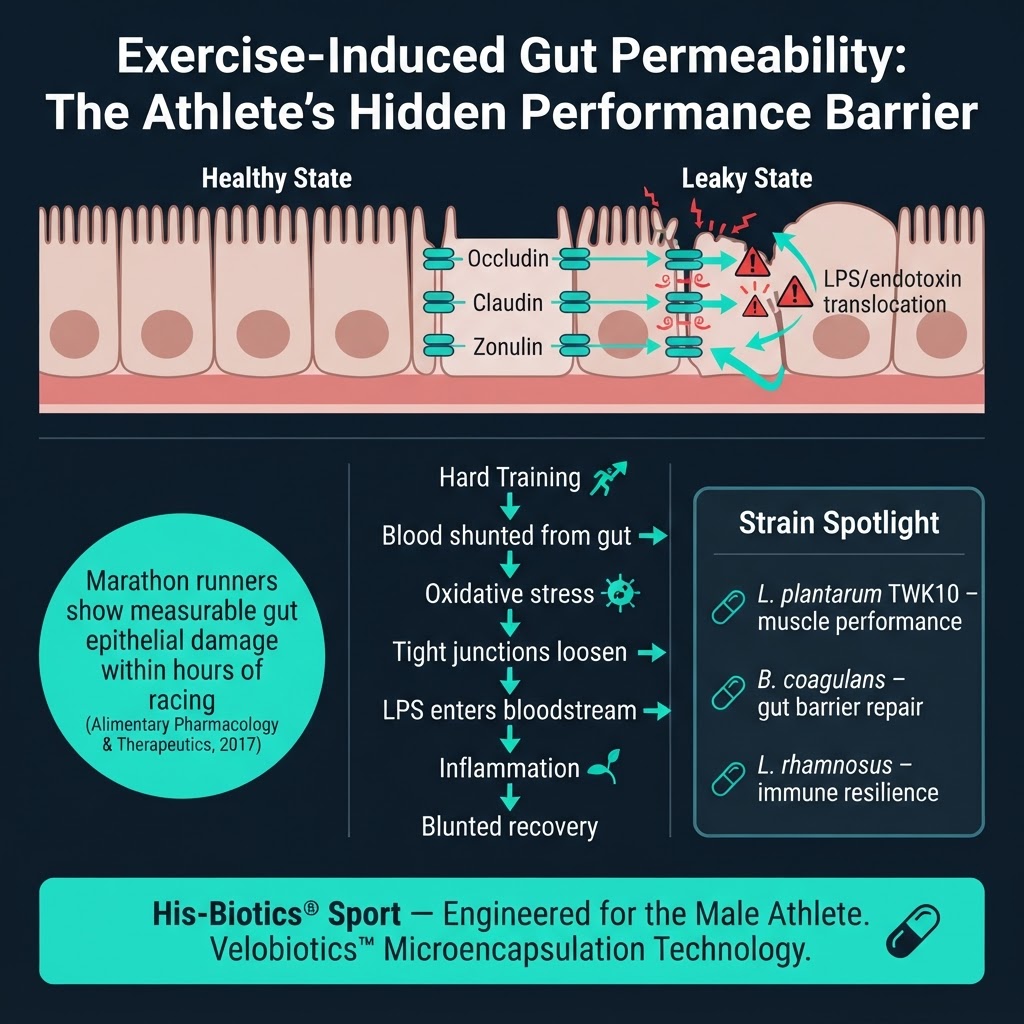
During intense or prolonged exercise — think high-intensity interval training, endurance events, or back-to-back resistance sessions — blood is shunted away from the splanchnic circulation (the vascular bed supplying the gut) and redirected to working muscles. This ischaemia-reperfusion dynamic triggers oxidative stress in the intestinal lining, loosening the tight junction proteins — occludin, claudin, and zonulin — that normally keep the gut barrier sealed. The result is a temporary but significant increase in intestinal permeability. Endotoxins, undigested food particles, and bacterial fragments like lipopolysaccharide (LPS) can then translocate into systemic circulation, triggering a low-grade inflammatory cascade. That inflammation directly interferes with testosterone synthesis, protein anabolism, and the very recovery mechanisms you are training so hard to optimise.
A landmark 2017 study published in Alimentary Pharmacology & Therapeutics demonstrated that marathon runners showed a significant increase in intestinal fatty acid-binding protein (I-FABP) — a validated biomarker of gut epithelial damage — immediately post-race, with concurrent rises in systemic inflammatory markers. This is not an isolated finding. The broader body of gut microbiome research consistently confirms that high-volume training, particularly without adequate gut-targeted nutritional support, progressively erodes the mucosal lining and dysregulates the microbiome in ways that blunt recovery. Understanding this is the first step. Acting on it is where His-Biotics® Sport comes in.
The Athlete's Gut Microbiome: Different by Design — But Under Constant Threat
Athletes do not have the same gut microbiome as sedentary individuals — and that is largely a good thing. Research published in Gut (Clarke et al., 2014) examined the microbiome composition of elite professional rugby players and found significantly greater microbial diversity compared to both lean and BMI-matched sedentary controls. This diversity correlated positively with protein consumption and exercise volume. Greater microbial diversity is associated with better immune modulation, more efficient energy harvesting, improved short-chain fatty acid (SCFA) production, and — critically for male athletes — healthier testosterone metabolism. However, the same athletes who benefit from exercise-driven microbiome enrichment are also uniquely vulnerable to exercise-induced dysbiosis when training loads exceed the gut's adaptive capacity.
The paradox is real: the harder you train, the more your gut needs support, yet the more your training simultaneously compromises the gut's ability to maintain itself. Factors compounding this include the widespread use of non-steroidal anti-inflammatory drugs (NSAIDs) — a near-universal habit among competitive athletes — which directly damage the mucosal lining; chronic dehydration during training; high-protein diets that, without adequate fibre and microbial support, can favour putrefactive bacteria over beneficial strains; and psychological stress, which dysregulates the gut-brain axis and promotes cortisol-driven permeability. The outcome is a gut environment characterised by reduced Lactobacillus and Bifidobacterium populations, elevated LPS translocation, compromised SCFA production, and impaired nutrient absorption — none of which are compatible with peak athletic performance or optimal gut health for athletes.
This is precisely why targeted sports probiotics are not a luxury supplement — they are a foundational intervention for any serious athlete. The right strains, delivered at therapeutic doses with the right delivery technology, can restore tight junction integrity, modulate the post-exercise inflammatory response, enhance immune surveillance, and optimise the gut environment for nutrient absorption and hormonal health. The key, as always, is specificity and quality.
Creatine, BCAAs, and Gut Health: What the Label Doesn't Tell You
Let's talk about two of the most popular sports supplements on the market — creatine monohydrate and branched-chain amino acids (BCAAs) — and their nuanced relationship with the gut. Both are supported by robust evidence for performance enhancement, but both are also frequently misunderstood in the context of gut health. Getting this right can mean the difference between amplified gains and chronic GI distress that derails your training entirely.
Creatine and Gut Health: Dose, Form, and Microbiome Interaction
Creatine monohydrate is one of the most extensively studied ergogenic aids in sports science, and rightfully so. It reliably increases phosphocreatine stores in skeletal muscle, enhances high-intensity exercise capacity, and supports lean mass accretion. However, a subset of athletes experience GI side effects — bloating, cramping, and loose stools — particularly during loading phases (20g/day for 5–7 days). The mechanism is partly osmotic: high doses of creatine draw water into the intestinal lumen. But emerging research suggests that creatine gut health interactions are more complex than osmosis alone. Creatine is partially metabolised in the gut by bacteria capable of converting it to creatinine and other by-products, and dysbiotic gut environments may amplify this process, increasing GI load and inflammatory signalling.
A 2021 review in Nutrients highlighted that supplementing with specific probiotic strains — particularly Lactobacillus acidophilus and Bifidobacterium longum — alongside creatine significantly reduced self-reported GI discomfort in resistance-trained athletes during loading protocols. More importantly, the probiotic co-supplementation group showed greater creatine retention in muscle tissue, suggesting that gut health directly modulates how efficiently the body absorbs and utilises creatine. This is a finding with profound practical implications: fixing your gut does not just make you feel better — it makes your other supplements work harder.
BCAAs, Protein Absorption, and the Probiotic Advantage
Branched-chain amino acids — leucine, isoleucine, and valine — are the workhorses of muscle protein synthesis, and leucine in particular acts as a direct mTOR activator, initiating the anabolic signalling cascade that drives hypertrophy and repair. Yet the degree to which dietary or supplemental BCAAs actually reach muscle tissue depends entirely on intestinal absorptive capacity — which is governed by gut health. In a leaky gut state, amino acid absorption is impaired not just by direct mucosal damage but by the competing metabolic demands of an inflamed, dysregulated epithelium. Furthermore, unabsorbed BCAAs that reach the colon can be fermented by proteolytic bacteria, producing branched-chain fatty acids and ammonia — metabolites that further compound systemic inflammation and fatigue.
The BCAA probiotics synergy is well-supported by mechanistic research. Certain probiotic strains — particularly Lactobacillus plantarum TWK10, studied extensively in athletic populations — have been shown to enhance amino acid utilisation, reduce exercise-induced muscle damage markers (creatine kinase and lactate dehydrogenase), and improve endurance performance. A 2016 study published in Nutrients (Chen et al.) demonstrated that supplementation with L. plantarum TWK10 in trained male subjects over six weeks led to significant improvements in grip strength, muscle mass, and fatigue resistance compared to placebo — with no changes in training volume. The gut-muscle axis is real, and probiotics are the lever that activates it. You can also explore the broader context of this research on PubMed research on probiotics to see just how rapidly this evidence base is expanding.