Why Hard Training Can Wreck Your Gut
Most men training for performance think about the variables they can see and measure — training volume, caloric intake, sleep hours, creatine loading. What they rarely think about is the one system quietly governing all of the above: the gut. When you push your body through intense exercise, particularly prolonged endurance efforts or high-volume resistance training, you trigger a phenomenon known as exercise-induced gut permeability — colloquially called leaky gut. It's not a fringe concept or a wellness buzzword; it's a well-documented physiological response that has profound implications for gut health in athletes and long-term performance. Understanding it is no longer optional for serious men. It's foundational.
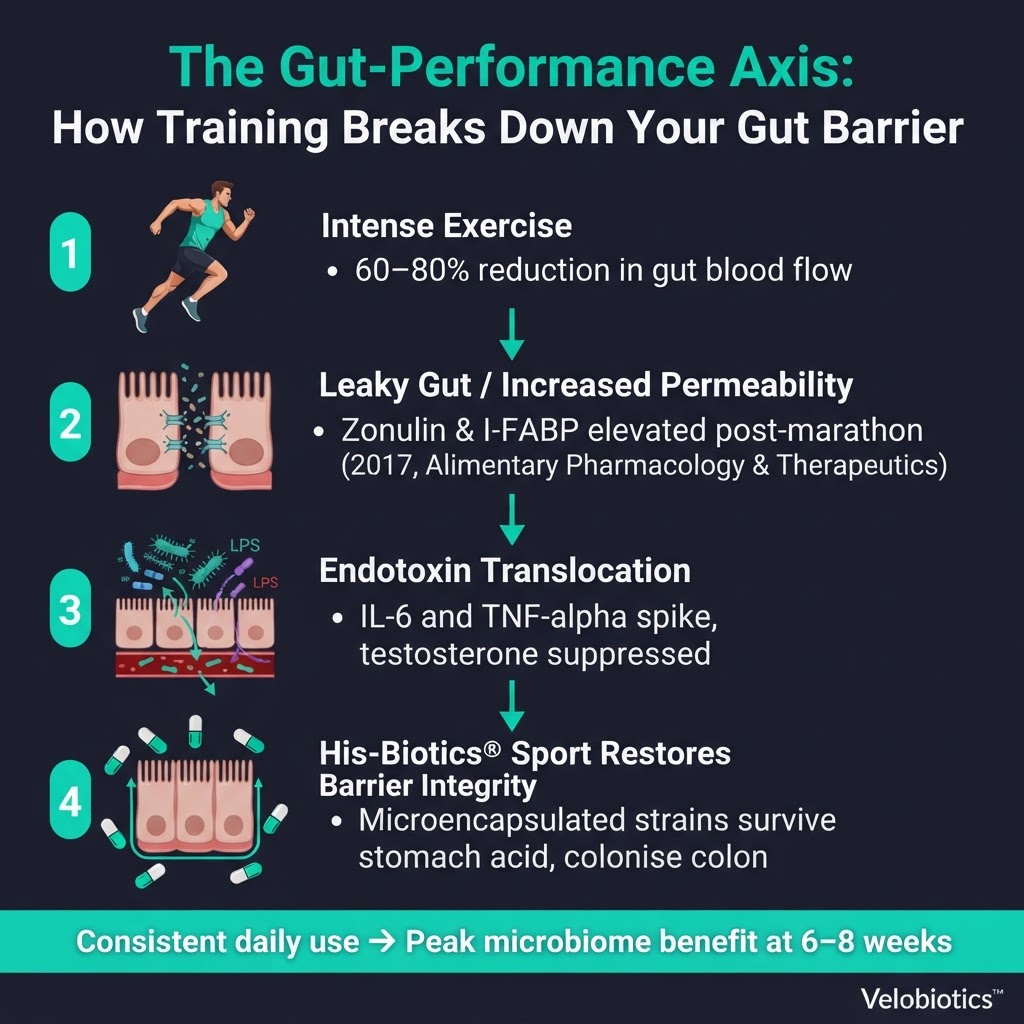
During strenuous exercise, blood is redirected away from the gastrointestinal tract and towards working muscles — a process called splanchnic hypoperfusion. This reduction in gut blood flow, sometimes as much as 60–80% during maximal exertion, creates transient ischaemia in the intestinal lining. The tight junction proteins that hold your gut epithelium together — occludin, claudin, and zonulin — begin to loosen. The result is a gut barrier that is temporarily, but meaningfully, compromised. Bacterial endotoxins like lipopolysaccharide (LPS) can translocate into systemic circulation, triggering low-grade inflammation, elevating cortisol, and blunting testosterone. For any man concerned with hormonal health and recovery, this is a critical mechanism to address.
A landmark 2017 study published in Alimentary Pharmacology & Therapeutics found that markers of intestinal permeability — including serum zonulin and intestinal fatty acid binding protein (I-FABP) — were significantly elevated following a marathon race, with athletes showing measurable endotoxaemia post-finish. The implications are stark: even well-conditioned athletes are not immune to gut barrier disruption during high-intensity efforts. The difference between a champion and a chronically inflamed underperformer may well lie in how effectively they protect and restore their gut lining. This is where His-Biotics® Sport was developed to step in.
The Gut-Performance Axis: More Than Digestion
The gut microbiome is often discussed purely in terms of digestive health — bloating, regularity, nutrient absorption. But for male athletes, its role extends far deeper into the performance matrix. The gut microbiome research published over the last decade consistently demonstrates that the composition of your intestinal flora directly influences inflammation, immune function, muscle protein synthesis signalling, and even testosterone regulation. A dysbiotic gut — one with reduced microbial diversity and overgrowth of pathogenic species — creates a systemic environment hostile to recovery.
Research from the British Journal of Sports Medicine (2019) demonstrated that elite rugby players harbour distinct microbiome profiles compared to sedentary controls, including significantly higher levels of Akkermansia muciniphila, a keystone species associated with gut barrier integrity and metabolic efficiency. These athletes weren't just eating well — their microbial ecosystems were actively supporting their physical outputs. But here's the critical caveat: those same elite athletes, when overtrained or under-recovered, showed rapid shifts in microbiome composition toward inflammatory profiles. High performance and gut dysbiosis can co-exist, and when they do, athletic progress stalls in ways that no extra training session will fix.
From a hormonal perspective, the connection is equally compelling. Specific gut bacteria are involved in the enterohepatic recirculation of oestrogen, and others produce short-chain fatty acids that modulate cortisol and androgen receptor sensitivity. If you're following the Morning Man Protocol, you already know that hormonal optimisation is a systems game. The gut is not a peripheral player — it is central to the endocrine environment that determines whether your training produces testosterone-fuelled adaptation or cortisol-dominated breakdown.
Creatine, BCAAs, and Your Gut: What Nobody Tells You
Creatine monohydrate and branched-chain amino acids are the two most widely used performance supplements among male athletes, and for good reason — the evidence supporting both is robust. But there's a gut-centric conversation around both supplements that most men have never had. Creatine gut health interactions are real: at loading doses of 20g per day, creatine monohydrate is known to cause osmotic disturbance in the small intestine, drawing fluid into the gut lumen and causing the bloating, cramping, and loose stools that many athletes report during the loading phase. This isn't just an inconvenience — repeated osmotic stress can exacerbate intestinal permeability in athletes already dealing with exercise-induced barrier disruption.
The good news is that the microbiome can mitigate this. Specific probiotic strains — notably Lactobacillus acidophilus and Bifidobacterium longum — have been shown to stabilise tight junction proteins and reduce gut inflammation, creating a more resilient intestinal environment that tolerates creatine loading with fewer gastrointestinal side effects. When men ask me why they can't tolerate creatine, my first clinical question is almost always about gut health, not dosage. Addressing the gut first transforms supplement tolerance and efficacy simultaneously. This is precisely why BCAA probiotics stacking — combining your amino acid supplementation with targeted sport probiotics — represents a meaningfully smarter approach to athlete supplementation.
BCAAs themselves have an interesting gut relationship. Leucine, isoleucine, and valine are metabolised partly by intestinal epithelial cells before reaching systemic circulation, and recent research suggests that BCAA availability influences the composition of gut microbiota. A 2020 paper in Nutrients highlighted that BCAA supplementation altered gut microbial diversity in endurance athletes, with effects on both lactobacillus populations and short-chain fatty acid production. This bidirectional relationship — where your supplement choices shape your microbiome and your microbiome shapes how you process those supplements — underscores the non-negotiable importance of maintaining a healthy, well-colonised gut. You can spend a fortune on BCAAs and creatine and absorb a fraction of their potential if your gut flora is suboptimal.
Key Gut Disruptors for Male Athletes
- Prolonged aerobic exercise above 70% VO2 max — triggers splanchnic hypoperfusion and tight junction disruption
- High-dose NSAID use — commonly used for training soreness, NSAIDs directly increase intestinal permeability
- Creatine loading phases (20g/day) — osmotic effect causes GI distress and can worsen barrier function
- Alcohol post-training — even moderate intake post-exercise significantly amplifies LPS translocation
- Chronic sleep deprivation — disrupts the circadian regulation of gut barrier proteins
- Antibiotic courses — obliterate microbial diversity, leaving the athlete vulnerable for weeks post-course
Sports Probiotics: The Science Behind the Strain
Not all probiotics are created equal, and in the context of athletic performance gut optimisation, strain specificity matters enormously. The term sports probiotics refers to probiotic formulations designed with the unique physiological demands of athletes in mind — addressing inflammation, gut barrier integrity, immune resilience, and nutrient absorption rather than simply promoting general digestive comfort. The science here has matured substantially, and PubMed research on probiotics now includes dozens of controlled trials examining sport-specific outcomes across distance runners, rugby players, cyclists, and resistance-trained men.
Lactobacillus plantarum LP299v, for example, has been studied in endurance athletes and shown to reduce upper respiratory tract infections — one of the most common performance disruptors in athletes who train hard and recover poorly. Saccharomyces boulardii has demonstrated efficacy in reducing LPS translocation and gut inflammation following exercise-induced permeability. Bifidobacterium breve has been investigated for its role in reducing DOMS (delayed onset muscle soreness) via its anti-inflammatory properties — likely mediated through the gut-immune-muscle axis. When you combine these strains in a synergistic, athlete-optimised formula, the cumulative effect on recovery, immunity, and hormonal environment is measurable and clinically significant.
His-Biotics® Sport is built on this evidence base. The formula features a multi-strain complex of clinically researched bacteria, delivered via Velobiotics™ microencapsulation technology — a proprietary method that protects each probiotic strain through the acidic environment of the stomach, ensuring maximum viable cell delivery to the large intestine where colonisation and benefit occur. Most commercial probiotics lose 60–90% of their viable bacteria before they ever reach the colon. Microencapsulation eliminates that wastage, making every dose count in a way that standard capsule or powder formats simply cannot match. For athletes who need reliable, reproducible results from their supplementation, this distinction is not trivial.
What to Look for in an Athletic Probiotic
- Strain diversity — a minimum of 5 clinically researched strains targeting gut barrier, immune, and inflammatory pathways
- CFU count at end of shelf life — not at manufacture; most labels cite manufacture CFU which overstates viable bacteria
- Delivery technology — microencapsulation or acid-resistant capsules to ensure survival through gastric acid
- Synbiotic formulation — inclusion of prebiotic fibres that feed the probiotic strains and encourage colonisation
- Sport-specific research — evidence from athlete populations, not just general digestive health trials
- Absence of unnecessary fillers — no maltodextrin, no artificial sweeteners that dysregulate the microbiome
Exercise Recovery Probiotics: The Recovery Window Reframed
The concept of the recovery window — that 30–60 minute post-training period during which protein and carbohydrate intake optimises adaptation — is well established in sports nutrition. What's far less discussed is the gut recovery window: the post-exercise period during which intestinal permeability remains elevated and the gut microbiome is particularly receptive to colonisation by administered probiotic strains. This is not a theoretical concept — it is a clinically relevant window that athletes are almost universally failing to exploit. Exercise recovery probiotics taken strategically in this window, alongside protein and carbohydrate, represent a next-generation approach to post-training nutrition.
A 2021 randomised controlled trial in the Journal of the International Society of Sports Nutrition demonstrated that athletes supplementing with Lactobacillus acidophilus and Bifidobacterium bifidum for eight weeks showed significantly reduced post-exercise inflammatory markers — specifically IL-6 and TNF-alpha — compared to placebo. They also reported lower perceived muscle soreness scores and faster return-to-readiness metrics. These are meaningful, practical outcomes for any athlete managing a high training load. Crucially, the effect was cumulative — the greatest benefits emerged by weeks six through eight, reinforcing the importance of consistent, daily probiotic use rather than sporadic supplementation.
For men integrating probiotics into a comprehensive recovery protocol, timing considerations include taking His-Biotics® Sport consistently each morning — ideally with the first meal of the day when stomach pH is less hostile — and maintaining the protocol through both training and de-load phases. Gaps in probiotic use allow competitive pathogenic bacteria to recolonise vacated gut territory, undoing weeks of established microbiome benefit. Consistency, in gut health as in training, is the variable that separates results from perpetual restart cycles.
His-Biotics® Sport: Engineered for the Male Athlete
His-Biotics® Sport was formulated specifically for the demands of the performance-focused man — not adapted from a generic digestive health product, not borrowed from a women's wellness line, but built from the ground up around the male gut-performance axis. The formula integrates sport-specific probiotic strains with KSM-66® Ashwagandha — the most clinically validated form of ashwagandha available — whose clinical studies on KSM-66® Ashwagandha demonstrate significant reductions in cortisol, improvements in testosterone levels, and enhancements in VO2 max in resistance-trained men. Combining gut microbiome support with adaptogenic cortisol regulation creates a dual-mechanism recovery product that addresses the systemic inflammation and hormonal disruption that follows hard training.
The inclusion of targeted prebiotics — specifically inulin-type fructooligosaccharides and partially hydrolysed guar gum — ensures that the probiotic strains delivered via Velobiotics™ microencapsulation have the substrate they need to establish and proliferate in the colon. Without prebiotic support, many probiotic strains transit through the intestine without colonising, providing transient rather than durable benefit. The synbiotic architecture of His-Biotics® Sport is deliberately designed to create lasting microbiome shifts, not temporary improvements that disappear between doses. This is the clinical standard that male performance supplementation should be held to, and it's the standard we built the entire Velobiotics™ range around.
Whether you're a competitive athlete managing a 20-hour training week, a weekend warrior pushing hard on two sessions a day, or a high-performing professional whose gym performance feeds your professional edge, the gut-performance connection is relevant to you. Explore our athlete formula and understand why gut optimisation is the recovery variable you've been missing. Every creatine load, every BCAA shake, every hard training session either builds on a resilient gut foundation or fights against a compromised one. The choice of which camp you're in is, increasingly, a deliberate one.
Key Takeaways
- Exercise-induced gut permeability is real and measurable — intense training disrupts tight junction proteins and allows bacterial endotoxins into systemic circulation, elevating inflammation and suppressing hormonal recovery
- The gut microbiome directly governs athletic recovery — through modulation of inflammation, immune function, cortisol regulation, and androgen receptor sensitivity
- Creatine and BCAAs interact with your gut microbiome — high-dose creatine loading causes osmotic GI stress, while BCAA supplementation alters gut microbial diversity; probiotic co-supplementation improves both tolerance and efficacy
- Strain specificity and delivery technology matter — not all probiotics survive to the colon; Velobiotics™ microencapsulation ensures viable strain delivery where colonisation actually happens
- Sports probiotics reduce DOMS, inflammation, and immune suppression — clinical trials in athlete populations demonstrate measurable reductions in IL-6, TNF-alpha, and upper respiratory illness frequency
- Consistency drives results — cumulative microbiome benefit peaks at six to eight weeks of daily use; sporadic supplementation produces minimal durable benefit
If you're ready to train harder, recover faster, and build the internal environment your performance demands, the next step is straightforward. Take our gut-performance assessment or go directly to His-Biotics® Sport to start your 90-day protocol. Your microbiome is either your competitive advantage or your hidden liability — and that's a variable you now have the tools to control.
— Dr. Chomba Chuma, MD & Founder, His-Biotics® by Velobiotics™