Why Men Are Googling "Probiotics for Muscle Recovery"
If you've typed this exact phrase into a search bar, you're probably standing in a supplement aisle (real or digital) trying to decide if a probiotic is worth adding to a stack that already includes protein, creatine, and maybe a multivitamin. You've heard the claims. You want to know if there's real science behind them before you spend money. That's a fair question, and it deserves a fair, evidence-based answer rather than a sales pitch.
As a physician, I get asked this in clinic almost as often as I get asked about testosterone. Men want to recover faster between sessions, wake up less sore, and get back to training without feeling like they've been hit by a truck. The honest answer is nuanced: some research is promising, some is preliminary, and knowing the difference matters more than any single headline.
What "Muscle Recovery" Actually Means in the Lab
Before we look at studies, it helps to understand what researchers are actually measuring when they talk about "recovery." It isn't just how sore you feel the next morning. Scientists track specific, measurable markers in the blood and in performance tests.
- Delayed Onset Muscle Soreness (DOMS): the stiffness and tenderness that peaks 24–72 hours after unfamiliar or intense exercise.
- Creatine kinase (CK): an enzyme that leaks into the bloodstream when muscle fibres are damaged; higher levels generally mean more muscle breakdown.
- Inflammatory markers (like IL-6 and CRP): proteins that rise after hard training as part of the body's normal repair response.
- Strength and power output: how quickly a lifter regains their pre-workout force in follow-up tests.
When a study claims a probiotic "supports muscle recovery," it should be showing improvement in one or more of these measurable outcomes — not just asking people how they feel. This is also where the topic connects to how intense training affects gut integrity, since a stressed gut lining can amplify the inflammatory load your body is already dealing with after a hard session.
The Studies: What Probiotics Have Actually Been Tested For
Reducing Exercise-Induced Inflammation
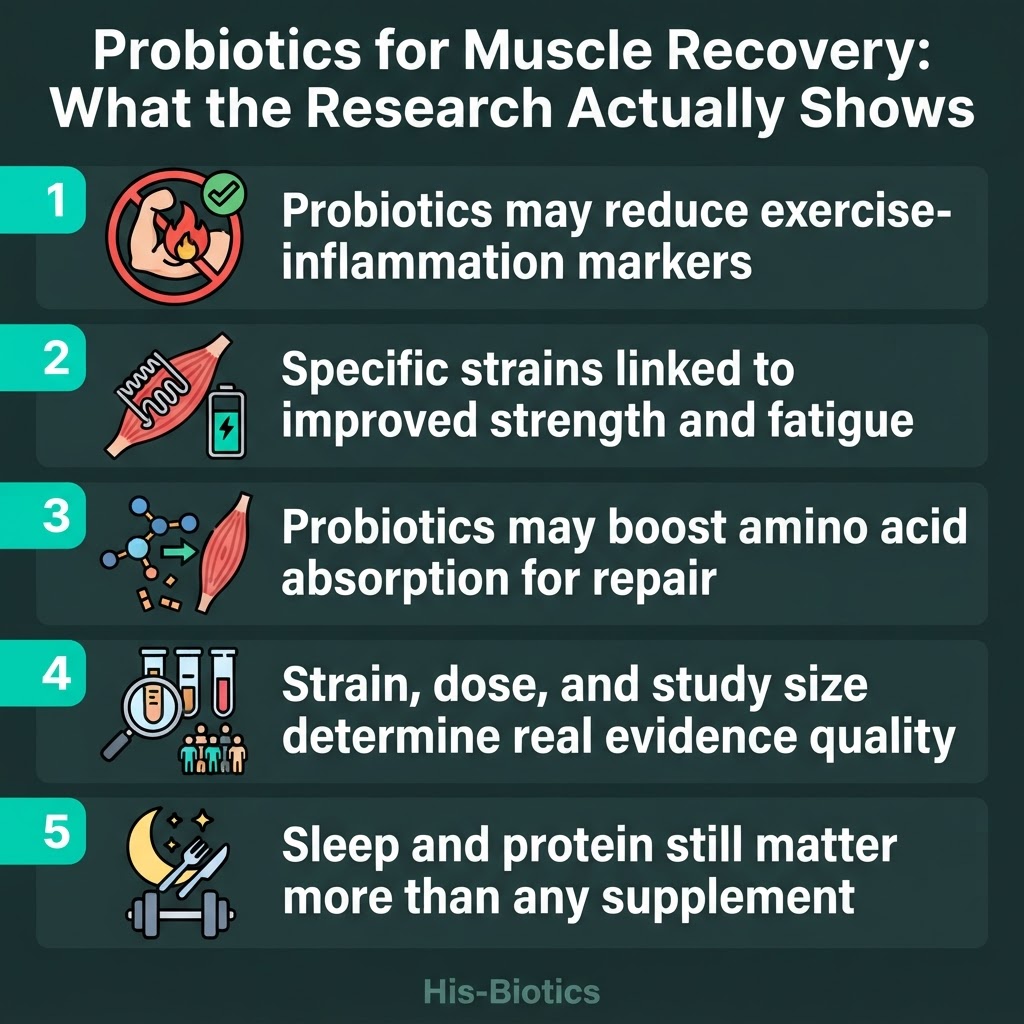
One of the better-known trials in this space came from a team of Austrian researchers who gave trained male athletes a multi-strain probiotic for 14 weeks before putting them through an exhaustive endurance test. They measured gut permeability markers and inflammatory cytokines before and after.
Probiotic supplementation was associated with reduced intestinal permeability markers and a blunted inflammatory cytokine response following strenuous endurance exercise, compared with placebo.
— Lamprecht et al., Journal of the International Society of Sports Nutrition (2012)
This matters because a gut that stays more intact under physical stress may mean less of the low-grade inflammation that can slow next-day recovery. You can read the full study on PubMed.
Strength, Fatigue, and Body Composition
A separate human trial out of Taiwan looked at a specific strain, Lactobacillus plantarum TWK10, in healthy adults completing a structured training programme. Researchers tracked muscle mass, grip strength, and exercise performance over six weeks.
Six weeks of Lactobacillus plantarum TWK10 supplementation was associated with increased muscle mass and improved exercise performance, alongside reductions in fatigue-related blood metabolites, relative to placebo.
— Huang et al., Nutrients (2019)
It's a small but well-controlled study, and the results are encouraging enough that this strain keeps appearing in follow-up sports nutrition research. You can view it directly via PubMed.
Nutrient Absorption and the Recovery Fuel Supply
Recovery isn't only about limiting damage — it's also about rebuilding. Muscle repair depends on amino acids (the building blocks of protein) actually reaching the bloodstream and the tissue that needs them. A randomized, double-blind crossover study tested whether a specific probiotic strain improved amino acid absorption from a plant-based protein source.
Co-ingestion of the probiotic strain with a plant protein source significantly increased plasma amino acid availability compared with protein alone.
— Jäger et al., Probiotics and Antimicrobial Proteins (2020)
In plain terms: the probiotic appeared to help the body actually absorb more of the raw material muscles use to repair themselves after training. The study is available on PubMed for anyone who wants to review the methodology.
How to Read This Research Like a Doctor (Not a Marketer)
Supplement marketing loves to borrow the word "clinically proven" and stretch it further than the data allows. Before you believe a claim about probiotics and recovery, run it through a short mental checklist — the same one I use when reviewing a new paper.
- Was it tested in humans, not just mice? Animal studies are a useful starting point, but effects don't always translate directly to people.
- Was the exact strain used named? "Probiotics" is a category, not a single ingredient — effects are strain-specific, so a claim about one Lactobacillus strain doesn't automatically apply to another.
- How many people were in the study? Trials with 10–40 participants are a reasonable early signal, not a final verdict.
- Was there a placebo group? Without one, it's hard to separate the probiotic's effect from normal training adaptation.
- Has it been replicated? One positive study is interesting; several independent studies pointing the same direction is more convincing.
Soreness itself is also worth putting in context — according to the Mayo Clinic, DOMS is a normal, usually self-limited part of adapting to new or harder training, not a sign of injury. No supplement, probiotic or otherwise, is marketed to eliminate that adaptation process — only to possibly support how your body handles the inflammatory and nutritional side of it.
Where This Leaves the Average Lifter
If you train seriously — three or more sessions a week, pushing for progressive overload — the current research suggests probiotics are a reasonable, low-risk addition to a recovery strategy, not a replacement for the fundamentals. Sleep, protein intake, and training periodisation still do the heavy lifting. We've written in detail about how sleep and the gut microbiome influence overall recovery, and that relationship is arguably bigger than any single supplement.
It's also worth remembering that recovery and hormone health are linked. Chronic under-recovery and gut stress can quietly affect the hormonal environment your body needs for repair, which is part of why we've explored the connection between gut health and testosterone production in a separate article. If you're over 40 and also managing energy and hormone concerns, our practical daily checklist for testosterone after 40 pairs well with the recovery habits discussed here.
Built for This: How His-Biotics Approaches Recovery Support
At His-Biotics, we formulated the SPORT multivitamin with the research above specifically in mind — pairing probiotic strains with nutrients that support the recovery process rather than promising to erase soreness overnight. You can see exactly which strains are included and why in our full ingredient breakdown.
We've also published independent reviews showing how real customers describe their experience, which is worth reading with the same critical eye discussed above — see how to read probiotic reviews like a doctor. No single product, including ours, should be marketed as a guarantee; it's one tool among several that may help support your recovery routine.
Your Next Step
The simplest first step isn't overhauling your entire supplement stack. It's adding one consistent, evidence-informed habit: a daily probiotic formulated for active men, taken alongside your existing protein and sleep routine for at least six to eight weeks, which is roughly the timeline used in the studies above. You can start with the His-Biotics SPORT Multivitamin, or browse the full range at the His-Biotics store to find the formula that fits your goals.
If you'd like more research-backed breakdowns like this one sent straight to you, subscribe to the His-Biotics newsletter below.