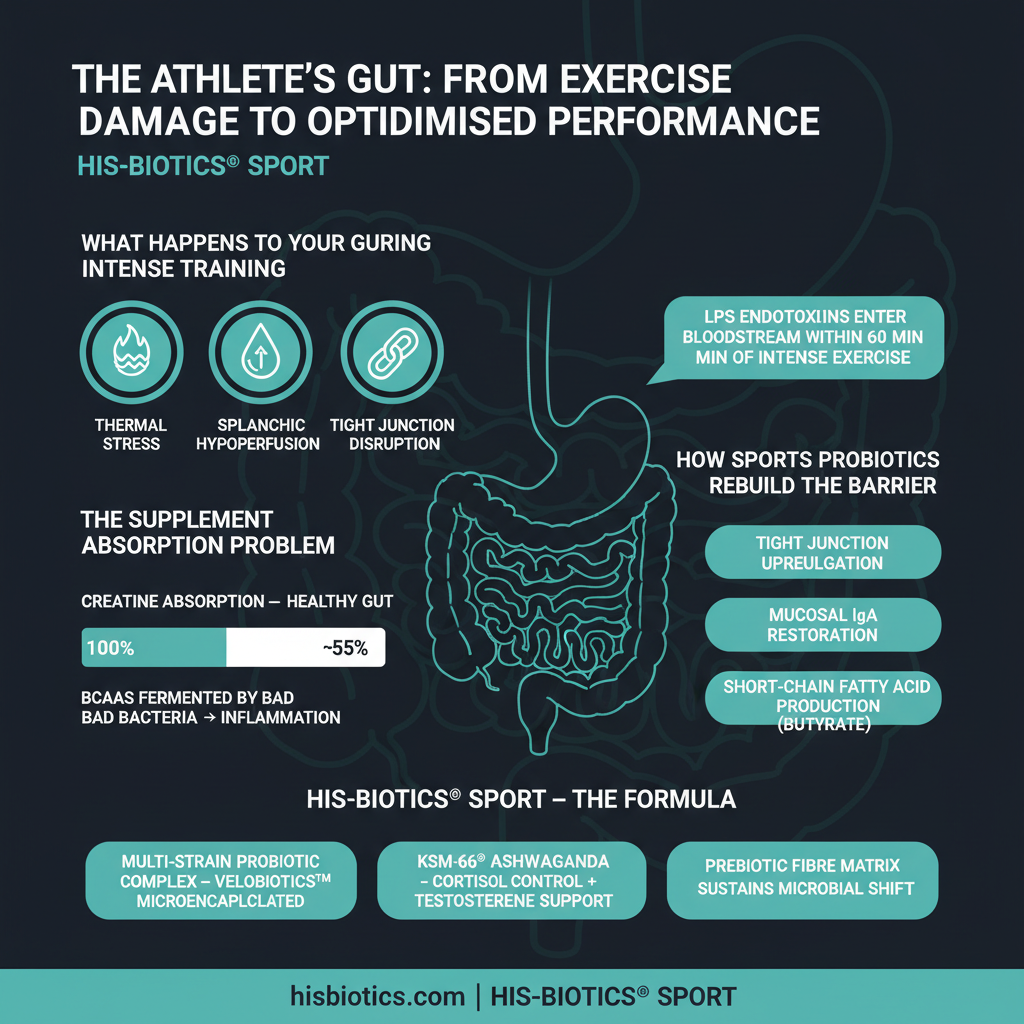
Why Your Gut Takes a Hit Every Time You Train Hard
There is a paradox sitting at the heart of high-performance sport that almost nobody talks about in the locker room: the very training that builds your body also systematically compromises one of its most critical defence systems — your intestinal barrier. Every intense session, whether it is a 20-kilometre tempo run, a heavy compound lifting block, or back-to-back HIIT circuits, triggers a measurable and well-documented rise in gut permeability. In clinical terms, we call this exercise-induced intestinal hyperpermeability, and for athletes pushing their limits week after week, it is a silent saboteur of athletic performance gut health, recovery, and long-term adaptation.
During sustained high-intensity exercise, blood is aggressively redirected away from the splanchnic circulation — the network of vessels supplying your gut — and towards the working muscles, heart, and lungs. This splanchnic hypoperfusion creates a local ischaemia-reperfusion injury along the intestinal epithelium, the single-cell-thick lining that separates your gut contents from your bloodstream. The tight junction proteins — occludin, claudin, and zonulin — that normally hold those epithelial cells together begin to loosen. The result is increased passage of lipopolysaccharides (LPS), bacterial fragments, and undigested food antigens directly into systemic circulation. This is what the popular press calls "leaky gut," and in leaky gut athletes, it is not a fringe theory — it is measurable biochemistry.
A landmark study published in Alimentary Pharmacology & Therapeutics (2012, Costa et al.) demonstrated that even a single bout of prolonged endurance exercise significantly elevated circulating intestinal fatty acid-binding protein (I-FABP), a direct biomarker of enterocyte damage, alongside elevated plasma LPS endotoxin levels. The implications for recovery, immune function, hormonal health, and nutrient absorption are profound and are only now being fully appreciated within sports medicine. If you are stacking creatine, BCAAs, and protein powders on top of a compromised gut, you are building on a cracked foundation — and that is a conversation we absolutely need to have.
Heat, Cortisol, and the Cascade of Gut Damage in Competitive Training
The gut permeability problem is not caused by training volume alone. It is an orchestrated cascade involving three principal stressors that compound one another with remarkable efficiency: thermal stress, mechanical shear, and hormonal dysregulation. When core body temperature climbs during intense training, heat shock proteins are activated, and the integrity of tight junction complexes is further compromised. Elite endurance athletes exercising in warm environments can see intestinal permeability rise by two to three times resting baseline within 60 minutes, as demonstrated in research published in the American Journal of Physiology — Gastrointestinal and Liver Physiology (Pals et al., 1997). That is not a marginal change — it is a structural failure in a critical barrier system.
Layered on top of the thermal and ischaemic injury is the role of cortisol. Sustained training loads — particularly in athletes who are under-recovered, over-trained, or in caloric deficit — drive chronic hypercortisolaemia. Cortisol directly degrades the mucus layer lining the gut wall, disrupts secretory IgA (the immune system's first responder in the gut lumen), and suppresses the growth of beneficial commensal bacteria, particularly Lactobacillus and Bifidobacterium species. This hormonal-microbiome interaction is precisely why PubMed research on probiotics increasingly explores the bidirectional relationship between probiotic supplementation, cortisol regulation, and downstream testosterone support in trained males.
The mechanical dimension is often overlooked entirely. The physical impact of repetitive running creates intestinal micro-trauma through a process known as caecal slap — the literal bouncing of visceral contents against the gut wall with each foot strike. Distance runners in particular experience significantly higher rates of gastrointestinal distress, rectal bleeding, and gut permeability markers than swimmers or cyclists performing equivalent aerobic work. This is not a comfort issue; it is a physiology issue that demands a structural solution. That solution begins, and in many respects ends, with the gut microbiome.
Creatine, BCAAs, and What the Gut Has to Do With Supplement Efficacy
The sports nutrition industry generates billions of dollars annually from creatine monohydrate and branched-chain amino acid (BCAA) supplements — two of the most researched and widely used ergogenic aids in existence. And yet, the conversation almost never addresses the fundamental gateway through which these compounds must pass to reach working muscle: the intestinal epithelium. Creatine gut health is an emerging sub-field for good reason. Up to 30–40% of athletes report gastrointestinal discomfort during creatine loading phases, and the mechanism is now better understood — high-dose creatine alters luminal osmolality and can disrupt the microbial ecosystem, particularly in individuals with pre-existing dysbiosis or elevated baseline gut permeability.
BCAAs — leucine, isoleucine, and valine — are absorbed primarily via sodium-coupled neutral amino acid transporters in the proximal small intestine. In a gut with compromised tight junctions and altered mucosal architecture, this absorption process is inefficient and inconsistent. More critically, unabsorbed BCAAs entering the large intestine become substrate for proteolytic bacteria, driving production of potentially pro-inflammatory metabolites including ammonia, indoles, and p-cresol. The irony is striking: the supplement you are taking to accelerate muscle protein synthesis may, in the context of a leaky gut, be actively fuelling systemic inflammation — the very thing that slows recovery. This is why the concept of BCAA probiotics synergy — using probiotic intervention to optimise the absorptive and protective capacity of the gut before stacking amino acids — represents a meaningful clinical advance for the serious athlete.
Creatine transport itself depends on the sodium-creatine transporter (SLC6A8) and is indirectly influenced by the mucosal integrity of the small intestine. Emerging gut microbiome research now suggests that specific probiotic species — notably Lactobacillus plantarum and Bifidobacterium longum — can upregulate tight junction protein expression, reduce LPS translocation, and improve the gut's overall absorptive surface area. In practical terms, a healthier gut lining means more creatine and more amino acids reaching the muscle, with less inflammatory fallout. Building your supplement stack without first addressing gut integrity is like trying to fill a performance car with premium fuel through a perforated hose.
The Science of Sports Probiotics: What the Evidence Actually Shows
The field of sports probiotics has matured considerably over the past decade, moving well beyond vague claims of "immune support" into specific, mechanistic evidence for performance and recovery outcomes. A 2019 study published in the Journal of the International Society of Sports Nutrition (Jäger et al.) — one of the most comprehensive reviews of probiotic use in exercise — concluded that select probiotic strains could meaningfully reduce upper respiratory tract infection incidence, lower inflammatory cytokine profiles post-exercise, enhance protein absorption, and support lean mass maintenance in trained athletes. These are not peripheral benefits; these are core pillars of athletic development.
For gut health athletes specifically, the most compelling evidence clusters around three mechanisms. First, barrier restoration: strains such as Lactobacillus rhamnosus GG and Lactobacillus plantarum have been shown to upregulate the expression of occludin and ZO-1 tight junction proteins, directly counteracting the exercise-induced permeability cascade described above. Second, immune modulation: regular probiotic supplementation has been associated with increased secretory IgA levels in saliva and intestinal mucus, restoring the gut's front-line immune defence that intense training systematically suppresses. Third, inflammatory resolution: by competitively excluding pathobionts and producing short-chain fatty acids (SCFAs) — particularly butyrate — commensal organisms stimulated by probiotic supplementation help resolve the chronic low-grade inflammation that acts as a brake on recovery and adaptation.
What matters equally, however, is not just which strains are delivered but whether they survive long enough to act. This is where Velobiotics™ microencapsulation technology becomes clinically significant. Standard probiotic capsules lose 60–90% of their viable organisms to gastric acid before those organisms ever reach the small intestine, where the actual mechanisms of action occur. The microencapsulation matrix used in all Velobiotics™ formulations — including His-Biotics® Sport — uses a lipid-bilayer protective shell that maintains organism viability across the full pH journey from stomach to distal gut, ensuring delivery rates that far exceed conventional probiotic formats. The clinical case for exercise recovery probiotics is only as strong as the delivery technology behind it.
It is also worth noting the growing evidence base connecting the gut microbiome to the hypothalamic-pituitary-gonadal (HPG) axis — the hormonal cascade governing testosterone synthesis and utilisation. Studies now show that dysbiosis in male athletes correlates with elevated oestrogen metabolites, reduced free testosterone, and impaired androgen receptor sensitivity, all of which directly impair body composition and training adaptation. This is why the Morning Man Protocol at His-Biotics® integrates gut health as a non-negotiable pillar of male hormonal optimisation — because the gut is not separate from your hormones, it is upstream of them.
His-Biotics® Sport: A Formula Built for the Physiology of the Trained Male
Most sports supplements are formulated in isolation — a probiotic blend here, a performance booster there. His-Biotics® Sport was designed differently: from the gut outward, with every ingredient selected to address the specific physiological vulnerabilities of the hard-training male. The formulation anchors on a multi-strain probiotic complex featuring clinically validated organisms at therapeutically relevant CFU counts, all protected by Velobiotics™ microencapsulation to ensure they arrive where they need to act. This foundational gut restoration layer is then built upon with performance-supporting co-factors that work synergistically with a restored intestinal environment.
Among the key performance co-factors in His-Biotics® Sport is KSM-66® Ashwagandha — one of the most rigorously studied adaptogenic compounds available. The clinical studies on KSM-66® Ashwagandha include randomised controlled trials demonstrating significant reductions in serum cortisol, improvements in VO2 max, increases in testosterone in resistance-trained males, and meaningful gains in muscle strength and recovery speed. In the context of exercise-induced gut permeability, this is particularly relevant: by blunting the cortisol spike that degrades the mucosal lining and suppresses beneficial microbiota, KSM-66® works synergistically with the probiotic blend to address gut damage from two complementary angles simultaneously.
The formula also incorporates targeted prebiotic fibres that serve as selective fuel for the beneficial organisms delivered by the probiotic complex — creating a self-sustaining ecological shift in the gut rather than a transient bacterial visit. This is the distinction between a product that changes the gut environment and one that merely passes through it. For the athlete managing athletic performance gut challenges — bloating during competition, erratic energy levels, slow post-session recovery, recurrent illness — this integrated approach addresses root causes rather than symptoms. To explore our athlete formula in detail and understand how every ingredient maps to a specific physiological mechanism, the full formulation breakdown is available on the product page.
Practical Protocol: Optimising Gut Health Around Training
Understanding the science is valuable. Applying it consistently within the structure of a demanding training week is where the real gains are made. Below are evidence-informed recommendations for athletes looking to protect and restore gut integrity while maximising the efficacy of their nutrition and supplementation strategies. These recommendations are derived from the published literature on exercise-induced gut permeability, probiotic intervention timing, and sports nutrition absorption science.
- Take sports probiotics consistently, not cyclically: Barrier restoration requires sustained microbial colonisation. The literature supports daily probiotic use for a minimum of four weeks before meaningful changes in tight junction protein expression and mucosal IgA are observed. Sporadic supplementation does not achieve the same effect.
- Time creatine and BCAAs around gut-supportive meals: Avoid high-dose creatine loading on an empty or inflamed gut. Co-ingesting with whole-food meals reduces osmotic stress and provides a buffering matrix for absorption. Where possible, creatine maintenance dosing (3–5g daily) is preferable to loading phases for athletes with GI sensitivity.
- Prioritise post-exercise gut cooling: Cold fluids, electrolyte replacement, and avoiding NSAID use immediately post-session all support faster intestinal barrier recovery. NSAIDs, while analgesic, directly impair prostaglandin-mediated gut repair and should be used judiciously in high-volume training periods.
- Monitor signs of chronic gut permeability: Persistent bloating after training, recurrent upper respiratory infections, unexplained fatigue despite adequate sleep, poor creatine or BCAA response, and loose stools during competition are all clinical signals that your gut barrier deserves attention before your next supplement addition.
- Address cortisol systematically: Chronically elevated cortisol is both a cause and a consequence of gut permeability in athletes. Sleep quality, training periodisation, and adaptogen supplementation (such as KSM-66®) should be managed concurrently with probiotic intervention for best outcomes.
- Hydrate strategically around training: Even mild dehydration (2% body weight) amplifies splanchnic hypoperfusion during exercise and worsens intestinal epithelial damage. Pre-hydration and intra-session electrolyte strategy are basic but frequently undervalued tools for gut protection.
The athlete who addresses these variables systematically — rather than chasing the next supplement without fixing the delivery system — is the athlete who achieves compounding returns on their investment in nutrition and training. The gut is not a passive bystander in performance; it is an active determinant of how much of your effort is converted into measurable adaptation.
Key Takeaways
- Exercise-induced gut permeability is real and measurable: Intense training creates splanchnic hypoperfusion, tight junction disruption, and LPS endotoxaemia — collectively compromising recovery, immunity, and nutrient absorption.
- Your supplements are only as effective as your gut allows: Creatine and BCAAs deliver suboptimal results when the intestinal barrier is compromised, and unabsorbed BCAAs can drive pro-inflammatory proteolytic activity in the colon.
- Clinically validated sports probiotics directly address the mechanisms of exercise-induced gut damage — particularly strains with evidence for tight junction upregulation, mucosal IgA restoration, and SCFA production.
- Delivery technology is not a marketing detail — it is a clinical variable: Without viable organism delivery to the small intestine, probiotic supplementation fails at the first hurdle. Velobiotics™ microencapsulation solves this problem at the formulation level.
- Cortisol is the hidden link between overtraining and gut permeability: Adaptogenic co-factors like KSM-66® Ashwagandha work synergistically with probiotics to address gut barrier damage from both the hormonal and microbial axes simultaneously.
- Gut health is upstream of hormonal health in the trained male: Dysbiosis drives oestrogen excess, reduces free testosterone, and impairs androgen receptor sensitivity — making gut optimisation a foundational pillar of male performance medicine.
If you are a serious athlete and any of the patterns described in this article resonate — the plateau despite hard training, the persistent GI distress, the creatine that never seems to deliver what the research promises — then the conversation starts with your gut. His-Biotics® Sport was formulated precisely for this intersection of gut integrity, hormonal resilience, and physical performance. Visit the product page to review the full clinical formulation, or take the Gut-to-Gains (TGS) quiz at hisbiotics.com to receive a personalised protocol recommendation tailored to your training load, lifestyle, and health goals. Your adaptation ceiling is not in the gym — it is in your gut.
— Dr. Chomba Chuma, MD & Founder, His-Biotics® by Velobiotics™